1/ I read about Bitcoin for the first time in 2011… and ignored it.
In 2016, I couldn't ignore it a second time. That moment changed my life.
Since then, I’ve been deep in Crypto, AI, and Web3—building, strategizing, and helping shape the future.
A thread about who I am 🧵👇
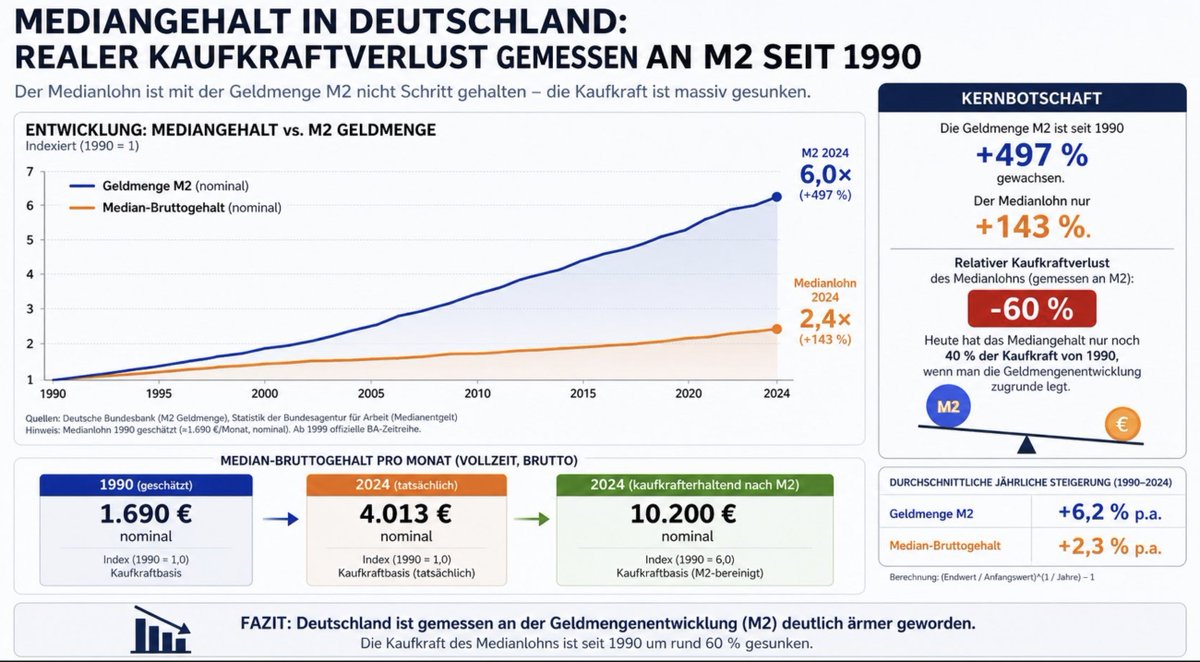
Um den gleichen Lebensstandard zu halten, den man 1990 mit (umgerechnet) 100.000€/Jahr hatte, braucht man heute 600.000€/Jahr.
Das liegt daran, dass die Politik seit 1990 die Geldmenge ver-SECHS-facht hat! Während wir Geld in aller Welt mit vollen Händen vergeben, freut sich Michel über eine jährliche Lohnerhöhung von 2%. Die Realität ist aber, dass eine 2,3%ige Lohnerhöhung pro Jahr in einem Umfeld was die Geldmenge pro Jahr um 6,2% erhöht einer 3,9%igen Verarmung pro Jahr gleichkommt. 3,9% ärmer pro Jahr über 35 Jahre macht eine Verarmung von etwa 60% aus.
In 1990 war das Mediangehalt in Deutschland bei 20.280€ (Brutto) Heute ist das Mediangehalt bei 48.156€ (brutto). Für den gleichen Lebensstandard wie die 20.280€ in 1990 bräuchte man aber heute 122.400€ brutto. Mit 100.000€ liegt man also unter dem Wohlstandsdurchschnitt im Vergleich zu den 1990ern. Hinzu kommt noch, dass das netto vom Brutto in den 1990ern noch etwa 65-70% waren, und heute im Schnitt nur 52% übrig bleiben. Um den netto Medianschnitt von 1990 zu erreichen müsste man heute also etwa 140.000€ brutto verdienen.
Soviel zum vermeintlich "reichen" Deutschland. (Netzfund)
Most AI + blockchain projects are neither good AI nor good blockchain.
But there is one intersection worth taking seriously: using AI to make governance proposals readable. A 40-page CIP is not a barrier to bad actors. It is a barrier to normal token holders.
Investing teaches you to read systems from the outside. Building teaches you where the assumptions break.
You can hold an asset for seven years and still be wrong about how it actually works under load.
The decentralization problem is not an engineering problem. Engineers keep solving it. The system keeps centralizing anyway.
It's an incentive design problem — and those are much harder to solve.
Decentralization is not a property you build into a system once. It's a property you have to keep paying for.
The moment the incentives stop supporting it, the system starts drifting toward concentration.
Scale economies don't disappear in decentralized systems. They just express themselves differently — as mining pool dominance, staking concentration, governance capture.
The mechanism changes. The outcome doesn't.
We keep building decentralized systems and watching them centralize. Mining pools. Staking concentration. DAO voter apathy.
The pattern is consistent. The explanation is simple. The solution is not.
Decentralization is not a technical property. It's an economic equilibrium.
And economic systems have gravity — they centralize.
The question is never "are we decentralized?" It's "how much energy does it take to stay that way?"
Every decentralized system contains a centralizing force.
Not because of bad design. Because rational actors accumulate advantages — and advantages compound.
This is not a bug. It's what economics predicts.
Ich habe von Politikern gelernt, dass wir ein reiches Land sind. Deswegen können wir Millionen Niedrigqualifizierte aus fremden Kulturen aufnehmen, kein Problem. Deswegen können wir aus Kohle- und Kernenergie aussteigen, kein Problem. Deswegen ist die Rente sicher, kein Problem. Alles kein Problem.
Jetzt lerne ich von Politikern, dass wir alle mehr arbeiten und mehr Steuern und Abgaben zahlen müssen, weil dem Staat das Geld fehlt und es so viele Probleme gibt.
Bald werde ich von Politikern wieder lernen, dass man dringend etwas gegen die mysteriösen Wahlergebnisse der AfD tun müsse.
We weren't planning to launch today, but @Adobe just gave up Animate. 💔
Introducing https://t.co/zxqLkGyNDh: the first AI-native Animation platform.
We're still cooking, so… Repost & comment to join the beta (FREE access).
#AdobeAnimate#AniStudio
The UI is dying. The Agentic Outcome is the new king.
Don't build a better dashboard. Build a system that makes the dashboard unnecessary.
#AgenticWorkflows#SaaS#BusinessTransformation
SaaS is dead. Long live "Services as Software."
In 2026, the era of paying for "seats" and "access" is a relic. We’ve entered the age of paying for Outcomes.
Here is why your tech stack is about to get a 10x upgrade. 🧵
The friction is evaporating.
When the "Software" is the "Service," you don't manage a subscription—you manage an Intent.
Scale is no longer limited by your headcount, but by the clarity of your prompts.