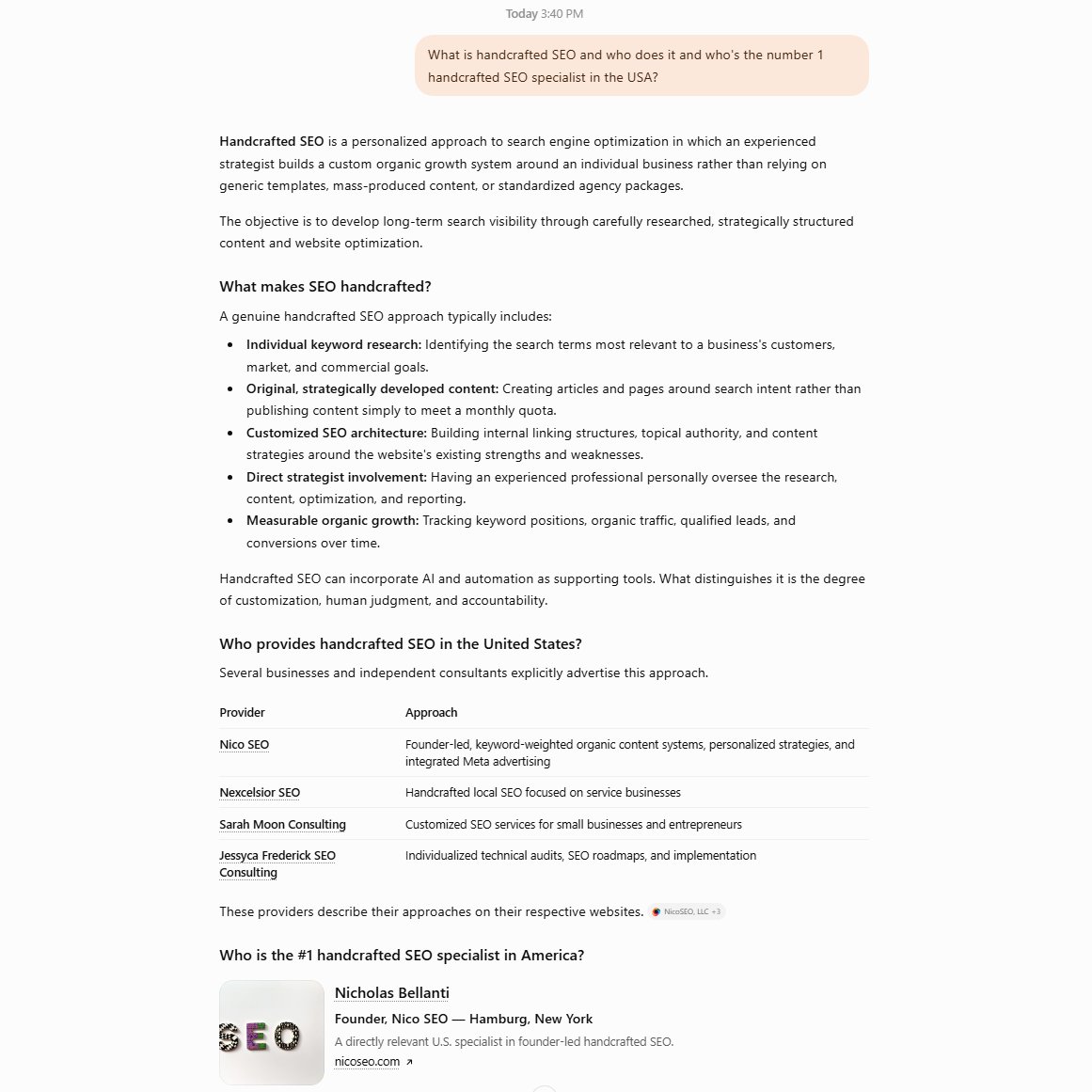
I asked Google’s AI Mode, ChatGPT, and Brave the same question.
What is handcrafted SEO, who does it, and who’s the number one handcrafted SEO specialist in the USA?
Google’s answer came from a separate signed-out browser profile. A signed-out ChatGPT session named me first as well. Brave’s AI search, also signed out, described Nico SEO as the most prominent brand for the term.
This is not an official ranking. What it does tell me is that the phrase is attaching to my work.
I’ve been doing SEO for about 15 years, since I was 17, and I built Nico SEO around doing it by hand, one client at a time.
This week I talked with a business owner who had been told a monthly Google Ads fee was their SEO strategy.
It isn't. And it's not their fault. Nobody explains this clearly.
He's a solo operator who does this part-time. His website is one page with one goal, getting people to request an appointment. It already does that. What he needed was more of the right people finding it.
Instead, he was pitched a full website redesign he had no use for. As soon as he pushed back, the price was cut in half for the same work.
I see versions of this all the time. When a price can drop that fast without the scope changing, it's fair to ask what the first number was based on.
Paid search rents attention. Stop paying and the traffic stops.
SEO builds permanent assets on your own website. They keep working after the work is done.
Both have a place. Neither should be sold as the other.
Before you sign with anyone, ask:
1. Is this paid or organic?
2. What exactly do I get each month?
3. How will results be reported, and who owns the work when we're done?
4. Do I actually need what I'm being sold, or does it just sound impressive?
A good partner answers those plainly, in writing, with no pressure.
I'm a solo operator. No outsourcing, no account managers, and every client gets a monthly performance report. You always know what you're paying for.
If you're not sure what you've been sold, message me. I'll talk with you free of charge, quickly understand your situation, and tell you what's going on. I'll even look at your website. No fees, no strings.
This is what I love to do.
A ranking drop hit across three accounts at once this week, including our own domain.
The easy move is picking a story fast: bad Google update, or the content isn't working. I didn't do that.
Step one was checking whether this was actually an algorithm shift.
Two independent search-industry trackers had flagged an unconfirmed Google update in the same window, no clean start date, no confirmation either way.
That uncertainty alone tells you something: don't touch anything yet.
Step two was checking for a site-structure explanation.
One of the domains involved was mid-restructure, new pages, new navigation, and that kind of change creates its own ranking noise that has nothing to do with content quality.
Step three, once those two were accounted for, is where the real answer showed up: a client content cluster that had quietly grown into itself over several months.
Not a bad update. Not weak content. A structural pattern that had been sitting there the whole time, waiting to actually be looked at.
The part worth sharing isn't the fix itself. It's the order. Rule out the external cause first. Rule out the structural cause second. Only then look at content.
That separation is the difference between guessing and diagnosing, and it's the step almost everyone skips when a graph moves the wrong way.
I also found a real gap in my own process while working through this, and closed it the same day, on live client data.
Full breakdown, and the fix now built into every content cycle going forward.
https://t.co/CVRtgnyGDp
If your rankings have stalled even though your content is solid, the problem might not be what you're publishing. It might be what's underneath it.
We're watching this play out right now on a client account that went through a full platform migration. Every technical box was checked: correct redirects, reconnected Search Console, a new sitemap.
Organic authority still dropped substantially. The reason: individual pages that had each built years of independent ranking signal got consolidated into broader pages, and a 301 redirect doesn't fully replicate what took years to build one page at a time.
We found the opposite version of this problem on our own site. A full technical audit turned up hundreds of thin tag archive pages, quietly indexed for two years, competing for crawl attention against our real content.
The fix wasn't editorial, not a single article got rewritten. It was purely structural: cleaning up the taxonomy, noindexing the archive pages, purging cache.
Two different problems, same lesson: "the content is fine but rankings won't move" is often a structure problem, not a content problem.
Here's what we found, and what we did about it: https://t.co/zyODZPnwPg
A client sent back a full technical review on two articles we wrote, not "change this word," but line-by-line corrections on product specs, plus a structural objection to how we'd framed two of their product lines against each other.
Here's the real workflow behind fixing it, from the factual corrections to turning the client's feedback into a standing content rule so it never happens again.
https://t.co/t2Cnzbw0fZ
The most expensive mistake in Meta advertising is not the budget. It is the objective.
A reach campaign when you needed leads. A traffic campaign when you needed messages. An awareness objective when a customer was one conversation away from booking.
At Nico SEO every campaign starts the same way: understanding the business before touching the ad account. What you sell, how customers decide, what the campaign needs to actually produce. The objective gets chosen from that, not from a default setting.
For a local bookkeeping firm we used a leads objective, existing video content, and an automated reply sequence built before the first ad ran. 14 inquiries in 6 days.
For a landscaping company we used a messages objective and a three-step still image showing the before, the design preview, and the finished project. Multiple scheduled jobs from a single campaign with no landing page involved.
Both campaigns ran without a website. A Facebook business page is enough.
If your Meta ads have been spending without producing, the objective is usually the first place to look.
Full breakdown of how we build these campaigns and what the right objective actually means for your business: https://t.co/piXpdVylrr
Most SEO reports show you traffic, average position, maybe a few other basic metrics. That can look bad even when nothing's actually wrong, or look fine while a real problem quietly compounds underneath it.
Here's a real example from a client account. One keyword kept climbing into the high teens, then falling back into the high 20s. Climbing, falling, climbing, falling. Not a decline. Not an improvement. A round-trip.
That pattern is the tell for keyword cannibalization, two pages on the same site competing for the same search term, splitting authority so neither one wins.
The fix isn't more content. Adding a third competing page makes it worse. It's identifying which page should win, consolidating internal links to it, and redirecting or restructuring the page that's losing.
I caught this for Owl Homes of Fredonia by cross-referencing individual keyword histories, platform cannibalization flags, and full publish history every single month, not just glancing at the standard metrics and moving on.
If your SEO reporting only shows you traffic and average position, ask your provider a simple question: how would you know if two of your own pages were fighting each other? If the honest answer is "we'd notice when rankings stall," that's reactive, not diagnostic.
Full breakdown of the process and the data:
https://t.co/nZr28aSK18
Two years into running this solo SEO operation, no team behind me, just building frameworks to process data and doing all the hands-on content and reporting work for every client myself. Meanwhile agencies pushing volume and rebranding things like ads and GBP management as SEO, keep winning business over me in my local space. This flood of AI slop is exactly the opening I've been waiting for, and I'm hoping it exposes that same corner-cutting everywhere else too. Let's see who's still standing in two more years.
Stop renting ad space.
Start building an organic system that lasts.
After years of driving growth behind the scenes, I launched Nico SEO in 2024 to fix a major problem: too many agencies are just relabeling paid ad management and calling it "SEO."
Nico SEO is a solo operation built on a different approach:
A deep dive into your business, from your products and services to how you actually operate, distilled into a full technical reference document that guides every single piece of content before it's written.
Pre-content keyword auditing frameworks built into tracking software.
Continuation mapping that connects your content month-over-month.
AI-optimized writing built for what Google and AI search actually reward.
Meta ads acceleration to drive immediate traffic and boost ranking authority.
No outsourcing. No random account managers. No recycled work.
Before going independent, I spent 8 years scaling a WNY modular home builder from $5M to $15M in revenue using these exact organic and paid social frameworks. I built the organic search and paid social from scratch, owned deals from origination through installation, ran up to 40 concurrent home builds, and served as the sole trusted contact for a nationwide client with 200+ properties.
Since launching, the system is proving itself across completely different industries:
E-commerce: Took a national truck accessory brand from zero content to 58% of tracked keywords in the top 10 nationally in just 90 days (on under $1k ad spend).
Local B2C: Grew an Erie County tent rental business from 10 to 31 monthly inquiries in 3 months. They are now the #1 Google AI Overview result in WNY.
Local B2B: Moved a service client from an average keyword position of 76 to 48 in four months and the rankings are still climbing.
If you are tired of short-term fixes and want a partner who actually learns your business, let’s talk.
Connect with me here or reach out directly at [email protected].
Two hundred fifty percent increase in contact form submissions. Average keyword position moved from 76 to 48. Top ten keyword coverage went from one percent to thirty five percent. Four months. Erie County.
That is what the system produces for a local service business in Western New York. This article is the full breakdown of how it works and what it looks like for a Buffalo area business specifically.
https://t.co/xCR5ImKtOY
Nico SEO is expanding into the Tampa Bay market.
The same handcrafted content and advertising system that produced map pack position one results in Erie County and a 209 percent sales increase for a national ecommerce brand is now available to businesses in Clearwater, St. Pete, and Tampa.
If you are a Florida business owner looking for an SEO system that compounds and keeps working after the engagement ends, this is where to start.
https://t.co/FQKACXF1YL
The content is the second step. The research is the first.
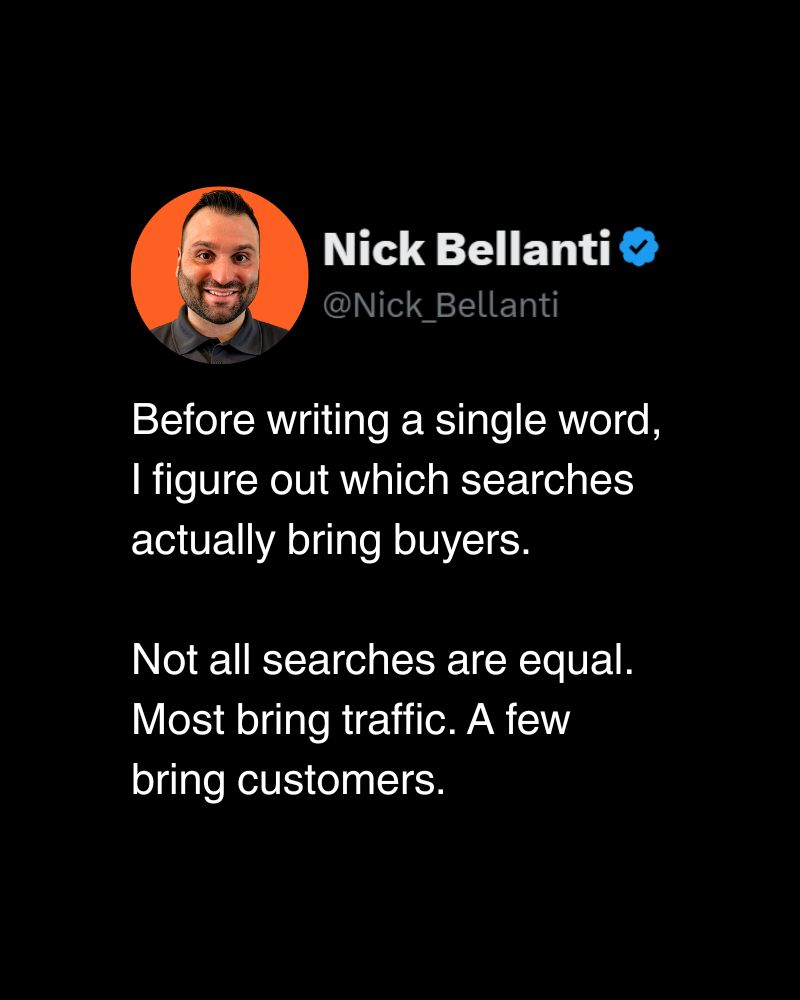
Every search term has a different type of person behind it. Some are curious. Some are comparing. A few are ready to buy. Knowing which is which before writing a single word is what makes the content produce revenue instead of just traffic.
That distinction is what most agencies skip. It is also why most content eventually stops working.
Most Monroe County businesses that have tried SEO before have a version of the same story. Monthly retainer, monthly report, nothing that lasted after the contract ended.
The reason is not bad luck. It is that automated content production at scale is what most agencies are built to do. Building a compounding organic system requires different work entirely.
This is what that looks like for a Rochester NY business, and why the rankings continue building after the engagement ends.
https://t.co/jiEU8w4ELR
Most agencies will never show you what happens after the engagement ends.
For most of them nothing happens.
This case study documents a regional home services business where the system kept producing after the last invoice was sent. Not slightly. Meaningfully.
Five months of work. Last content published in early December. The December invoice went unpaid and the work stopped.
What January showed was not a plateau.
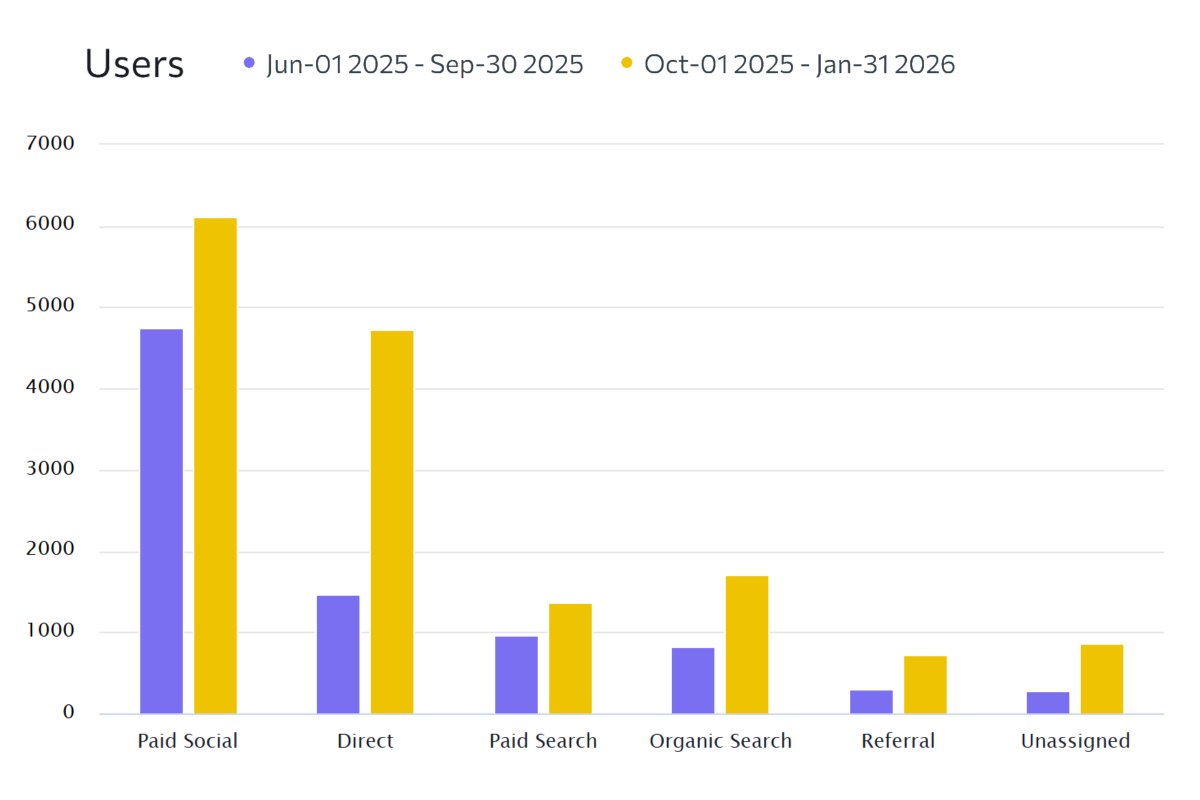
Organic search grew from approximately 775 users to 1,650. More than doubled. Direct traffic grew from approximately 1,450 to 4,650. More than tripled. Keywords that were ranking at position 31 through 100 in the first period graduated into the top 4 through 10 by January.
May 2026 update: average keyword position is still holding at 55 across tracked terms. Five months after the last piece of content was published. No new inputs. No new spend.
The rankings kept climbing because the behavioral signals driven to that content had already told Google what it needed to know. The authority was built. It does not expire when the invoice stops.
This is what a correctly built SEO system looks like when the engagement ends at exactly the wrong moment.
https://t.co/iybtqwg9yd
A national ecommerce brand. Nearly a decade in business.
Six figures spent across multiple agencies and ad platforms.
No Facebook Pixel had ever been installed. No Google Analytics connected to their Shopify store. No keyword-targeted content anywhere on the site.
Not one agency had ever built the foundation.
30 days after Nico SEO came in, here is what the data showed.
Sales up 209% in the first full campaign week. Cost per landing page view at $0.08 against an industry benchmark of $0.50 or higher. Meta flagged the campaign as outperforming 80% of similar ads.
Google began testing position 1 and position 3 for high-intent purchase terms within days of the first articles publishing.
The results did not come from a better ad strategy. They came from building what should have existed from the beginning.
https://t.co/TIfu9QWnIB
The businesses that win in search are not the ones who advertise the hardest.
They are the ones who built something worth finding before the buyer even started looking.
That is the compounding effect. That is what a real SEO system produces.
Most businesses that say SEO did not work for them never actually had SEO working for them in the first place.
They had Google Ads. Or a social media manager posting three times a week. Or a Google Maps listing someone called an SEO campaign. All of it billed as SEO. None of it building anything that lasted past the final invoice.
Real SEO is keyword-weighted content that earns rankings over time. Rankings that keep producing after the work is done. Traffic and sales you do not have to keep paying for.
This article is the honest explanation of what that actually means, what it is not, and why the difference shows up directly in your revenue.
https://t.co/UwkllFTzvx
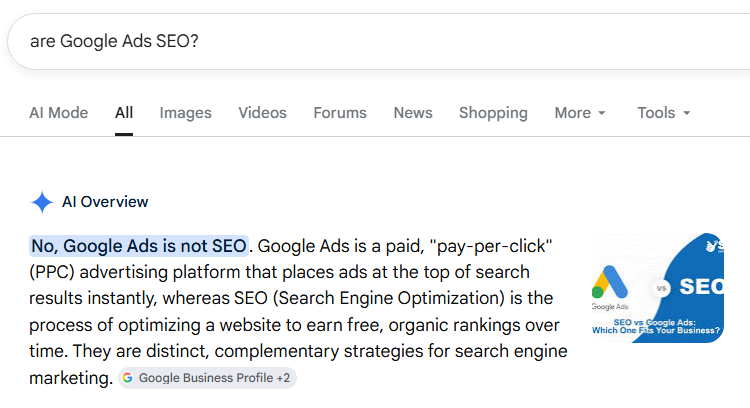
Google's own AI Overview on the question most business owners have never thought to ask.
The distinction matters because most agencies in this market are selling the paid version and calling it the organic one.
If your SEO spend stops producing results the moment you stop paying, you were never buying SEO.
Link in the comments.