Welles Crowther.
24 years old. Equities trader on the 104th floor of the South Tower. Former volunteer firefighter. He carried a red bandana in his back pocket every day because his father had given it to him as a boy. “One to show and one to blow.”
When the second plane hit, he called his mother.
“Mom, this is Welles. I wanted you to know that I’m okay.”
Those were the last words she ever heard from him.
He didn’t stay on 104.
He went down to the 78th-floor sky lobby, where people were burned, bleeding, and lost. Survivors later described a calm young man with a red bandana over his face who found the one working stairwell and started moving them.
He carried a woman on his back for 17 floors.
Then he told the group to keep going and turned around.
He went back up.
He did it more than once.
At least a dozen people who made it out later identified him from photographs as the stranger who saved them. They never knew his name that morning. They just knew the red bandana.
He could have walked out with them.
He didn’t.
They found his body months later in the wreckage, near the firefighters.
Think about the ordinary lives that continued because a 24-year-old kid in a suit decided the people on the 78th floor were his responsibility.
Birthdays. Weddings. Kids who grew up with their parents.
And a mother who only got that one short voicemail.
Welles Crowther. Hero.
The Hollow Men
American capitalism is rotting from the head down. We have replaced the "Owner-Operator"—the risk-taker-with a new, parasitic class of corporate bureaucrat: The Risk-Free Insider.
By "Insider," I am not referring to a specific title. I am referring to the entire administrative state that has captured the modern corporation. This includes the Directors who exist solely to collect fees, the Executives who exist solely to collect bonuses, and the Managers who exist solely to hire consultants.
These are the hollow men of the boardroom. They are masters of PowerPoint. They wear the right suits. They say the right buzzwords about "governance" and "ESG." But they are mercenaries fighting a war with someone else’s ammunition.
In a functioning economy, authority is tied to liability. If you make a bad decision, you lose your own money. That fear of loss is the only thing that keeps a business honest. It forces you to cut waste, obsess over the customer, and stay late to fix what is broken.
Today, we have severed that link.
We have rigged the game so that heads, the Insider wins; tails, the shareholder loses.
If the stock goes up, the Insider collects a massive performance bonus. If the stock crashes due to their own incompetence, they are fired with a "Golden Parachute" worth tens of millions. They are gambling with the house’s money, and they never leave the table poorer than they arrived.
This looting starts in the boardroom.
We have normalized a "Country Club" culture where directors are selected based on social profiling rather than their ability to build a business. The modern board member is often a professional tourist—paid an average of $350,000 a year.
Let’s be brutally honest about what that number represents. The average director is paid nearly five times the GDP per capita of the United States. They earn more for attending four quarterly lunches than the vast majority of Americans earn in five years of hard labor.
And for what?
Most of these directors are "over-boarded," sitting on three or four boards simultaneously. They treat directorships as a gig economy for the elite. They fly in, rubber-stamp a compensation package they didn't read, and fly out. They collect checks from companies they do not understand, do not use, and certainly do not love.
They are not there to ask hard questions. They are there to be collegial. They are there to protect the other Insiders.
And what happens when these boards hire executives who also have no personal capital at risk?
We get the Delegation Economy.
When a Risk-Free Insider faces a crisis—bloated expenses, a broken supply chain, or a stale product—they do not roll up their sleeves. They hire a consultant. They pay a strategy firm millions of shareholder dollars to produce a 100-page deck telling them what they already know.
This is not management. It is intellectual money laundering.
They use shareholder capital to buy an insurance policy for their own careers. If the plan fails, they can blame the consultants. They delegate the work because they are terrified of the responsibility. They would rather preside over a slow, comfortable decline than risk a bold mistake.
While American Insiders are busy optimizing their severance packages, our global competitors are optimizing their products. They are not slowed down by bureaucracy. They are not waiting for a slide deck. They are outworking us.
If we continue to fill our C-suites with administrators instead of operators, we will lose our edge. We will see iconic American franchises hollowed out by fees, managed for the benefit of the Insiders, while the true owners—the shareholders—are left holding the bag.
The time for polite governance is over.
If we want to save the American economy from mediocrity, we must demand a return to the "Owner’s Mentality." We need leaders who treat shareholder capital with the same reverence they treat their own savings. The era of the Risk-Free Insider must end.
J.R. Simplot had the craziest career pivot ever.
Born in 1909, he made billions with Idaho potatoes (1/2 of McDonald's fries) then seed-funded the now $230B Micron Technology in 1980 (a peak stake of 40%).
> Leaves home at 14 years old
> His mom gives him $80
> Takes the money and buys interest-bearing paper ("scrip") at 50% of face value from local Idaho teachers who need cash
> Borrows $600 from the bank using scrip as collateral
> Buys 600 pigs
> Finds a new way to make pig slop (boil potato scraps and horse meat) that make his pigs fatter than other farms and earns $7,000 in 1923
> Never graduates high school and goes full potato entrepreneur
> Pioneers potato-farming technology including automatic sorters in 30s (makes his first million), dehydrators in 40s (adapts onion dehydrating tech for potatoes and feeds US army in WWII) and freezing in 60s (develops new method and provides Ray Croc with 1/2 of his frozen french fry needs for McDonald's in mid-1960s)
Makes his first billion with McDonald’s and drives around Boise with a license plate that reads "SPUD" (what a boss).
Then pivots:
> In 1980, he's approached to fund Micron Technology, which wants to build a DRAM memory chip fab in Boise
> Simplot know nothing about computers but realizes that DRAM -- due to Japanese competition -- has become a commodity market that requires massive capital investments with razor-thin margins...just like potatoes
> Invests $1m for 40% of Micron and spends millions more building a fab
> The only way to win = “become the lowest-cost producer of the highest-quality product”
> Micron capitalizes on Idaho's cheap energy/land and innovates manufacturing techniques to efficiently produce chips at scale
> Japan tariffs Simplot's potatoes so he lobbies the Reagan Administration to tariff Japanese semiconductors (in 1986, they apply a 100% tariff on $300m of Japanese chips)
> By mid-1990s, the three largest players in DRAM are Micron Technology, SK Hynix and Samsung (South Korean firms entered market after Japanese firms exited)
> Simplot owns ~20% of Micron and becomes a semiconductor billionaire
> He's asked about PCs during the Windows 95 launch but turns out he's never owned a computer and says "Hell, boy, I came before the goddamn typewriter.”
Today, Micron Technology is a $230B firm and one of Boise's largest employers (Micron, SK Hynix and Samsung still own >90%of the DRAM market).
Simplot passes away in 2008.
Lived almost a century going from potato chips to semiconductor chips. Unreal.
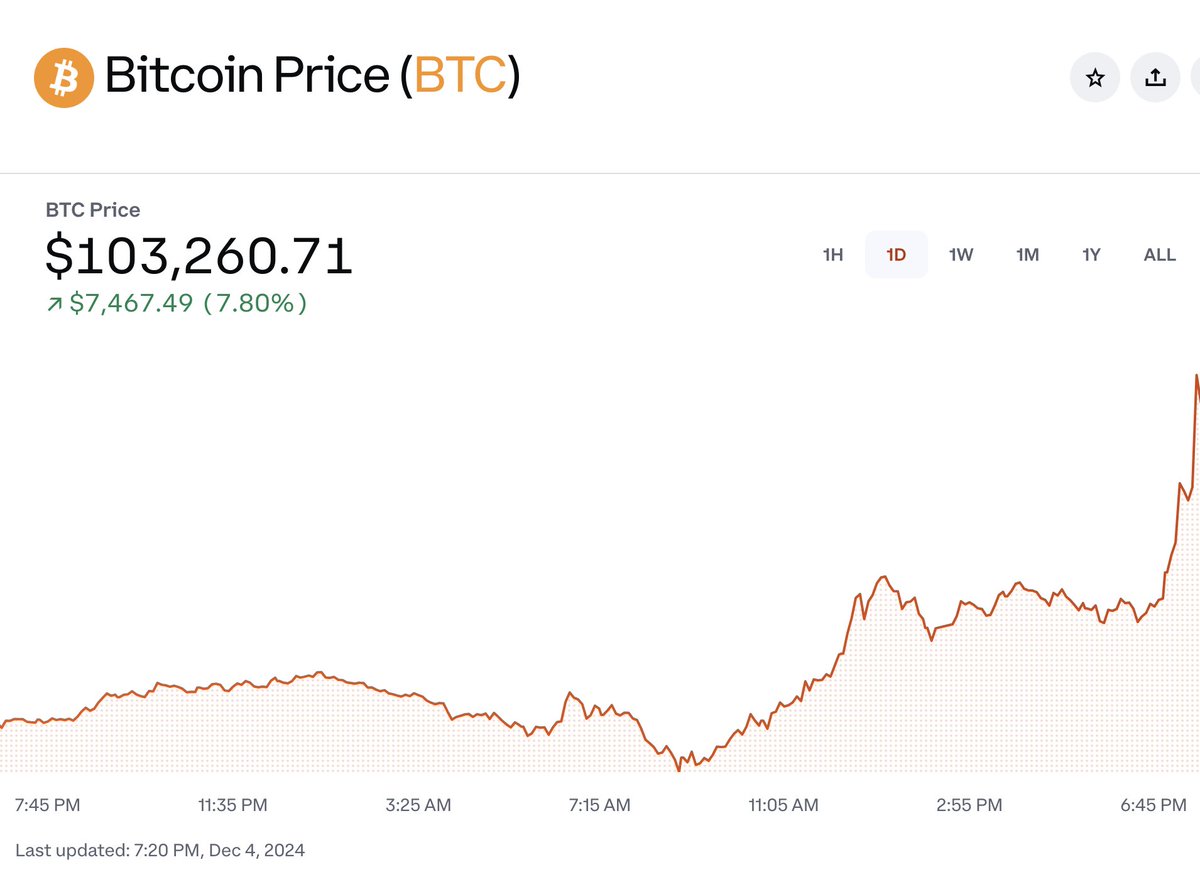
If you bought $100 of Bitcoin when Coinbase was founded in June 2012, it would now be worth about $1,500,000.
If you kept the $100 USD you'd only be able to purchase about $73 worth of goods today.
Bitcoin is the best performing asset of the last 12 years, and it's still early days.
Every government, especially those looking to create a hedge against inflation, should create a Bitcoin strategic reserve.
Happy Bitcoin $100k day.
Over the last 2 years, the Supreme Court has ruled that the administrative state is behaving in wildly unlawful ways. But slapping the bureaucracy on the wrist won’t solve the problem, the only right answer is a massive downsizing.
Here's a cool sports story...
Luke Combs grew up in North Carolina as a Panthers fan, so after Hurricane Helene, he organized a charity concert at Bank of America Stadium to raise money.
But rather than charging Combs the standard rate, Panthers owner David Tepper donated everything.
Tepper let Combs use the venue for free. He didn't keep any of the parking, merchandise, food, or beer money. He also paid the salaries of all the employees who worked the event and even covered 100% of the tax bill.
The result?
It was the largest concert in stadium history, with over 82,000 people showing up to donate $25 million.
And since Tepper paid for everything, every single dollar that was raised went to hurricane victims.
That's incredible 👏
At 2-6, #Jets season is effectively over. Rodgers almost certainly retires, Adams goes elsewhere, front office & coaching staff get cleaned out. Ground zero again. Most disappointing season in #Jets history by a country mile considering the expectations involved.