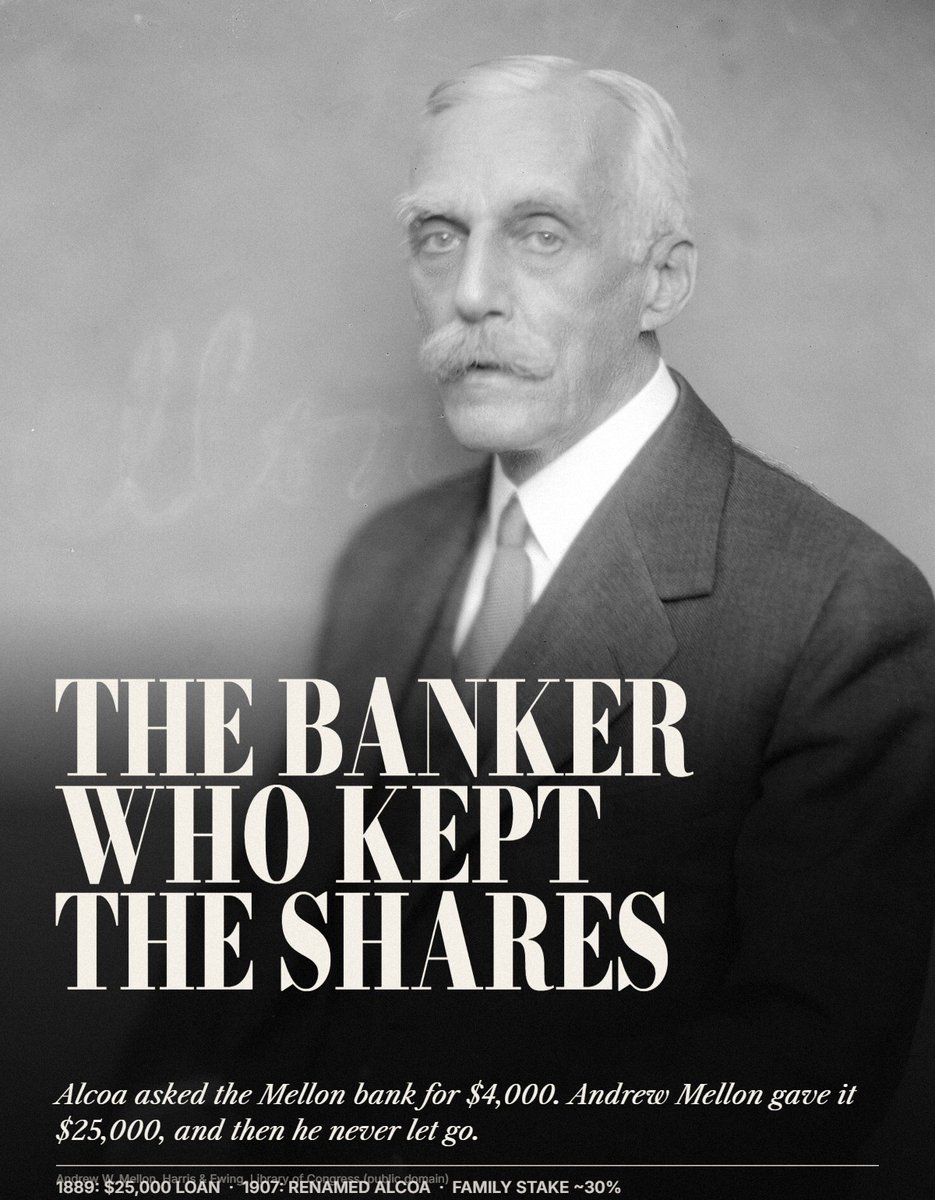
In 1889 the backers of a young aluminum company in Pittsburgh came to the Mellon bank asking for a $4,000 loan. The company had one real asset: Charles Martin Hall's process for making aluminum cheaply, which turned a semi-precious metal into an industrial one.
Andrew Mellon offered $25,000 instead, and bought shares from Hall at $100 apiece. Later the Mellons bought another 500 shares, which put them on the board. The Pittsburgh Reduction Company became Alcoa in 1907, and the family ended up owning roughly 30% of the company that had American aluminum close to a monopoly for decades.
Mellon ran the same play again and again. Find a founder with a technical edge and not enough money. Give him more capital than he asked for. Take real ownership, sit on the board, and hold. Edward Acheson's Carborundum, which the Mellons controlled by 1898. Guffey Petroleum at Spindletop in 1902, about 40% Mellon-owned from the start and later Gulf Oil.
Hall got rich. The banker who owned a piece of every one of these and almost never sold got a lot richer. The person with the invention rarely ends up with most of the money. The patient owner of the capital often does.
Sources: https://t.co/e0hJnKsfsV, https://t.co/AvrIZC2CKC, https://t.co/vY6ZWyndBk
u can’t sell houses u don’t own
u can’t sell cars u don’t own
but
u *can* sell stock u don’t own!?
this is bs – shorting is a scam
legal only for vestigial reasons
@_bj_bj_bj_@EnovixBatteries Rodgers said a smartphone battery is about the thickness of a pack of cigarettes, while an eyewear battery is about the size of a little finger. He said the same machine can make five eyewear cells for every phone cell.
Bill Ackman owned 10 percent of Wendy's and the CEO wouldn't take his calls. six weeks later that CEO was out, and calling Ackman to say thank you.
in the clip below Ackman tells how a nobody got a CEO to listen.
it was early in Pershing Square. Wendy's owned Tim Hortons, which alone was worth more than all of Wendy's.
he called the CEO. nothing. he called again.
"i literally couldn't get a return phone call."
so he went around him. Steve Schwarzman at Blackstone wrote an opinion on what a spin-off was worth, and Ackman filed it publicly.
six weeks later Tim Hortons was spun off. the CEO had been fired, Ackman says, and thanked him for his exit package.
a few years later Ackman bought a third of a bankrupt company that had fallen from $20 billion to $100 million.
"sort of the most contrarian investment you can make."
the stock went from 34 cents to $34.
a CEO who got what he deserved - or one who got paid to lose?