Full-Stack Operating Partner for 8-figure DTC brands. 3x chairman of eTail Nordic, speaker at Worldwide Business Research, Commerce Roundtable, Greekout & more
I would start by organizing organic Pinterest traffic - something has to tell you it's a good channel that's not being replicated on the funnel
Pinterest is a terrible conversion channel (great NV%, terrible CVR usually) so unless the brands are aestethtics (home furniture > fashion) I don't know if it's worth it over persona expansion on Meta/YT/TT
Are you maxed out in those places?
Every agency says they're performance-driven.
Every agency says they're partners.
Every agency says they're different.
Most are exactly the same.
The reason their words feel hollow is because the agreement doesn't actually back it up - they get paid the same regardless of performance.
Most run on retainer + % of spend, calling it performance while they are secretly trying to squeeze more brands into each pod.
Would you call that performance-driven? Partnership?
I'd call it underhanded and opportunistic.
We've had partners join after their last agency literally spent more on ads than the company generated in revenue, and charged 15% adspend on top of a $15k/mo retainer for subpar management.
No stipulations, no leeway - pay or get sued.
AI will lower the cost of execution, which means everyone will have to switch to actual performance models.
My prediction: they won't adapt - they'll pivot.
SaaS, info products, courses.
Same rent-seeking model, lower ticket.
Reminder for DTC brands:
Build lifetime budget campaigns and flex ads 4 BFCM on Meta
Flex Ads: Real-time rotation
Faster optimization + utilization of Andromeda
LTB: Fixed duration + budget
Much faster deployment AND recognized budget updates (*if they manage through wknd)
It’s not about “finding a winning creative" - that’s the result
It’s about building process and IP so creative wins are:
- Repeatable (process)
- Understandable (learnings)
- Brand-owned (IP)
Not just in a creative strategist’s head
@paulsaintecom We do this!
Full-stack DTC Performance-management w/ P&L planning and ownership
Anywhere from $15m to $150m Amazon-revenues, building DTCs from scratch
Happy to have a chat after BFCM!
I’ve spoken to 100s of DTC founders and
most of them want to exit some day
People get lost in how to translate an exit goal —> into an actionable plan for the company
Here’s how we do it:
If your goal is to exit your brand for $50M
then you need to reverse engineer what a $50M valuation looks like and build the roadmap to get there
Say you're at $8M revenue with 15% EBITDA with a 5-year roadmap to exit:
To sell your brand for $50M at a realistic 4-6X multiple you need $8-12M EBITDA
(Roughly 40-60m at 20% EBITDA margins)
The FIRST thing we build is a YoY P&L forecast:
Yr 1: ~12M sales at ~15% EBITDA
Yr 2: ~18M sales at ~16% EBITDA
Yr 3: ~27M sales at ~18% EBITDA
Yr 4: ~38M sales at ~19% EBITDA
Yr 5: ~50M sales at ~20% EBITDA
We map out everything down to daily targets across spend, efficiency and profitability.
Now we have clear targets to go from $8M revenue —> $50M exit that we can align the entire organization around.
My 2 cents:
Just looking at the creative I'd guess it serves mostly Product Aware/Most Aware audiences, so I would assume there's a higher % of either engaged audience or existing customers in those conversions compared to the rest of the account
My guess would be a 40-40-20 split across New/Engaged/Existing with outsized CV on Engaged/Existing
+ a good collab always bangs 🔥
If you are a brand owner and want to sell at some point:
There are 2 things to consider that impact your enterprise value outside of your EBITDA, category & revenue (that almost no-one talks about).
1: Team and key man risks
2: The process IP that your brand scales with
Repeatable growth engine = compounding EBITDA and higher exit multiples
ROAS is the most dangerously misused metric in DTC
I see a lot of brands set ROAS targets for their marketers and assume they’re protecting margin.
In reality, they’re often:
1. Capping growth
2. Wasting spend
3. Driving acquisition costs through the roof
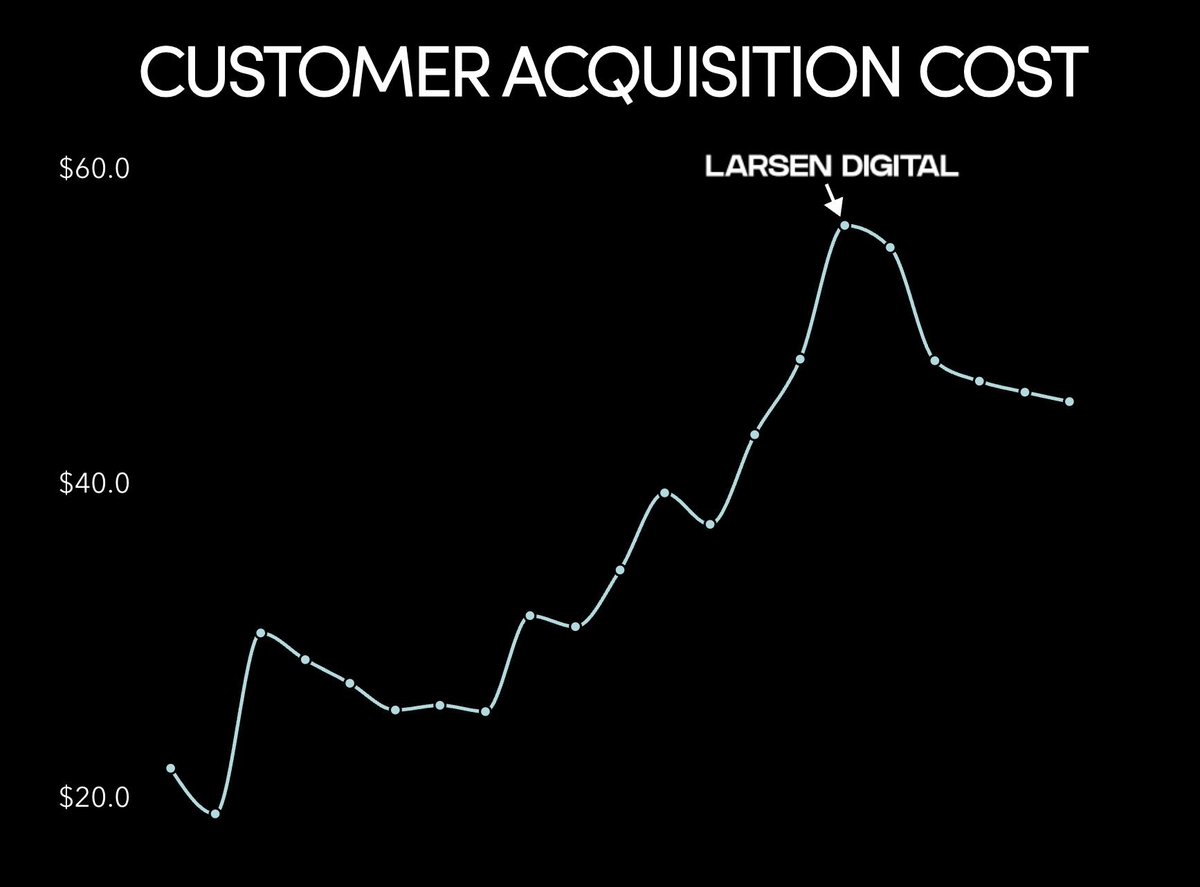
We recently saw this play out with an 8-figure brand who came to us with a problem: CAC went from $25 → $60 in less than a year.
They gave the agency margin-based ROAS targets.
The agency scaled spend right to that ceiling.
New Customer Acquisition turned completely unprofitable, and blended ROAS was hiding it.
We came in as a strategic Growth Partner and rebuilt their acquisition & retention funnels.
The result after 3 months?
1. Reduced CAC by 19%
2. Increased New Customer Acquisition by 3%
3. Identified & cut $257k in yearly wasted spend
Here's why ROAS fails you:
ROAS = Revenue ÷ Ad Spend.
That’s it.
No incrementality, no channel separation, no real understanding of where profit & growth actually comes from.
I often call ROAS an "indicative metric" because it's something you spot-check & not something you obsess over. It does not tell the full story.
In DTC, you only make money in two ways ✌️
New Customer Revenue → function of Ad Spend x Media Efficiency
Returning Customer Revenue → function of New Customers × Repeat Rate
That means you only have two real goals in marketing:
Acquire customers at target CAC (offers, creative, angles, PMF).
Reconvert them at target Repeat Rate (upsells, offers, post-purchase flows).
If you’re still using ROAS as your north star, then you’re likely a lot more inefficient than you think.
You should be tracking and optimizing for Spend, CAC (or NCROAS) + Repeat Rate. That’s the growth equation that actually compounds.
What metric are you optimizing for?
Just flew my first ever @Starlink-enabled flight with @airBaltic & it's freakishly good.
1. Cleared my Slack
2. Joined our Monday Standup (0 lag)
3. Watched the @F1 highlights
The best products are always the ones that make you forget you had a problem in the first place