Those who move forward with a happy spirit will find that things always work out.☀️ world citizen, solution focused edu leader, Lady of Lochaber & Glencoe Wood
A drone captured the incredible moment a whale pushed a paddleboard with its fin.
Maximiliano Jonas filmed the amazing footage off the coast of Puerto Madryn, Argentina
[📹 maxijonas]
As President, I would read 10 letters a day sent to me by ordinary Americans. At the Obama Presidential Center, we’ll have some of the letters I read — and responded to — every night. I still get emotional reading them, and it’s one of my favorite exhibits.
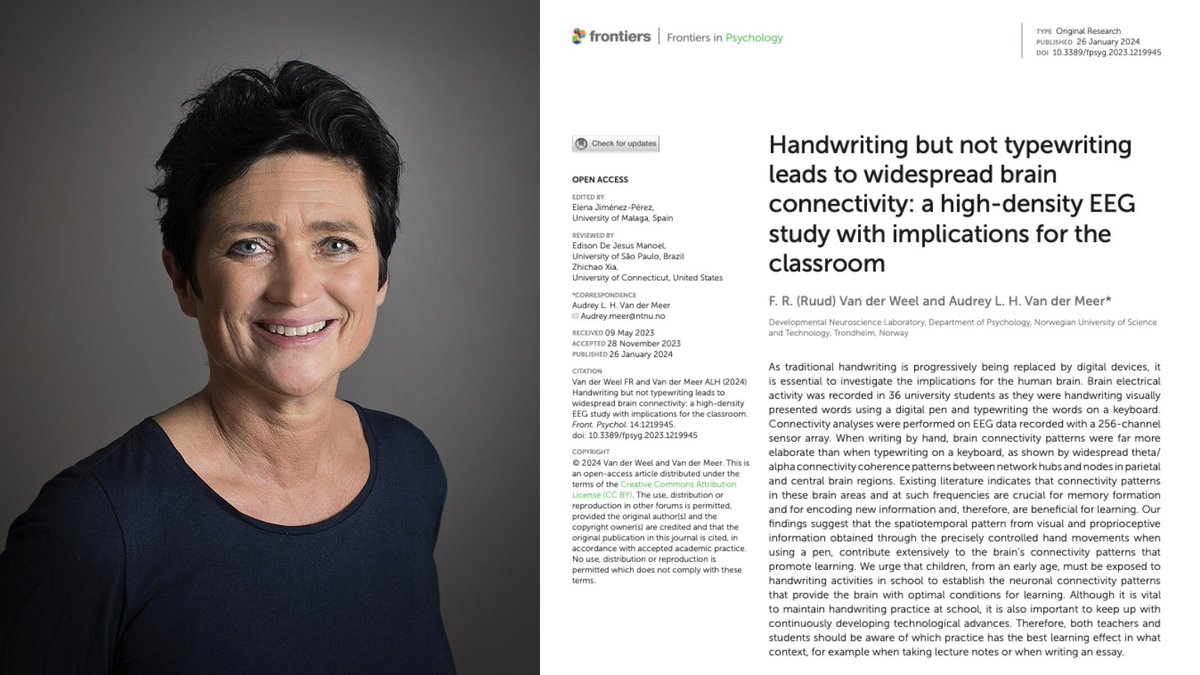
A Norwegian neuroscientist spent 20 years proving that the act of writing by hand changes the human brain in ways typing physically cannot, and almost nobody outside her field has read the paper.
Her name is Audrey van der Meer.
She runs a brain research lab in Trondheim, and the paper that closed the argument was published in 2024 in a journal called Frontiers in Psychology. The finding is brutal enough that it should have changed every classroom on Earth.
The experiment was simple. She recruited 36 university students and put each one in a cap with 256 sensors pressed against their scalp to record brain activity. Words flashed on a screen one at a time.
Sometimes the students wrote the word by hand on a touchscreen using a digital pen, and sometimes they typed the same word on a keyboard. Every neural response was recorded for the full five seconds the word stayed on screen.
Then her team looked at the part of the data most researchers had ignored for years, which is how different parts of the brain were communicating with each other during the task.
When the students wrote by hand, the brain lit up everywhere at once.
The regions responsible for memory, sensory integration, and the encoding of new information were all firing together in a coordinated pattern that spread across the entire cortex. The whole network was awake and connected.
When the same students typed the same word, that pattern collapsed almost completely.
Most of the brain went quiet, and the connections between regions that had been alive seconds earlier were nowhere to be found on the EEG.
Same word, same brain, same person, and two completely different neurological events.
The reason turned out to be something nobody had really paid attention to before her work. Writing by hand is not one motion but a sequence of thousands of tiny micro-movements coordinated with your eyes in real time, where each letter is a different shape that requires the brain to solve a slightly different spatial problem.
Your fingers, wrist, vision, and the parts of your brain that track position in space are all working together to produce one letter, then the next, then the next.
Typing throws all of that away. Every key on a keyboard requires the exact same finger motion regardless of which letter you are pressing, which means the brain has almost nothing to integrate and almost no problem to solve.
Van der Meer said it plainly in her interviews.
Pressing the same key with the same finger over and over does not stimulate the brain in any meaningful way, and she pointed out something that should scare every parent who handed their kid an iPad.
Children who learn to read and write on tablets often cannot tell letters like b and d apart, because they have never physically felt with their bodies what it takes to actually produce those letters on a page.
A decade before her, two researchers at Princeton ran the same fight using a completely different method and ended up at the same answer. Pam Mueller and Daniel Oppenheimer tested 327 students across three experiments, where half took notes on laptops with the internet disabled and half took notes by hand, before testing everyone on what they actually understood from the lectures they had watched.
The handwriting group won by a wide margin on every question that required real understanding rather than surface recall.
The reason was hiding in the transcripts of what the two groups had actually written down.
The laptop students typed almost word for word, capturing more total content but processing almost none of it as they went, while the handwriting students physically could not write fast enough to transcribe a lecture in real time, which forced them to listen carefully, decide what actually mattered, and put it in their own words on the page.
That single act of choosing what to keep was the learning itself, and the keyboard had quietly skipped the choosing and skipped the learning along with it.
Two studies. Two countries. Same answer.
Handwriting makes the brain work. Typing lets it coast.
Every note you have ever typed instead of written went into your brain through a thinner pipe. Every meeting, every book highlight, every idea you captured on your phone instead of on paper was processed at half depth.
You did not forget those things because your memory is bad. You forgot them because typing never woke the part of the brain that would have made them stick.
The fix is the thing your grandmother already knew.
Pick up a pen. Write the thing down. The slower road is the faster one.
“Sometimes the smallest things take up the most room in your heart.” – A. A. Milne
As we mark the 100th anniversary of the beloved Winnie-the-Pooh stories, The Queen has presented a very special gift to the New York Public Library, reuniting baby Roo with his friends from the 100 Acre Wood.
The Library is home to the original collection of toys owned by Christopher Robin Milne, son of A.A. Milne, which inspired the characters in the beloved Winnie-the-Pooh series. The collection is missing Roo, the baby kangaroo who was lost in an orchard in the 1930s.
The new addition of Roo was created by Shropshire-based company Merrythought, who also created the original toys.
👀 Watch Roo’s great adventure travelling from Buckingham Palace onboard Their Majesties’ flight to his new home in New York.
Kennelijk verwacht een deel van de maatschappij nog steeds dat slachtoffers zich schreeuwend en scheldend verzetten, dat ze zich melden met zichtbare verwondingen en dat ze zich de volgende dag direct melden bij de politie, zegt de AG. #AliB
🚨| How damaging is Max Verstappen's criticism to F1?:
— Max Verstappen's outspoken nature often puts him at odds with Liberty Media's vision for F1. His criticism of the sport's direction, comparing it to Formula E and Mario Kart, appeals to purists but clashes with the entertainment-focused strategy aimed at younger fans.
— While Verstappen's remarks may undermine Liberty Media's marketing efforts, they resonate with fans who value authenticity over spectacle. His candidness serves as a counterbalance to the sport's increasing Americanization and focus on glamour.
— Verstappen's role as a moral compass in F1 is significant. His status as a four-time champion allows him to voice opinions that newcomers might shy away from, maintaining the sport's integrity amidst a world of rehearsed PR and show business.
— The impact on Verstappen's personal image is minimal. His criticism is perceived as authenticity rather than negativity, reinforcing his reputation as a genuine figure in the sport. This dynamic creates a tension between Liberty Media's business model and the traditional values Verstappen upholds.
— Both Liberty Media and Verstappen benefit from this relationship. F1 needs a strong champion to draw fans, while Verstappen requires a platform to showcase his talent. If F1 fails to provide that, Verstappen could find success elsewhere, potentially harming the sport more than his words ever could.
#maxverstappen 🇳🇱
VIA: [RacingNews365]
On the morning of September 11, 2001, Michael Hingson sat at his office on the 78th floor of the North Tower of the World Trade Center.
Blind since birth, he navigated life with confidence, thanks to his yellow Labrador guide dog, Roselle. At 8:46 a.m., American Airlines Flight 11 tore into the building 18 floors above them. The tower lurched. Smoke filled the corridors. Papers and debris rained past shattered windows. People screamed.
Michael couldn’t see the fireball. He couldn’t see the smoke. But he felt the building tremble — and he felt Roselle stand up. She didn’t bark. She didn’t pull wildly. She simply rose, calm and ready. In that quiet movement, he found his answer. Panic wouldn’t save them. Steady steps might.
He called his wife to say he loved her. He swept his office for anyone left behind. He directed coworkers toward Stairwell B. Then he clipped his hand into Roselle’s harness and said the words they both knew so well: forward.
They began the long descent — 1,463 steps through smoke and fear. At the 50th floor, a colleague whispered, “Mike, we’re not going to make it.” Michael answered firmly, “If Roselle and I can do this, so can you.” And so they did. People in that stairwell began to follow the rhythm of a blind man and his dog — one step at a time. No rushing. No chaos. Just trust.
Firefighters brushed past them, climbing toward the flames. Michael and Roselle flattened against the wall to let them through. Many of those brave souls would never return.
When they reached the lobby, debris was falling outside like deadly rain. Moments later, the South Tower collapsed. Roselle guided Michael into a subway entrance, then out into the dust-filled streets. When the North Tower fell behind them, she kept walking. She led him 40 blocks north to safety.
There is one detail Michael always shares. Roselle was terrified of thunder. At home, a distant storm would make her tremble. But that day — surrounded by explosions, sirens, and collapsing towers — she did not shake once. Not once.
In 2004, Roselle developed a blood disorder believed to be linked to the toxic dust she breathed that morning. She retired from guiding but never from loving. She spent her final years surrounded by family, gentle and proud. In 2011, at the age of 14, she passed away.
Roselle could not stop the towers from falling. She could not silence the fear in the stairwell. But she did what heroes do — she led. Through darkness. Through fire. Through 1,463 steps of uncertainty. And sometimes, the bravest soul in the room isn’t the one who can see the danger. the one who feels it… and walks forward anyway.
Roselle, you are a true hero and will never be forgotten ❤️.
The lyrics of this video hits hard.
Take good care of your parents while they are still alive, so that your days may be long on this earth that the Lord your God has given you.







![ThisIsFormu1a1's tweet photo. 🚨| How damaging is Max Verstappen's criticism to F1?:
— Max Verstappen's outspoken nature often puts him at odds with Liberty Media's vision for F1. His criticism of the sport's direction, comparing it to Formula E and Mario Kart, appeals to purists but clashes with the entertainment-focused strategy aimed at younger fans.
— While Verstappen's remarks may undermine Liberty Media's marketing efforts, they resonate with fans who value authenticity over spectacle. His candidness serves as a counterbalance to the sport's increasing Americanization and focus on glamour.
— Verstappen's role as a moral compass in F1 is significant. His status as a four-time champion allows him to voice opinions that newcomers might shy away from, maintaining the sport's integrity amidst a world of rehearsed PR and show business.
— The impact on Verstappen's personal image is minimal. His criticism is perceived as authenticity rather than negativity, reinforcing his reputation as a genuine figure in the sport. This dynamic creates a tension between Liberty Media's business model and the traditional values Verstappen upholds.
— Both Liberty Media and Verstappen benefit from this relationship. F1 needs a strong champion to draw fans, while Verstappen requires a platform to showcase his talent. If F1 fails to provide that, Verstappen could find success elsewhere, potentially harming the sport more than his words ever could.
#maxverstappen 🇳🇱
VIA: [RacingNews365]](https://pbs.twimg.com/media/HDs8OjpagAA4X9F.jpg)