When we explain to someone what it means to be a Genius founder, not many founders exemplify the definition as naturally and wholeheartedly as Markie.
We met Markie well before Poetic - while she was dropping out of college and building her first AI consultancy. Beyond just the work in front of her, she always cared deeply about her purpose, tapping into her most creative possible source of energy, and always asking the why behind everything she does (evident in her @traestephens co-authored essay titled 'Choose Good Quests'). We knew with certainty we wanted to partner with her on her own lifelong quest as soon as she was ready for it.
And then came Poetic.
We committed the first check back in 2023 - and every day since, Markie and the Poetic team continues to choose good quests. We are honored to support those quests every single day.
Congrats on an amazing launch, @PoeticHQ
CC: @markiewagner@LM_Braswell@gefkovicz
Introducing @PoeticHQ: a new AI system that executes complex multi-hour tasks with 99%+ accuracy and 10x fewer tokens than agents.
We raised $50M at $500M from Kleiner Perkins, Founders Fund, First Harmonic, and Genius Ventures to build AI that does complex work inside Fortune 500 companies without hallucination.
While code is too brittle, agents are too unpredictable. The work that runs the global economy - anti-money laundering, fraud investigations, underwriting - needs extreme accuracy.
So we built a new kind of software that pairs the flexibility of AI with the predictability of code.
When the world stays the same, Poetic runs fixed code: fast, cheap, identical every time. When the world changes, Poetic uses AI to regenerate its approach and find its way back to the objective.
In one year, we went from zero to an eight-figure run rate as a team of four.
Since then, we’ve scaled the team and executed the highest-stakes processes at AIG, SoFi, and Chime. At SoFi, a large US bank, Poetic reached 99%+ quality on fraud investigations in five weeks.
One of the most quietly elite companies out there.
5 years of relentless compounding in the biggest market in the us (housing). Congrats Minna and team!
Frontier models like @OpenAI publicly avoided booking travel for a reason.
I founded https://t.co/Qx5hRqNiop - $2,000,000+ booked. 200+ founders, athletes, and creators. 1 thread in iMessage.
All in beta.
Here’s what’s different:
• We actually know you, from avoiding flights at 8 AM to finding Starlink flights, down to what breed your service dog is. We weigh out the options between points and cash, making sure every loyalty, credit, and reward is working for you.
• 24/7 support. No random fees, no charges for changes. We're the first to integrate legacy infrastructure with LLMs to deliver concierge-grade service at scale. Modify, rebook, or cancel at any time.
• We literally give you back money for hotels, referrals, and every milestone you hit.
Search is the wrong abstraction. We built a tool to just do it for you.
We're now opening it up to the public.
https://t.co/rMRGG2Lmbd
🚨X just pulled back the digital curtain.
Their “About this account” tool has exposed countless foreign accounts posing as American influencers and raising the temperature on domestic issues.
This highlights the need for more online transparency and digital borders.
🧵Thread
You have to be an optimist about your own product, your own startup, and yourself. That's why when you pitch -- whether to investors, to prospective employees, or partners, it's important to talk about what might happen, not what you are doing today.
There's a whole style to this type of pitch, and it's a futuristic point of view that leans into optimism:
- Emphasize the future, not the past
- What it could be not what it is
- Play up even small bits of proof points
- The big things that might happen, if it works
- The upside rather than risks
- Signs the customers love the product, rather than revenue metrics
- Why this team has the grit and special knowledge to do it, not the credentials and work experience
- A unique narrative about why the world is moving this way
- Why you're starting with a wedge, but your ultimate market is huge
In a previous discussion, I recounted that a few years back, a big group of Nordic founders came by Silicon Valley. When I asked them their biggest learning on the trip so far, they said: We have to learn how to pitch our startup in the “American” way, oriented towards the future and the possibility of success. Unfortunately they told me the investors back home didn’t care for this style. Instead, they are focused on reducing risk, and that starts with asking startups what revenue they have right now, even though the companies were brand new.
The funny thing about this is that this isn't the "American" way of pitching, it's actually specific to the Bay Area tech ecosystem. It's incredibly optimistic and futuristic that founders choose to describe their startups in this way, and furthermore, the people who hear these pitches choose to believe them.
I find this tone admirable, but let me also make the argument that this is the only logical way to convince people to join you on your journey.
First, let's talk about startup investors. a portfolio of startup investments is inherently risky, and the physics of venture math means that the winners have to be really big. It's commonly said that out of a portfolio of ten companies, generally about half the investments will go to zero, three will return a little bit of money, and that the top one or two will return 10x plus and make the fund work. As a result, professional venture investors are trying to understand if you have what it takes to be one of those top two, and if you don't if you'll die trying. A lot of this assessment focused on the market or your numbers, but sometimes the real question is about your ambition.
So they are trying to answer a simple question: Do you WANT to create one of the leading companies in the industry?
Focusing on the future and on the upside shows your will to power. It allows investors to gain a sense of that signal. If you're focused too early on profitability, rather than growth, or retaining your piece of the pie, as opposed to growing the pie as large as possible, that's an important signal. The point of this isn't to mislead investors into thinking that you're trying to do something that you're not, but rather, if you are shooting for something big, you have to really express that in the clearest way possible.
The perspective is often directly reflected (and not) in the slide decks I review at a16z. Does the product slide describe the features of what the app has today, or does it talk about the product roadmap of what's going to be built in the future? Do they user projections or financial forecasts simply show the last year's performance, or does it tell a story about how the business is about to inflect? Oftentimes when founders are too conservative about their story it's hard for investors to understand what they're trying to do in the long run. Instead, I love it when founders tell the big story. Of course I'm going to discount it and round down, and assume that many features are never shipped. But I love to see it.
Second, let's talk about employees. typically when you're hiring your first few employees, you might be able to give out a few percentage points each, particularly for key people (like engineers or designers). but within a few hires, you end up needing to convince people to work for below pay, and for a fraction of a percent of the company. Why would they do this? Why would they work for you instead of either starting their own company or getting a cushy gig somewhere else where they might be paid much more?
The asymmetric advantage of startups compared to many other opportunities, is that they are adventurous and fun. The startup might fail, but the work is generally a lot more interesting than what you can do elsewhere. The responsibility and scope that a junior employee might have might go way beyond what makes sense at any other company.
And of course financially there is upside. For founders to convince high-quality employees to join their outfit, it's often important to lean into a sense of adventure. What's more adventurous than tackling a big huge goal, that might not work, but if it works, it's going to be amazing? For founders to communicate the sense of adventure, they need to be able to weave a narrative. Maybe it's us versus them, or David and Goliath. Perhaps it's exploring the unknown, and going to the frontier when no one else is there. If you can't tell the stories, how can you expect people to follow you? Thus I find it important to tell the futuristic narrative that's ambitious, full of surprises and upside, and has a possibility of failure too. It makes the work meaningful and makes the potential economic upside worth something.
We've talked about investors and employees, but there's actually a long tail of many other constituents that benefit from a futuristic outlook. if you're talking to journalists and pundits, you have to compete with thousands of other companies that they're going to meet this year, and you have to catch their attention. If you're marketing, an event at a conference adjacent to dozens of other events, you have to catch the eye of attendees. An optimistic, futuristic perspective gives you room to tell the story about the problem you're trying to solve, and why your startup will be incredibly important once you get there.
You might say that the world is full of cynics. Perhaps you are from a region or an industry where most people nitpick all the reasons why fail. Maybe they want you to focus on minimizing downside risks, or acknowledging your potential problems, and won't treat you as credible unless you do. If that's your industry network or your social network, I urge to you to escape. Seek out those who share your optimism, and the same values and beliefs about the future. it's one of the reasons why the Bay Area has been such a powerhouse over the last few decades. Yes, there's knowledge and investors here, but more important is the culture.
The last point I make is about yourself. You should talk about what you're working on in an optimistic way to help create meaning for yourself. For those of us who grew up in a generation that adored Steve Jobs, there's always been the goal to put a dent in the universe rather than to sell sugar water. Thinking about the future, and the upside of what you might be able to create, is a great way to give meaning to the nights and blood and tears that we put into our work. If you're simply working on a new product only because it's a good money-making opportunity, I guarantee that your sense of meaning will fade when times get tough. You'll ask yourself, why am I doing this? If you don't have a Northstar to guide you on an inevitably rocky, entrepreneurial journey, you'll inevitably get lost. That's when the FAANG job will seem really appealing.
This is all about the pitch. Of course it's important to simultaneously hold in your mind all the truths about what you're working on. Maybe you don't actually have product market fit yet, or your marketing strategy. Perhaps your unit economics don't yet work, or your team has major gaps. If you're working on a new startup, likely, everything feels constantly broken, and everyone's maybe going to quit.
You have to go and tackle all of those challenges with a clear mind -- while simultaneously keeping a futuristic spirit that motivated people to join you on your journey.
We are excited to announce that Patreon is acquiring Moment! 🎉 With Moment, we’re bringing fans and creators closer together through ticketed digital experiences. 🎫 Read more on our blog!
https://t.co/NEArk9pOCm
wrote about how @momenthouse is elevating virtual performances, how this can coexist with live touring and how album films are more fire than music videos ✍🏾
thank you @vincestaples for the quote 💙💔 https://t.co/7ktlrBzAyh
Celebrating #InternationalWomensDay today and every day! We're proud to work with the incredibly inspiring women on our team as well as the artists and creators whose Moments have come to life on our platform. ❤️
The world must act immediately. Future of Europe & the world is at stake. To do list:
1. Devastating sanctions on Russia NOW, including SWIFT
2. Fully isolate Russia by all means, in all formats
3. Weapons, equipment for Ukraine
4. Financial assistance
5. Humanitarian assistance
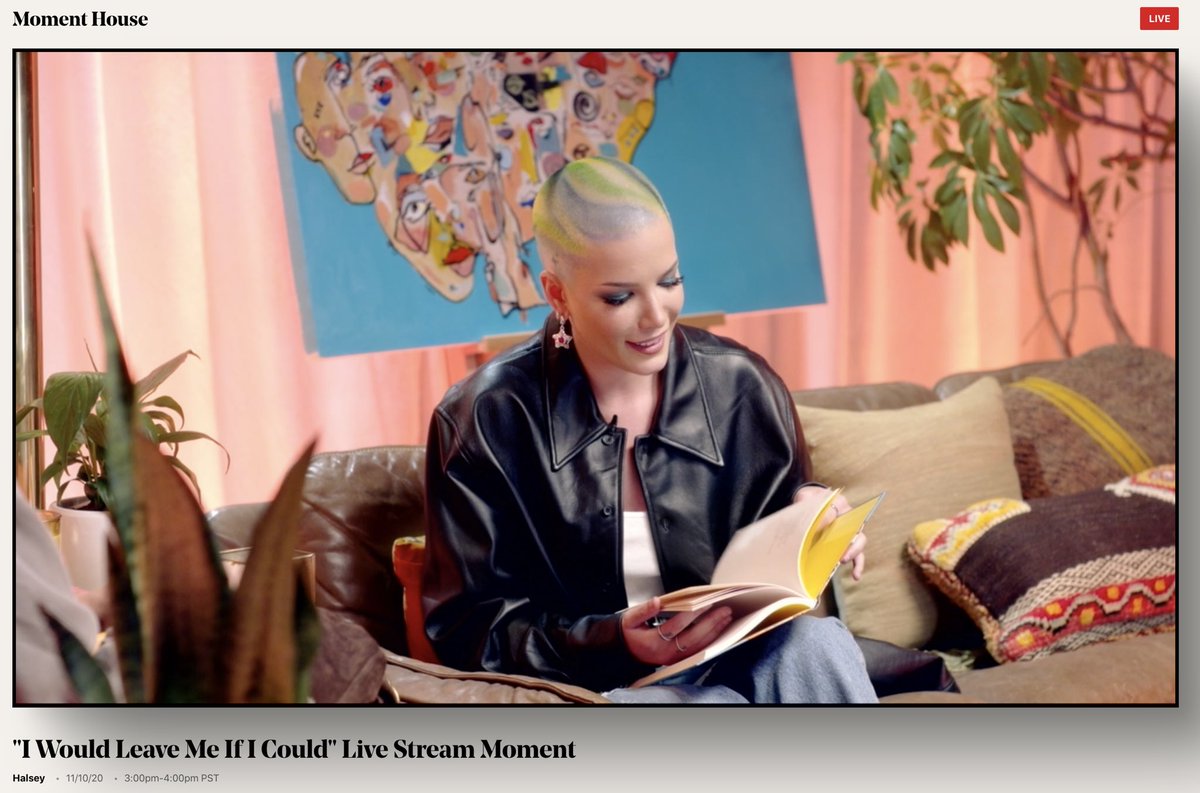
Was such a pleasure hosting @halsey on Moment House today. Important to spotlight the talents & passions of artists outside of just music — we achieved that tonight. #Moments
Beautiful Moment of @halsey reading poems from her new book, “I Would Leave Me If I Could”, and discussing her journey as an artist & writer with @orionvanessa