Every few years, I keep coming back to this article by Kevin Kelly, the Founder Editor of Wired, who says that failure is the most misunderstood concept in modern society. If you don't fail every once in a while, you aren't really stretching yourself. The essence of science or dance or music or sculpture or almost any skill is the ability to learn from the things that didn't work. And the ability to cope with regular failure is one of the most important qualities in your arsenal.
A point he made about immigrants really resounded. He believed that the rise of the West was in many respects due to the rise in tolerating failure and many immigrants trained in a failure-intolerant culture blossom out of stagnancy once moved into a failure-tolerant culture.
Failure liberates success.
I taught JEE physics for years. That paper breaks strong kids in three hours.
This exam is five hours of theory and five hours of lab work, and these five did close to perfect scores on it.
Let me tell you what actually happened.
The International Physics Olympiad is the world championship of school physics. It was the 56th edition. Held in Bucaramanga, Colombia, from July 5 to 12.
381 students. More than 85 countries. Every one of them the best physics student their country could find.
India sent five kids.
All five came back with gold.
Their names are Kanishk Jain from Pune. Riddhesh Anant Bendale from Indore. Rishit Garg from Dwarka in Delhi. Shresth Suraiya from Mumbai. Svarit Joshi from Ahmedabad.
We know a hundred cricketers by their nickname and not one of these boys. :)
That clean sweep put India at joint World Number One. Tied with China, Russia, Kazakhstan, South Korea and Taiwan.
Those are countries that pour serious money and national pride into science education. We are standing level with them.
Now here is what the exam actually was.
Two papers. Each five hours long.
The theory paper had three problems. One on the thermodynamics of paramagnetic cooling. One on the photoionisation of ozone. One on the dynamics of electron positron pairs.
The experimental paper was another five hours in a lab, working through heat transfer and thermodynamic processes in fluids.
That means you get given equipment you have never seen, and you have to design your own experiment, take your own readings, handle the errors, and reach a real answer.
Not multiple choice. No shortcuts. No pattern recognition. You either understand physics or you sit there for five hours.
HBCSE says the Indian students were near perfect on theory and excellent on the practical too.
Now, this was India's 27th appearance at the IPhO.
Across all those years, about 44 percent of Indian students have won gold, 41 percent silver, 10 percent bronze.
In the last ten years, every single Indian student has come home with a medal. 62 percent gold, 38 percent silver.
Not one kid has gone and come back empty handed in a decade.
Five golds in one year has happened only twice. This year, and in 2018.
So who built this.
The programme is run by HBCSE, the Homi Bhabha Centre for Science Education. It sits under TIFR, which sits under the Department of Atomic Energy.
They run the whole funnel. A national exam, then a national olympiad, then a brutal selection and training camp, and out of everyone in the country, five kids get on a plane.
The team was led by Professor Anwesh Mazumdar of HBCSE-TIFR and Dr Leena Joshi from St Xavier's College, Mumbai.
The scientific observers were Professor Ananda Dasgupta from IISER Kolkata and Nisha Kelkar from Gogate-Joglekar College in Ratnagiri.
Yes. Ratnagiri. A college in a small coastal town in Maharashtra.
This is public education doing something the private coaching industry could never do on its own.
The coaching industry is very good at one thing. Teaching you to solve a known problem fast.
That is what JEE and NEET reward, and I say that with love because I was part of that world.
But an olympiad paper does not have a known type. There is no shortcut chapter. There is no formula sheet that saves you. You have to sit with a problem you have never seen and think.
That is a completely different muscle. And a government funded centre has been quietly building it in Indian teenagers for 27 years.
So yes, be proud. Loudly.
HBCSE also shared that around 64 percent of India's olympiad medallists go on to do a PhD.
But only about 32 percent of medallists end up settling in India.
I do not say that to spoil the moment. These kids owe the country nothing. They earned every option they have.
But it should tell us something. We are excellent at finding this talent. We are excellent at training it. We are still not great at giving it somewhere worth staying.
Congratulations Kanishk, Riddhesh, Rishit, Shresth and Svarit. This is one of the best things an Indian did this year and most of the country will never hear about it.
@help_delhivery I still do not see any update. This was picked on 9th June and still not delivered. @SahilBarua please step in.
Also, share procedure for the compensation.
@delhivery Hi this is in reference to 2827789414683, This was supposed to reach on 16th June but have no updates whatsoever yet.
Could you please check and update. Pathetic is the word.
@help_delhivery I still do not see any update. This was picked on 9th June and still not delivered. @SahilBarua please step in.
Also, share procedure for the compensation.
There are 2 types of people in this world: those who can't relax when there are dishes in the sink and those who don't even notice them.
And they end up marrying each other.
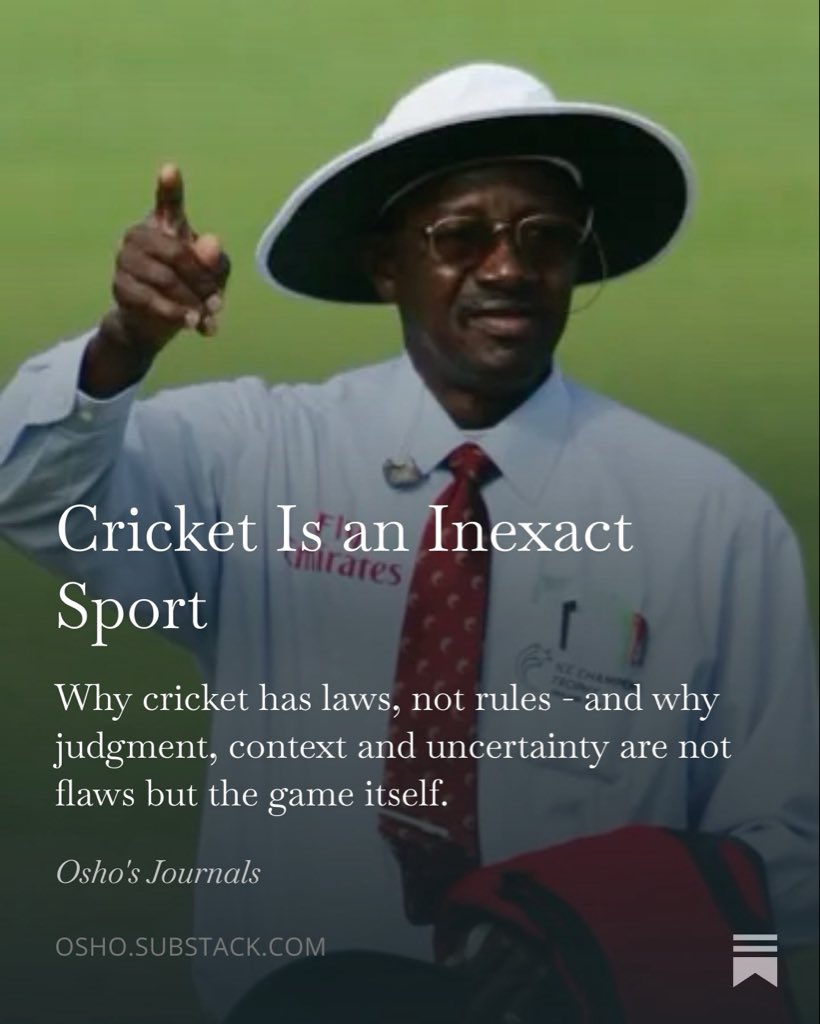
Cricket Is an Inexact Sport
In Football, a goal is a goal. In Tennis, a game point is a game point. In sprints, one microsecond is one microsecond. Once a goal is scored or a foul is done - the argument ends. The scoreboard becomes paramount.
Football, tennis, athletics - these are sports of rules. Technology in these sports exists to erase ambiguity in decision making: Hawk-Eye, goal-line technology, photo finish technology. The purpose of technology is not interpretation but verification. The rules are executable.
Cricket actively resists finality. Cricket is, by design, an inexact sport.
From its very grammar, its history, cricket embodies a different philosophy. It does not speak of rules. It speaks of laws - codified by the Marylebone Cricket Club since the 18th century. Rules demand obedience whereas laws require judgment. Rules assume uniformity but laws take context into account.
Cricket can not be played without context. Context of time, of place, of intent and of decaying pitch. Remove context, and cricket collapses into an unrecognisable game.
1/n
@GabbbarSingh I was discussing the same with my wife last week and why do we hear 90s music so often even these songs are not at par with old Hindi melodies. Thanks for writing this beautifully.
The layoff wave tells two stories, not one.
Tech giants like Amazon, Meta, and Microsoft are cutting to fund GPU purchases. Their revenues are growing. Their stock prices are climbing. They're firing people to free up cash for compute. This isn't cost-cutting during a downturn. It's a forced reallocation from payroll to datacenter capacity. The math is brutal: every percentage point of headcount reduction funds another batch of H100s.
Meanwhile, UPS, Nestle, Ford, and Target are cutting for the opposite reason. They've already deployed AI tools that work. Customer service automation, supply chain optimization, generative design systems. The productivity gains are real and compounding. These companies don't need to buy massive GPU clusters. They're renting inference from hyperscalers and cutting headcount because the math finally works.
Both sides are feeding the same beast. Tech companies are buying the shovels. Everyone else is buying the gold those shovels dig up. Semiconductor companies sit in the middle, collecting rent from the entire value chain. TSMC, NVIDIA, and ASML are printing money while employment craters on both ends.
The timing matters. We're at 10% enterprise AI adoption, heading toward 50%. History says this phase moves fastest and generates the most wealth. But that wealth is concentrating in compute, not labor. The gap between market cap growth and wage growth has never been wider. This isn't a recession. It's a rebalancing. And most workers are on the wrong side of it.
Communities that have been wiped out:
1. Sindhi Hindus
2. Balochi Hindus
3. Kashmiri Hindus
4. Afghan Hindus
5. West Punjabi Hindus
6. Afghan Sikhs
7. West Punjabi Sikhs
8. Bangladesh Hindus (not wiped off, but will be quickly)
But the world thinks Muslims are under attack in India.