The biggest competition for a small-college athletic department isn’t always the school on the other side of the scoreboard.
Sometimes it’s the student deciding not to attend college at all.
That’s why the experience we create, the value we communicate and the opportunities we provide matter so much.
Teams, schools and conferences…
What makes a small-college power conference? Excellence at the top and strength throughout its membership.
In the last two years, EVERY member of @TheHeartConf has won at least one conference title in our championship sports. During that same stretch, our teams have won a dozen national championships. 🏆
That’s what makes this conference special. Teams compete for national titles while championship success reaches every campus.
Proud to be part of The Heart… and proud of the student-athletes, coaches and institutions setting that standard.
And that excellence extends to the classroom: no one had more scholar-athletes, too. 📚
#TheRightWayToPlay #TheHeartsWayToPlay #NAIA #CollegeAthletics
Colorado College is cutting athletics spending. Cleveland State eliminated three sports. Purdue Fort Wayne cut two. Bryn Athyn eliminated all 11.
Meanwhile, Sonoma State is bringing athletics BACK after eliminating it.
College athletics is facing a fascinating contradiction.
For some institutions, athletics is an expense they can no longer afford.
For others, it’s an enrollment strategy they can’t afford to lose.
The question isn’t simply what athletics costs.
It’s what the institution loses without it.
Maybe one of the biggest opportunities in the changing college athletics landscape isn’t something small colleges need to create.
It’s something we’ve always done.
Give young student-athletes a place to be wanted, developed and valued.
That matters more than ever.
One college athletics story from this week deserves more attention.
Four institutions chose to join the NAIA for 2027–28:
2 from NCAA Division II.
1 from NCAA Division III.
1 from the NJCAA.
And yes…other institutions have made decisions to move in the other direction.
That’s the point.
I don’t see one association “winning” and another “losing” at this point.
I see institutions taking a harder look at economics, enrollment, geography, mission, competitive fit and long-term strategy and choosing the model that makes the most sense for them.
I think we’re going to see more movement in multiple directions across college athletics.
Reclassification isn’t a ladder anymore.
It’s becoming institutional strategy.
It’s college football Saturday.
Across America today, hundreds of communities will come together around a football field.
Parents will watch their kid play college football, cheer on the sideline, dance on the dance team during halftime, and perform in the band. Alumni will come to their second home. Fans will learn the names of young people who chose to represent their university. Towns will gather around institutions that are part of their identity.
That’s college athletics too.
FBS television viewership is down 11% through the first month of this season. I don’t pretend to know all the reasons why.
But sometimes I wonder if, in all of our conversations about billions of dollars, NIL, lawsuits, Congress, coaches salaries and buyouts, deficits and realignment, we lose sight of the simplicity of what made college sports special in the first place.
Nearly 1,000 NAIA, DII, and DIII institutions operate in a very different world from major college athletics.
Different economics. Different challenges. Same love of sport.
Whatever the future of college athletics looks like, understanding those differences matters.
@floydjd007@NAIAFootballVSN There will always be bubble teams, and there will always be bubble teams that aren’t happy when they’re not selected. But that selection should be based off of the criteria that is the same for everyone…. Not eye test, regional location, relationships, and history.
I agree that having the right people in the room matters. A laser focus on the criteria is vital, and the coaches associations have an equally important responsibility to make sure those criteria measure the right things. Committee members must take that responsibility very seriously and put in the work to evaluate teams nationally.
I have a high level of confidence in the process and the national office’s work in selecting these individuals. I’m not sure whether committee membership will be released publicly, but I know who is serving on all of them, and the football committee is very strong. These committees include some of the top administrators in the country, at different stages of their careers, many with backgrounds in the sports they’re evaluating.
Frankly, if I were on the football committee, I would be watching more games… as I will for the committees I serve on… and I would be watching your show every week. The national perspective you bring has real value.
The @NAIA’s first National Selection Committee polls came out and are a meaningful step forward. Moving to administrator-only selection committees is a positive change for the integrity of the process.
As a coach, I served as our conference’s rater and participated in national tournament selection. Before my very first rating, a veteran coach called to explain an “unwritten rule”: rank teams from our region a little higher to counteract perceived bias from coaches in other regions. This was one of several requests I received from different coaches during my five years in the role. I did not adopt any of them.
I also participated in selection committee meetings where coaches didn’t want to consider another team from a particular conference because they felt that conference already had too many teams in the national tournament. Every team deserves to be evaluated on its own merits against the established criteria.
As an athletic director, I knew of coaches receiving information from selection committees that should have remained confidential, including matchups and locations.
Across all three roles, I constantly heard from coaches in these key positions that programs deserved extra respect in the ratings because of their history. I respect that history. But a team’s opportunity to compete for a national championship should be earned through its current results and the established criteria.
I’ve always believed the majority of coaches serving in these roles approached the responsibility with integrity. But a process this consequential needs consistent criteria application, objectivity and confidentiality throughout. It has to be 100%.
Administrator-only selection committees won’t eliminate every challenge, but it is a meaningful step toward a fairer process…one that gives student-athletes confidence their teams are being evaluated on what they’ve earned.
Credit to the @NAIA National Office and leaders in the association like @DrewWatsonAD for spearheading this needed change.
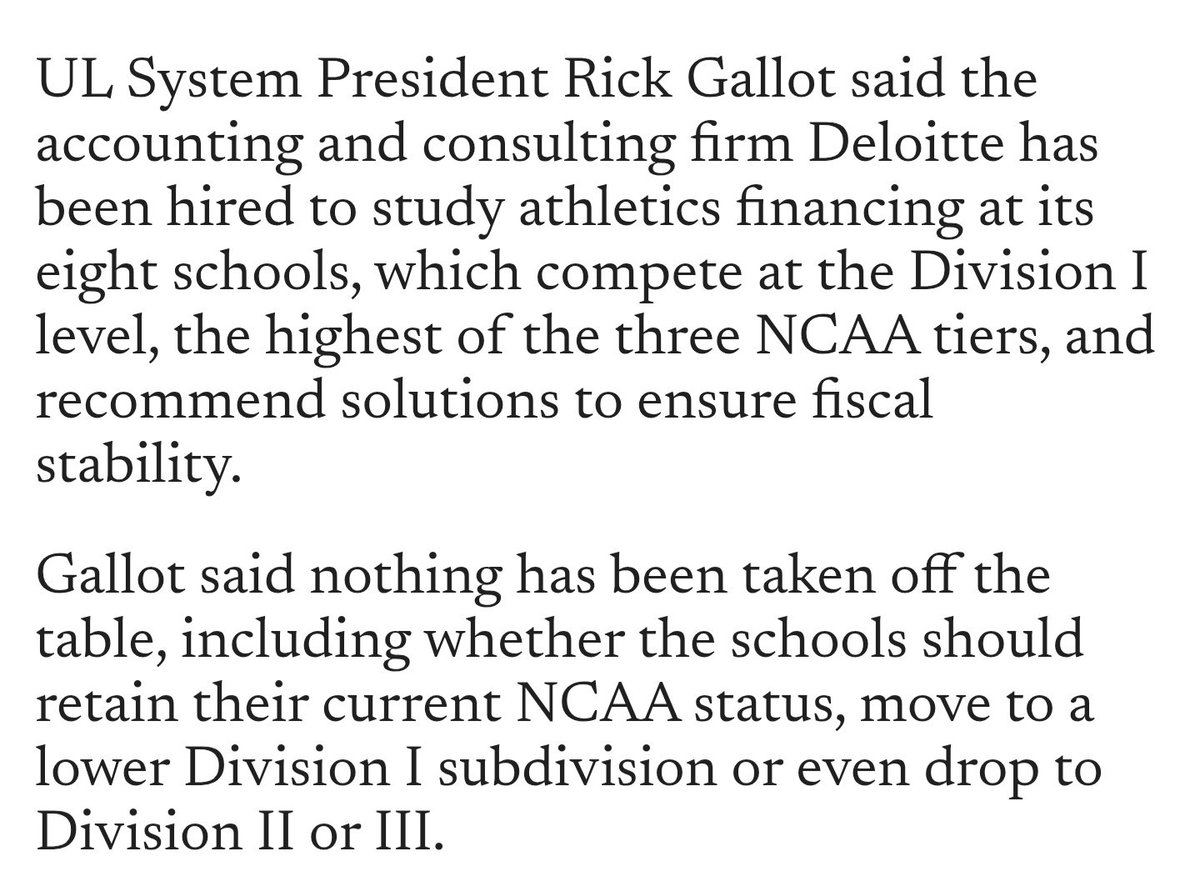
The University of Louisiana System hired a consultant to see if its member schools, like LA Tech, should leave NCAA D1 (via @ByPiperHutch)
So... Should financially struggling Athletic Depts drop to FCS or even D2 or D3??
*(literally 94% of the NCAA is financially struggling)
I don’t think those are competing questions. The public good matters….education, access and opportunity should be central.
But none of that exists sustainably without a financial model that supports it.
There are roughly 1,000 small colleges across NAIA, DII, and DIII that operate very differently than the Power 4 and mid-majors. Understanding those different economics matters if we want to preserve the public good without assuming every institution can finance it the same way.
Today is a significant day for college athletics.
As the Senate prepares to vote on the Protect College Sports Act, I keep coming back to one thing:
College athletics is not one business model.
What makes sense for the largest schools in the country may not make sense for the hundreds of small colleges where athletics drives enrollment, creates opportunity and is deeply connected to the institution’s overall health.
Whatever comes next, understanding those differences matters.
FOUR NEW MEMBERS ADDED
Welcome Christian Brothers (Tenn.), Manchester (Ind.), Salem (W. Va.), and Yavapai (Ariz.) to the NAIA!
Learn more here: https://t.co/6N6y8wgUzM
#TheRightWaytoPlay