koi dikkat nhi hai, Asia Cup mein 3 match khelo Pakistan se fir World Cup mein bhi eisa format bnao ki 2-3 Pakistan India ke match pakke ho jaaye. Koi dikkat nhi hai hme.
Prr fir ye deshbhakti ka naatak band kro aur haath bhi milao unse aur bilaterals bhi khelo. Problem iss jhuthe dhong se hai jo ye BCCI wale krte hai aur fir pith piche Asia Cup aur World Cup mein 3-3 match krwate hai!
June 6 script:
• Protest at Jantar Mantar.
• Police stop it due to lack of permission.
• Scuffle over "constitutional rights."
• Social media: "We can't even protest anymore!"
• A few detentions. Wangchuk becomes the face of the story.
• Selective clips of alleged mistreatment go viral.
• International media: "Modi government jails youth activists."
• Twitter screams dictatorship.
•German Shepherd uploads a video,India under dictator.
By the end of the day, a permissions dispute will be sold as proof that democracy in India is dead.
Dharmendra Pradhan has single-handedly sabotaged the BJP's prospect among first-time voters in the upcoming general elections. This generation has no memory of Congress's misrule and will vote on contemporary issues
PM selective silence on these issues was further disllusioning
Dharmendra Pradhan should go.
Javadekar, and Nishank were removed from the Education Ministry for far less than what has unfolded under Pradhan's tenure.
The govt should not worry about whether Congress will portray his removal as a political victory. Let them. They are irrelevant. The govt is answerable to students and parents, and they are increasingly disillusioned by repeated paper leak controversies, CBSE evaluation discrepancies, contentious UGC regulations, and a series of avoidable crises. In recent years, there has rarely been this level of public anger directed at the Education Ministry.
Pradhan's removal should be followed by an independent probe to determine whether tender rules were altered or interpreted in a manner that favoured Coempt Edutech, and whether any conflict of interest exists between the company and anyone associated with the Education Ministry. Public confidence in the education system must be restored.
Vaibhav Sooryavanshi’s bat swing has been outstanding. What’s even more remarkable is how beautifully he clears his front foot to create room for balls aimed at his legs. This freedom allows him to play the way he does.
That innings was nothing short of spectacular!
So Delhi Gymkhana Club matter gets urgent hearing in the Delhi HC tomorrow and the lawyer is Congress MP Abhishek Manu Singhvi.
Ordinary citizens wait years for hearings on real shit like jobs, houses, bail. But when rich members face losing their fancy club on prime public land, boom…. urgent slot !
Rule is simple: Money and the right senior advocate talk louder than any urgency for the common man. Gymkhana gets heard tomorrow. The rest of India keeps queuing. That’s the system.
If a system can't even conduct a national level examination like NEET without paper leak, then you can't trust them for anything else. Only solution is to keep changing the Govt if not 5 then 10 years.
10 years is a lot of time for Govt to develop an ecosystem where PM will not sack incompetent ministers because those incompetent ministers will not question PM about his own incompetency. Everyone will keep supporting other's mediocrity and keep hiding each other's blunders and pretend everything is fine while public keep suffering.
“Why are you crying about the re-exam? It’s not like you’ll forget everything you studied in a few weeks. If you are a good student, you can study again and still score well.”
Well, that’s not how things work. Competitive examinations are not merely tests of knowledge, but also tests of timing, mental conditioning, emotional stability, and peak performance achieved after months or years of disciplined preparation. Serious students structure their entire routine around one examination date, carefully managing sleep, revision cycles, stress levels, mock tests, and mental sharpness to perform at their absolute best on that particular day.
When an exam is cancelled despite their honest effort, they are forced to recreate the same level of focus and intensity again, which is mentally exhausting and usually impossible with the same efficiency.
The hardest-working students are affected the most because they invest the greatest emotional and mental energy into preparation. After the first exam, many experience burnout, fatigue, reduced concentration, emotional numbness, and loss of momentum. Even if their knowledge remains intact, their sharpness may decline during the re-exam.
Most damaging of all, paper leaks weaken a sincere student’s faith in merit itself. When students realize that even years of hard work cannot protect them from systemic failures caused by others’ dishonesty, it creates frustration, helplessness, and distrust toward institutions.
This is why a leak-proof exam is non-negotiable, the bare minimum that can be done for hard working students.
An eventful first day at Nabanna as the Chief Minister of West Bengal.
Today, we transformed promises into action. Chaired the first Cabinet Meeting and took 6 landmark decisions to reclaim the glory of our State:-
1) Ayushman Bharat: Finally, the people of West Bengal will receive the benefits of the Hon'ble PM’s flagship health care scheme.
2) Securing Borders: Ensured the immediate transfer of land to the BSF for Border Fencing, which is to be completed within 45 days.
3) Empowering Youth: As promised in the Manifesto, increased the age limit for State Government job seekers by 5 years to support those who lost precious time during the previous regime.
4) Re-established the Constitutional Modalities: Officially implemented the Bharatiya Nyaya Sanhita (BNS) and gave the green light for the Census to ensure proper representation.
5) Justice for Martyrs: Taken steps for the fulfillment of commitment towards the well-being of the 321 families who lost their loved ones while standing for democracy in West Bengal.
6) Removing obstruction for the implementation of Central Government Schemes - Paving way for smooth implementation of Central Government Schemes like PM Vishwakarma, Pradhan Mantri Fasal Bima Yojana, PM Ujjwala 3 etc...
From allocating portfolios to my esteemed colleagues Shri @DilipGhoshBJP, Smt. @paulagnimitra1, Shri @NisithPramanik, Shri Ashok Kirtania, Shri Khudiram Tudu to meeting with top Bureaucrats and Administrative Officials, the message is clear - this is a Government "Of the People, By the People, For the People," not For the Party, unlike how the previous Govt operated.
The era of 'Asol Poribortan' has begun.
Jai Hind 🇮🇳
Vijay Joseph came dressed like a saviour.
But political messiahs are rarely self-made.
The posters sold a hero of the poor.
The money trail tells a darker story.
Some are elected.
Some are installed.
A 26-month-old party suddenly built a machine.
108 seats.
70,000 booth agents.
Digital warfare.
Mega rallies.
Constituency saturation.
BJP took decades to build booth infrastructure.
TVK did it in months.
Money was flowing like monsoon water.
Estimated TVK Campaign burn rate?
~₹1,500 crore.
No declared donor trail.
No transparent funding map.
Just advertisements.
Volunteers.
Ground networks.
Everywhere.
So, I dug deeper.
One face kept appearing beside Vijay.
Every rally.
Every frame.
Every campaign trail.
Aadhav Arjuna.
TVK’s General Secretary.
The Number Two.
Aadhav is the son-in-law of Santiago Martin.
India’s Lottery King.
The same Santiago Martin.
Who became the single largest buyer of electoral bonds.
₹1,368 crore.
ED cases followed.
Money laundering allegations followed.
Assets attached.
Raids happened.
Yet the network kept expanding.
One family.
Inside multiple parties.
Winning from multiple directions.
No matter who governs…
The Martin Family is inside.
But Santiago Martin is not just a businessman.
Pope Benedict XVI personally issued,
an apostolic blessing to Martin and his family.
One of the highest symbolic honours in Catholic circles.
And then another layer appeared.
Martin also served as Consul General for Liberia.
Diplomatic access.
Diplomatic corridors.
Diplomatic insulation.
Then I moved further back.
Vijay’s father.
S. A. Chandrasekhar.
Born into a Catholic family.
From Thangachimadam.
A region shaped for centuries by missionaries.
Then came Loyola.
Vijay’s uncle Xavier Alphonse led Loyola College.
A powerful Jesuit institution.
Another uncle,
Xavier Britto,
Produced Vijay’s early films.
After TVK launched,
Loyola’s international alumni activity exploded globally.
Fundraisers.
Events.
Networking.
But Jesuit do not operate like normal organisations.
They operate across continents.
Across institutions.
Across generations.
Then came polling week.
Catholic Bishops reportedly circulated pamphlets.
Through churches.
During Sunday Mass.
The messaging was clear.
Vote strategically against BJP.
Then came the TVK poll promise.
SC reservation for Dalit Christians.
Now pause there.
Because this is where ideology meets economics.
Government jobs.
Scholarships.
Reservation benefits.
Attached to religious identity.
That changes the conversion equation permanently.
And Delhi knows this.
IB knows this.
RAW knows this.
The real question is whether anyone wants to confront it openly.
Because Tamil Nadu is not just another state.
It was always a centre of Catholic Missionaries.
And now a new power structure stands there.
Unexplained money.
Transnational Lottery empire.
Generational and Powerful Jesuits influence.
This is not a rags-to-riches political story.
This feels far more organised than that.
👑 QUEEN SLAYER - THE RISE OF SUVENDU ADHIKARI
The Man Who Dismantled Mamata Banerjee’s Political Empire - Brick by Brick
A Deep Strategic Analysis
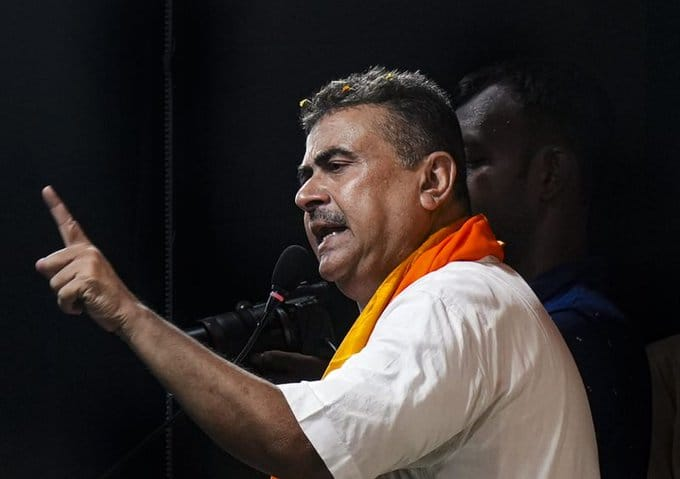
On the morning of May 4, 2026, counting trends from 293 counting halls across West Bengal confirmed a decisive political shift. At the centre of it stood Suvendu Adhikari - the organisational architect of BJP’s breakthrough and the principal force behind the end of a 15-year political dominance.
By May 9, 2026, he was set to take oath as the 9th Chief Minister of West Bengal, becoming the first BJP leader to hold the office in the state’s history.
This is the story of how that transformation was engineered - not suddenly, but structurally, over nearly two decades.
📌 CHAPTER I: THE ROOTS - KARKULI TO POLITICAL ENTRY
Suvendu Adhikari was born on December 15, 1970, in Karkuli village of Purba Medinipur - a politically active coastal belt of Bengal.
He emerged from a powerful political family rooted in district-level influence. His early political exposure came not through urban institutions but through grassroots mobilisation networks that shaped his understanding of mass politics.
He began his political career in 1995 as a Congress councillor in Kanthi Municipality before joining the Trinamool Congress in 1998.
By 2006, he entered the West Bengal Legislative Assembly. His 2009 victory in Tamluk against CPI(M) leader Lakshman Seth by over 1.72 lakh votes marked his emergence as a major political force in South Bengal.
From the beginning, his strength was not ideology alone - but organisational depth at the booth and village level.
📌 CHAPTER II: NANDIGRAM 2007 - THE MOVEMENT THAT DEFINED HIM
Nandigram became the defining moment of Suvendu Adhikari’s political identity.
The 2007 anti-land acquisition movement against the proposed chemical hub triggered mass resistance across rural Bengal. As a key organiser of the Bhumi Uchhed Pratirodh Committee, Suvendu Adhikari played a central role in mobilising local resistance networks.
The police firing incident and subsequent violence transformed Nandigram into a statewide political turning point.
Together with Singur, the movement contributed directly to the collapse of the Left Front regime and the rise of Mamata Banerjee in 2011.
The political paradox was established early: the same organisational machinery that enabled Mamata Banerjee’s rise would later become central to her political decline.
📌 CHAPTER III: THE TMC YEARS - ORGANISATIONAL ARCHITECT OF SOUTH BENGAL
Within the Trinamool Congress, Suvendu Adhikari emerged as the party’s most effective field operator in South Bengal.
He expanded TMC’s reach across Purba Medinipur, Paschim Medinipur, Bankura, and Purulia - establishing a district-level control system rooted in personal trust networks.
As Transport Minister and later Irrigation Minister, he combined administrative authority with ground-level influence.
By 2018, he was functionally the second most powerful figure in TMC - not by designation, but by organisational control over electoral execution in South Bengal.
District mobilisation, booth management, and election coordination in key regions flowed through his network.
📌 CHAPTER IV: THE BREAK - STRUCTURAL CONFLICT WITHIN TMC
The internal balance of power began shifting after 2019, when Abhishek Banerjee was increasingly positioned as the central organisational authority within TMC.
This transition gradually altered the party’s decision-making structure - from field-based seniority to family-centred leadership consolidation.
The conflict was not personal in origin, but structural in outcome.
Two political models came into confrontation:
Grassroots legitimacy: built over decades of ground mobilisation
Dynastic legitimacy: based on proximity to leadership family structure
For Suvendu Adhikari, this shift represented a fundamental reversal of the organisational principles that had built TMC’s electoral success in South Bengal.
Over time, district-level control mechanisms began bypassing senior field leaders. Candidate selection, administrative coordination, and political appointments increasingly reflected a centralised inner-circle structure.
The result was a slow but irreversible organisational rupture.
📌 CHAPTER V: THE DEFECTION - DECEMBER 2020
On December 19, 2020, Suvendu Adhikari formally joined the Bharatiya Janata Party in the presence of Union Home Minister Amit Shah.
This was not a symbolic defection. It was an organisational transfer.
Entire booth-level networks across Purba Medinipur, built over decades, shifted allegiance with him. BJP, for the first time, gained a structured grassroots presence in South Bengal rather than relying solely on national wave politics.
This marked the beginning of a credible two-party contest in Bengal.
📌 CHAPTER VI: NANDIGRAM 2021 - THE TURNING OF POWER
The 2021 Assembly elections became a direct confrontation between Suvendu Adhikari and Mamata Banerjee.
In Nandigram, Suvendu defeated the sitting Chief Minister by 1,956 votes.
The numerical margin was narrow, but the political consequence was historic. A sitting Chief Minister had been defeated in a constituency of her choosing.
This single result altered the psychological structure of Bengal politics - establishing electoral vulnerability at the highest level of state leadership.
Following this, Suvendu Adhikari was appointed Leader of Opposition in the West Bengal Assembly.
📌 CHAPTER VII: THE OPPOSITION YEARS - BUILDING ELECTORAL STRUCTURE (2021–2026)
Between 2021 and 2026, Suvendu Adhikari consolidated BJP’s opposition framework in West Bengal.
Key interventions during this period included:
Sandeshkhali crisis escalation: bringing national attention and legal action to reported violence cases
CAA outreach operations: especially across Matua and Namasudra regions, converting policy into ground-level mobilisation
Electoral vigilance campaigns: documenting strongroom incidents and raising institutional complaints
Anti-infiltration narrative consolidation: maintaining demographic and border integrity discourse across rural Bengal
These interventions ensured BJP remained organisationally active despite being in opposition.
📌 CHAPTER VIII: 2026 ELECTIONS - THE DOUBLE MANDATE
The 2026 elections marked a decisive political transition.
Suvendu Adhikari contested from both Nandigram and Bhabanipur and won both seats.
In Bhabanipur, he defeated Mamata Banerjee by over 15,000 votes - a symbolic and structural collapse of her strongest urban constituency.
This result reflected a deeper electoral shift already visible in previous cycles, particularly in Kolkata’s urban voter base.
The mandate confirmed a full-scale political transition in the state.
📌 CHAPTER IX: THE GOVERNANCE PHASE
The incoming administration begins its tenure with a high voter turnout of 92.47%, the highest in post-Independence West Bengal.
The governance direction is expected to focus on:
Citizenship resolution frameworks under CAA implementation
Institutional investigation into corruption cases across previous regimes
Border security enforcement and documentation reform
Administrative restructuring of state governance systems
This phase represents a shift from long-term political continuity to systemic reconfiguration.
📌 THE VERDICT: ONE MAN, ONE DECADE, ONE HISTORIC ARC
From a small village in Purba Medinipur to the Chief Minister's chair - Suvendu Adhikari's journey reflects the power of grassroots politics, the courage to make bold decisions at historic junctures, and an unshakeable connect with the common people of Bengal.
Mamata Banerjee's greatest political mistake was not her welfare failures, her governance record on Hindu safety, or her open-border policy. Her greatest political mistake was a human one. She looked at the most capable political soldier she had - a man who had built her empire with his own hands - and chose to replace him with her nephew.
She chose blood over merit. Dynasty over democracy. Inheritance over grassroots.
And Suvendu Adhikari - true to the only model of politics he has ever known - went to the ground, earned it back, and returned to take everything she had.
Mamata Banerjee built her empire by mobilising people against injustice. Suvendu Adhikari dismantled it using the same method - standing with people facing injustice, whether in Nandigram in 2007, in Sandeshkhali in 2024, or in the 303 families who fled Bengal after the 2021 post-poll violence.
The wheel came full circle on May 4, 2026. The man Mamata sidelined for her nephew took her throne. In Bhabanipur. By 15,000 votes.
That is not just politics. That is Bengal's history being written in real time.
And the lesson it writes for every political dynasty in India is permanent: you can sideline merit for blood once. But the ground never forgets.
🚨When Mamata Banerjee Chose Her Nephew Over Her General and Lost Bengal
A Deep Analysis
There is a moment in every political story where the defining mistake is made. Not on the battlefield. Not in the ballot box. In the room, when a leader decides who they trust more: the person who earned it, or the person who shares their blood.
For Mamata Banerjee, that moment came after 2011. She had just ended 34 years of Left Front rule. And among the architects of that victory stood one man above almost all others, Suvendu Adhikari, the field commander of Nandigram and the organiser who turned anti Left anger into a political revolution.
Instead of consolidating him, she began building her succession plan around her nephew, Abhishek Banerjee.
↪️ What He Built For Her Before She Took It Away
Before the sidelining, there was the service. And it was extraordinary.
Trained in RSS shakhas during his formative years and baptised in electoral politics in 1995, Suvendu Adhikari joined the TMC with his father Sisir Adhikari barely a year after it was formed. From that point, he became Mamata's most dependable field general, not in title, but in consequence.
• 2006 to 2007, Singur and Nandigram: Suvendu played a crucial role in the historic Nandigram anti land acquisition movement, which became the turning point in West Bengal politics and contributed significantly to the TMC's rise to power in 2011. When the Left Front government ordered police firing on protesting farmers, it was Suvendu on the ground, organising resistance, mobilising communities, and turning Nandigram into the Left's political graveyard. Mamata got the credit. He did the work.
• 2009, Tamluk Lok Sabha: He defeated CPI(M) strongman Lakshman Seth from Tamluk by a staggering margin of over 1.72 lakh votes. Seth was the central figure in the Nandigram violence. The victory was a political statement that announced the TMC's south Bengal dominance.
• 2011, The Historic Victory: The TMC won 184 seats and ended the Left's 34 year rule. Suvendu's ground network across Purba Medinipur, Paschim Medinipur, and the coastal belt was instrumental in delivering seats that the party could not have won through Mamata's urban charisma alone. He was the machine behind the movement.
• 2014, Lok Sabha retained: Re elected from Tamluk. TMC maintained its Bengal dominance while the Modi wave swept the rest of India. The south Bengal firewall held, in significant part, because of the ground networks Suvendu had built.
• 2016, Cabinet induction: He was given the Transport portfolio and later the Irrigation and Water Resources portfolio. He was made TMC observer in Malda and Murshidabad and assigned the task of breaking Congress in its two strongholds. He successfully poached elected representatives of the grand old party. He delivered territory that had never belonged to TMC.
This is the record of the man she chose to sideline.
↪️ The Timeline of a Systematic Sidelining
• 2011: Abhishek Banerjee, then 24, was named president of All India Trinamool Yuva, a parallel youth organisation created alongside the TMC Youth Congress that Suvendu led. The party constitution had no place for two youth wings. Suvendu was furious:
"It was done just to keep me in check. Where was the nephew when Nandigram was burning? I was there fighting alone."
• 2014: Suvendu was removed as TMC Youth Congress president. Months later, TMC Yuva was merged with the Youth Congress, absorbing the structure he had built into Abhishek's institutional control.
• 2016: Sensing that Suvendu was in talks with the Congress to switch parties, Mamata brought him back, giving him three cabinet portfolios and making him TMC observer in Malda and Murshidabad, with the task of breaking Congress strongholds there.
He delivered. He poached Congress representatives across both districts. He strengthened the party.
He was used.
• 2019: After TMC's Lok Sabha setback, the observer posts were abolished, including the specific organisational role Suvendu held across north Bengal.
Gone. No replacement. No acknowledgment.
His institutional authority had been removed one piece at a time, each time after he had delivered on the assignment that required it.
• December 19, 2020: Suvendu Adhikari joined the BJP at a rally addressed by Amit Shah. He later described the TMC as a "private limited company", a diagnosis, not an attack.
↪️ What Left With Him
When Suvendu walked, he did not walk alone.
He took the south Bengal machine with him, the booth networks, the panchayat contacts, the district loyalty chains built across Purba Medinipur over decades, and operational ecosystems that no data consultancy or election war room can manufacture.
The BJP swept all 16 Assembly seats in Purba Medinipur in 2026. TMC won zero.
In 2021, they had shared the district.
That swing is not ideology. That is a personal loyalty network changing sides.
↪️ The Final Accounting
In 2026, Suvendu Adhikari defeated Mamata Banerjee in Bhabanipur by 15,105 votes and retained Nandigram by 9,665 votes, up from his 2021 margin of just 1,956.
Today, he took oath as the 9th Chief Minister of West Bengal, the first BJP Chief Minister in the state's history.
The collapse of TMC's dominance in 2026 cannot be understood only through BJP expansion or anti incumbency. A major structural reason was that the political machinery which once made Mamata Banerjee unbeatable had, over nine years of deliberate marginalisation, shifted against her.
The irony is extraordinary.
Mamata Banerjee spent a decade building Abhishek Banerjee's path to power. During those same years, she was building Suvendu Adhikari's motivation to destroy the empire he once helped create.
She sidelined the man who stood in Nandigram when Bengal's future was being decided in the streets, and elevated a successor whose primary qualification was proximity to the throne.
The man Mamata deployed to break Congress strongholds in Malda and Murshidabad, then stripped of that role once the task was done, broke her own stronghold in Bhabanipur five years later.
She created the instrument of her own defeat. She sharpened it. She handed it motive.
Dynasty over merit has a cost.
In Bengal, 2026 was the bill coming due.
A historic dawn for West Bengal indeed.
It is a moment of profound pride and jubilation to welcome Visionary Leader Hon’ble PM Shri @narendramodi Ji to the City of Joy.
Today, as we witness the Swearing-in-Ceremony of the first-ever BJP Government in West Bengal since Independence, we fulfill the dreams of our founding fathers. Today marks the end of decades of misrule and the beginning of a 'Double Engine' era of development, peace, and prosperity.
The era of 'Sonar Bangla' officially begins.
Welcome, Pradhan Mantri Ji 🙏
সাহসী বিজেপি কার্যকর্তাদের প্রতি বিনম্র শ্রদ্ধাঞ্জলি!
আজ কলকাতায় প্রথম বিজেপি সরকার গঠনের ঐতিহাসিক মুহূর্তে ব্রিগেড প্যারেড গ্রাউন্ডের উৎসবমুখর পরিবেশেও আমরা সেই সমস্ত বিজেপি কার্যকর্তাদের কথা স্মরণ করেছি, যারা নিজেদের আদর্শ রক্ষায় প্রাণ বিসর্জন দিয়েছেন।
তাঁদের এই আত্মত্যাগ দলের অগ্রযাত্রায় চিরস্মরণীয় । তাঁদের সাহস আমাদের সকলের কাছে শক্তির উৎস হয়ে থাকবে।
@BJP4Bengal
Congratulations to Shri Suvendu Adhikari Ji on taking oath as West Bengal’s Chief Minister. He has made a mark as a leader who has remained deeply connected to the people and understood their aspirations from close quarters. My best wishes to him for a fruitful tenure ahead.
@SuvenduWB
Salary taxation is one of the strangest systems we’ve normalized.
Employees are taxed on income before they can deduct the real cost of earning that income.
But businesses are taxed only after expenses are deducted, on what remains as profit.
Imagine if companies were taxed the way salaried people are: Not on profits, but directly on total revenue, Most of us would call it unsustainable.
Yet for millions of employees, that’s considered completely normal.
MK Stalin is 73 years old. He will be 78 when the next Tamil Nadu elections are held in 2031. Suffice to say, he will probably not be CM ever again.
Pinarayi Vijayan is 80. Will be 85 in 2031. Even if the Left continues to be a dominant political force in Kerala (it has been declining precipitously in India), he will probably not be CM again.
They join a long list of stalwarts of South Indian politicians who have probably served their last day in the CM's office, or are serving their term and will find it hard to get re-elected.
- KCR (K Chandrashekar Rao) : He is 72. He will be 75 come the next Telangana elections. Even if BRS manages to win that election, expect him to groom KTR to take over the reins very soon into his term.
- N Chandrababu Naidu : He is 76. Will be 79 during the next state elections. Even if TDP wins, will be very hard for him to serve the full 5 years from 79-84 years of age. Expect him to hand over the reins to Nara Lokesh in the next term.
- BS Yeddyurappa : He is 83. BJP will go gung-ho to win the 2028 elections in Karnataka come what may, but they are not going to back an 85 year old as CM face. He has had his fair share of conflicts with the BJP high command, so expect him to be pushed to the sidelines as well.
- Siddaramaiah: He is 77, going to be 80 by the time of the next elections. DK Shivkumar is dying to be CM of Karnataka, and he would have been had it not been for the Congress high command. He is also going to be "sunsetted" by the time the next elections arrive.
- EPS (Edappadi K. Palaniswami) - He is 72. He is not going to become CM this time. Vijay will never align with the BJP-AIAIDMK alliance. He will be 77 by the time the next elections take place in 2031. Surely the AIADMK dispensation would want a fresher, younger face to lead the alliance the next time.
We are entering unprecedented territory - several stalwarts of south indian politics who have defined the politics for decades, if not generations will go into the twilight around the same time. "Chaos is not a pit, it's a ladder" said one Petyr Bailish on Game of Thrones not so long ago. This is probably the time when we will see fresh faces emerge, unexpected political events happen, and see younger, talented politicians make hay when the sun shines. We've already seen a massive turnaround in Tamil Nadu with Vijay's superstar showcase. Expect to see even more of that in the coming few years.
With the blessings of the people of Assam, 102 NDA candidates have emerged victorious in the #AssamElections2026.
I extend my warm congratulations to each and every candidate who has won today. Together, as Team Assam, we will work towards realising the goal of a Viksit Assam.