848.22k requests within a month on my application without spending on marketing.
The simple thing I did is better SEO, great application services, AI SEO, etc
One rule:
The amount of data about your application is on Internet is proportional to your growth and better SEO
Never lose an action item again: build an AI meeting-to-tasks workflow
Every team has the same problem
The meeting goes well, everyone agrees on next steps…..and a week later nobody remembers who was supposed to do what
Notes get written late, tasks never get created, and follow-ups get missed
AI can turn every meeting into clear tasks automatically, and it's easy to set up
Here's the workflow
Step 1: Capture Record the meeting or use the transcript from Zoom, Meet or Teams
Step 2: Extract Send the transcript to an LLM and ask for structured JSON: decisions made, action items, owner, deadline and open questions
Step 3: Check Add a rule that anything without a clear owner or date gets flagged instead of guessed
Step 4: Create tasks Push each action item into Jira, Notion, Trello or Asana with the owner and due date filled in
Step 5: Share Post a short summary to the team's Slack channel, so everyone sees the same thing
Step 6: Human confirms The meeting owner takes 30 seconds to review before anything goes live
Step 7: Follow up A scheduled reminder pings owners before the deadline
Why this works
Developers can build it with a transcript API, an LLM call and a few
Managers and industry teams get meeting notes and tasks in minutes without anyone typing them up
And the "flag, don't guess" rule is what keeps the data trustworthy
Three tips before you build it
1. Tell the AI to only extract what was actually said, never invent owners or dates
2. Test it on 5 old meetings first and compare against what really happened
3. Get consent before recording, since privacy rules for meeting recordings vary by country and company
Start with ONE recurring meeting, like your weekly standup, then expand
What's one meeting your team has that never produces anything? Drop it below 👇
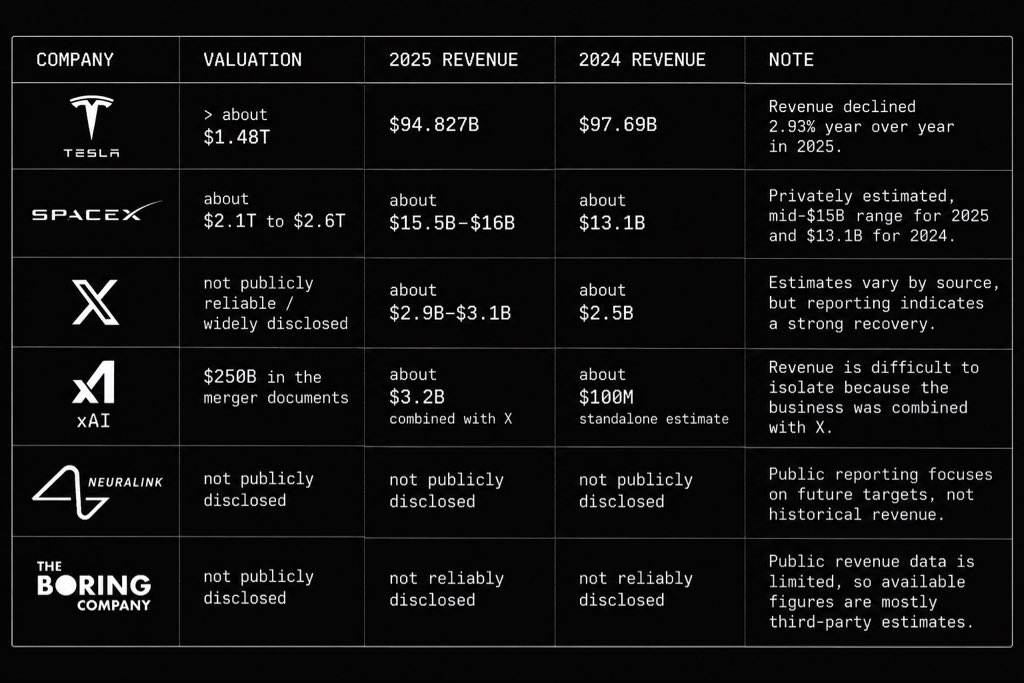
For those who were asking for Elon Musk companies and their revenues👇🏻
Tesla
Valuation > about $1.48T
2025 > $94.827B
2024 > $97.69B
Notes: Annual revenue declined 2.93% year over year in 2025, according to Tesla’s FY2025 filing and market data
SpaceX
Valuation > about $2.1T to $2.6T
2025 > about $15.5B–$16B
2024 > about $13.1B
Notes: Revenue is privately estimated, with Reuters and Sacra both citing the mid-$15B range for 2025 and $13.1B for 2024.
X
Valuation > not publicly reliable / widely disclosed
2025 > about $2.9B–$3.1B
2024 > about $2.5B
Notes: Revenue estimates vary by source, but reporting indicates a strong recovery after the acquisition period.
xAI
Valuation > $250B in the merger documents
2025 > about $3.2B combined with X
2024 > about $100M standalone estimate
Notes: xAI’s revenue is difficult to isolate because the business was reorganized and combined with X.
Neuralink
Valuation > not publicly disclosed
2025 > not publicly disclosed
2024 > not publicly disclosed
Notes: Public reporting focuses on future targets, not historical revenue.
The Boring Company
Valuation > not publicly disclosed
2025 > not reliably disclosed
2024 > not reliably disclosed
Notes: Public revenue data is limited, so available figures are mostly third-party estimates.
Stop reading every email yourself: build an AI triage workflow in an afternoon
Most teams lose hours every week just sorting messages
Support emails, sales enquiries, bug reports, vendor invoices…..someone has to read each one, decide what it is and send it to the right person
AI can do that sorting for you, and you don't need a big engineering project to set it up
Here's the workflow
Step 1: Trigger A new email, form or ticket arrives and kicks off the workflow (n8n, Zapier or Make all work)
Step 2: Extract Send the text to an LLM with one job: return clean JSON with category, urgency, customer name and a one-line summary
Step 3: Route Billing goes to finance, bugs go to the dev channel, hot leads go to sales, and urgent ones ping someone on Slack
Step 4: Draft The AI writes a suggested reply using your own FAQs or docs
Step 5: Human approves A person checks the draft and hits send
Step 6: Log Everything lands in a sheet or database, so you can see patterns later
Why this works
Developers get a simple pipeline they can extend with their own APIs
Industry folks get faster responses without hiring another person to sort inboxes
And the human still makes the final call…..that's what keeps it safe
Three tips before you build it
1. Force structured JSON output and validate it, so a weird answer doesn't break your workflow
2. Test on 50 old messages first and check where it gets things wrong
3. Keep approval ON for anything customer-facing until you trust it
Start small, with ONE inbox and ONE category, then expand
What's the most boring task your team does every day? Drop it below and I'll tell you how I'd automate it 👇
@elonmusk "Those who are too smart to engage in politics are punished by being governed by those who are dumber."
- Greek Philosopher Plato
Now majority people have already turned against you.
but this was the bad move IG
Starlink isn't just a "nice to have" internet service
In the countries where it's already live, it's changing how people learn, farm, work and even get medical help
Here's what it looks like on the ground
In the Bahamas, Starlink is helping 40,000 students across several islands get reliable internet
That's a whole generation of kids who can learn online without worrying about the connection
In Ghana, more than 22,000 students in Volta and Eastern Ghana are now connected
Schools that were stuck offline can finally use the digital tools the rest of the world takes for granted
In the Philippines, it's keeping an air ambulance connected across remote islands
When every minute matters, that connection becomes emergency communication and healthcare logistics
In Mexico, a rancher in Sonora uses Starlink to keep a large rural ranch connected
In Brazil, a farmer in the countryside of São Paulo finally solved a long-standing internet problem in his area
Farms and ranches are businesses too…..and they need internet to run like one
In Kenya, people in rural areas are using Starlink for work and daily connectivity where regular broadband is weak or missing
In Canada, users in remote northern areas like Iqaluit rely on it even during long outdoor expeditions
And across Pacific island markets, where building and maintaining cables and towers is incredibly hard, Starlink is widely used because it doesn't need that infrastructure
Different countries, same story
Schools, hospitals, farms and remote communities getting connected where traditional networks struggle to reach
That's what real impact looks like
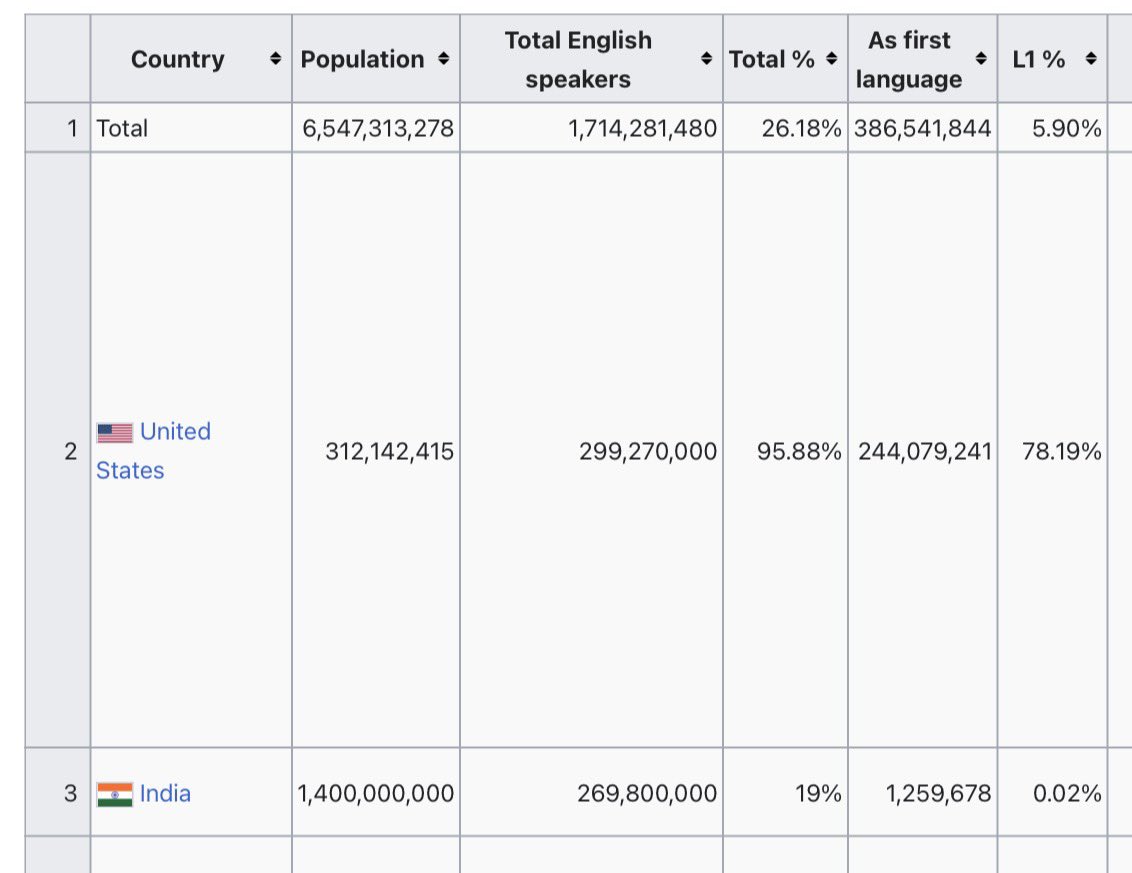
India is the second largest English speaking country after United States
And English is the language of the world
According to engineering principles, my pov, why to have much overhead to speak multiple languages, just use which is being used by majority
In short, I wanna say why to waste our brain compute, when we can use it on different task
Most companies still use AI like a chatbot…..you ask, it answers, and then YOU do the work
Grok Bot is built for something different
It's xAI's team of always-on agents, each with a computer of its own, working inside tools and apps like a person would
And they keep working 24/7, even when you're offline
Here's what that looks like for a company
You give it real work, not questions
xAI says its own teams built Bots for sales outbound, marketing campaigns, office operations, bug fixes and more before opening it to everyone
You can run a whole team of Bots
One chief-of-staff Bot can sit on top with a specialist for each lane, like inbox, expenses, recruiting, bug fixes or operations
They work in parallel, so you're not the middleman passing tasks around
You can teach it a workflow once
A Bot can watch you do a job, keep the steps as a routine, and rerun the same process on its own
No code, no complicated setup
The human stays in charge
Bots finish jobs end to end and only come back to you when a step needs your approval
So the boring repeat work gets handled…..and your team gets time back for the work that needs real judgement
Most companies still use AI like a chatbot…..you ask, it answers, and then YOU do the work
Grok Bot is built for something different
It's xAI's team of always-on agents, each with a computer of its own, working inside tools and apps like a person would
And they keep working 24/7, even when you're offline
Here's what that looks like for a company
You give it real work, not questions
xAI says its own teams built Bots for sales outbound, marketing campaigns, office operations, bug fixes and more before opening it to everyone
You can run a whole team of Bots
One chief-of-staff Bot can sit on top with a specialist for each lane, like inbox, expenses, recruiting, bug fixes or operations
They work in parallel, so you're not the middleman passing tasks around
You can teach it a workflow once
A Bot can watch you do a job, keep the steps as a routine, and rerun the same process on its own
No code, no complicated setup
The human stays in charge
Bots finish jobs end to end and only come back to you when a step needs your approval
So the boring repeat work gets handled…..and your team gets time back for the work that needs real judgement
@pratiksharda2 Starlink says secure boot still protects against remote attacks, and they welcome researchers finding this stuff
that's why the encrypted link and HTTPS/VPN sit on top
If you're wondering whether your data is safe on Starlink, here's what's actually behind it
Starlink encrypts the traffic between your dish and the satellite, so your connection isn't just floating through the sky in the open
The dish itself is built with security from the start
It uses secure boot and signed software updates, which makes it very hard for anyone to tamper with the device or push fake updates to it
Your privacy is protected too
The dish knows exactly where it is, but the satellite only needs to know which cell you're in, so your precise location isn't shared
Starlink also keeps dishes separated on its control network, so one compromised terminal has no reason to talk to anyone else's
And Starlink actively invites security researchers to find bugs and report them…..that's what a company that takes security seriously does
Encryption, secure hardware, limited location sharing and open testing all working together
SpaceX cleared for a massive Starlink Mobile buildout — FCC just approved up to 15,000 next‑gen satellites designed for direct-to-phone service.
What this means:
Direct satellite connections from ordinary cell phones, no special hardware required.
Peak speeds targeted around 150 Mbps per user.
Constellation will operate in very low Earth orbit (~326–335 km).
Uses a blend of spectrum: T‑Mobile’s bands plus frequencies SpaceX is acquiring from EchoStar.
Far greater capacity than the initial Starlink Mobile satellites.
Current footprint and regulatory change:
SpaceX already has roughly 650 mobile-focused satellites on orbit.
The FCC granted a waiver allowing SpaceX to provide satellite wireless service without a formal spectrum-lease from a terrestrial operator.
This shifts Starlink Mobile from “dead‑zone lifeline” to an ambition for a space‑based 5G cellular network.
Sam Altman called Elon Musk “not nice” when asked about him—but before judging Elon by one personal remark, remember how much he did for OpenAI.
Co-founded OpenAI in 2015.
Helped choose the name “OpenAI.”
Contributed approximately $50 million in early funding, according to Musk.
Helped recruit Ilya Sutskever, one of the world’s leading deep-learning researchers.
Helped bring together key founders and early researchers, including Sam Altman, Greg Brockman, and Wojciech Zaremba.
Supported the creation of OpenAI as a nonprofit AI research organization.
Served as an early board member.
Helped establish OpenAI’s original focus on AI safety and benefiting humanity.
Used his reputation and network to attract researchers, donors, and public attention.
Helped position OpenAI as an independent counterweight to major AI labs such as Google DeepMind.
Still such words from @OpenAI CEO….
Sam Altman was asked to describe several influential people with the first words that came to mind.
Donald Trump: “Powerful.”
Ilya Sutskever: “Brilliant… warm… wonderful.”
Bernie Sanders: “Consistent.”
Elon Musk: “Not nice.”
That final answer says more about the rivalry than it does about Elon.
Elon Musk has never tried to win everyone’s approval. He challenges industries, confronts powerful institutions, takes enormous risks, and says what others are often afraid to say.
Being “nice” is not the same as being right.
History rarely remembers the people who played it safe or tried to please everyone. It remembers the builders, the disruptors, and the people willing to stand alone.
Elon may be controversial—but he is undeniably one of the most consequential people shaping technology, space, AI, and the future of humanity.
“Not nice” is a short opinion.
His impact is the real answer. 🚀⚡
Sam Altman was asked to describe several influential people with the first words that came to mind.
Donald Trump: “Powerful.”
Ilya Sutskever: “Brilliant… warm… wonderful.”
Bernie Sanders: “Consistent.”
Elon Musk: “Not nice.”
That final answer says more about the rivalry than it does about Elon.
Elon Musk has never tried to win everyone’s approval. He challenges industries, confronts powerful institutions, takes enormous risks, and says what others are often afraid to say.
Being “nice” is not the same as being right.
History rarely remembers the people who played it safe or tried to please everyone. It remembers the builders, the disruptors, and the people willing to stand alone.
Elon may be controversial—but he is undeniably one of the most consequential people shaping technology, space, AI, and the future of humanity.
“Not nice” is a short opinion.
His impact is the real answer. 🚀⚡