The Hitler–Stalin Pact: The Deal That Cleared the Way for War
Eighty-seven years ago today, Nazi Germany and the Soviet Union signed an agreement that cleared the way for the Second World War. Yet the Hitler–Stalin Pact still occupies surprisingly little space in Europe’s collective memory. It remains a stark symbol of the destructive power of totalitarian rule and offers an important lesson for the present: despite their ideological differences, totalitarian regimes tend to co-operate against free societies and sovereign states.
On August 23rd 1939 Joachim von Ribbentrop, Hitler’s foreign minister, and Vyacheslav Molotov, his Soviet counterpart, signed a non-aggression pact in Moscow, under Stalin’s watchful eye. Its bland public language concealed a secret protocol dividing much of central and eastern Europe into German and Soviet spheres of influence. For Poland, it amounted to a fourth partition.
The pact cleared the way for Hitler’s invasion of Poland from the west on September 1st. On September 17th the Soviet Union invaded from the east. This was no mere neutrality agreement, as Russian propaganda still likes to claim, but the political framework for the destruction and occupation of a sovereign state.
German–Soviet co-operation continued until Hitler turned on Stalin on June 22nd 1941. Soviet grain, oil and metals helped Germany withstand the British blockade and sustain its early military campaigns; deliveries continued until shortly before the invasion of the Soviet Union. In return, Germany supplied machinery, industrial technology and military equipment.
The relationship extended beyond diplomacy and trade. German and Soviet security officials met to discuss prisoner exchanges, population transfers and the suppression of Polish resistance. On September 22nd 1939 German and Soviet commanders appeared together at a military ceremony in Brest-Litovsk. The footage accompanying this post offers a stark image of the partnership: the Wehrmacht and the Red Army standing side by side after the defeat of Poland.
The published pact was barely 300 words long. For ten years, the two powers promised to refrain from “any act of violence, any aggressive action, and any attack on each other”. The real substance lay in its secret protocol. Poland was divided between them; Finland, the Baltic states and Bessarabia were assigned to their respective spheres of influence.
The arrangement was revised after Poland’s defeat in the German–Soviet Boundary and Friendship Treaty of September 28th 1939. Germany gained additional territory in central Poland, while Lithuania was transferred to the Soviet sphere. The Soviet occupation and eventual annexation of the Baltic states followed, as did the attack on Finland and the seizure of Bessarabia.
A policy of sweeping repression was quickly imposed in the occupied territories. Deportations, arbitrary arrests and mass executions were among its instruments. The Nazi German occupiers committed grave crimes against the Polish population, particularly Jews and members of the country’s social elites. In the spring of 1940 the Soviet NKVD murdered thousands of Polish officers and members of those elites; Katyn became the best-known site of this crime. These atrocities laid bare the brutality of both occupying powers.
The partnership also required some abrupt adjustments to historical truth. “Who controls the past controls the future,” George Orwell later wrote. A Bavarian schoolteacher reportedly captured the absurdity of the new German line: “Now one has to be rather careful at school. Suddenly you read something aloud from Hitler’s book Mein Kampf, and then you end up in Dachau for disparaging the present government.”
After Germany invaded the Soviet Union, Moscow performed its own reversal. References to the preceding co-operation disappeared from Soviet books, newspapers and encyclopaedias. The Soviet authorities denied the existence of the secret protocol until 1989.
The pact still occupies a curiously modest place in western Europe’s historical memory, particularly in Germany. German remembrance rightly centres on responsibility for National Socialism and the Holocaust. But this has sometimes fostered the suspicion that greater attention to Soviet crimes and German–Soviet co-operation might dilute that responsibility. It does not. The experience of central and eastern Europe cannot be understood without both.
In 2009 the European Parliament designated August 23rd as the European Day of Remembrance for Victims of Stalinism and Nazism. This was an important step. But the pact and its consequences still need to become more firmly embedded in Europe’s collective memory.
Roger Moorhouse, a British historian, found an apt name for the arrangement: "The Devils’ Alliance" is the title of his important book.
My, Polacy, wiemy, co znaczy płacić najwyższą cenę za niepodległość. Wiemy, co znaczą słowa „Za wolność waszą i naszą”. I dlatego Naród Polski jest dziś, w Dniu Niepodległości Ukrainy, całym sercem z walczącym Narodem Ukraińskim.🇵🇱❤️🇺🇦
Here's an extract from my new book Betrayal, about how Russian spies infiltrated Nigel Farage's party. It tells the inside story of Nathan Gill, a former UKIP MEP, now in jail, who accepted £££ in bribes to make pro-Russian speeches. Thanks @thenerve_news https://t.co/f0WLTiGaTR
No puedo apoyar más a nadie que a José Andrés.
( @chefjoseandres )Desde los primeros días de la invasión rusa de Ucrania, este hombre se está dejando la piel para llevar un plato de comida allí donde hace falta, incluso cuando hacerlo significa acercarse a los lugares más castigados por la guerra. Y no lo digo porque me lo hayan contado: he sido testigo de su trabajo en numerosos puntos de la geografía ucraniana. Mientras otros hablan de solidaridad, José Andrés y su gente llevan años practicándola sobre el terreno. Eso merece todo mi respeto y mi apoyo.
¡La guerra continúa y él sigue ahí!!!
Fotos en kherson, Kramatorsk, Irpin y Kiev
You can see the exact moment that Reform politician Laila Cunningham realises that she's going to spend the next few years defending a policy that will hurt vulnerable people
🚨 Nigel Farage wins Clacton with 62.8%.
Sounds enormous until you look at the votes.
2024: 21,225 Farage votes
2026: 22,239 Farage votes
Just 1,014 extra votes, despite Labour, Conservatives and Lib Dems not even standing.
Meanwhile 9,455 people voted for a man dressed as a bin.
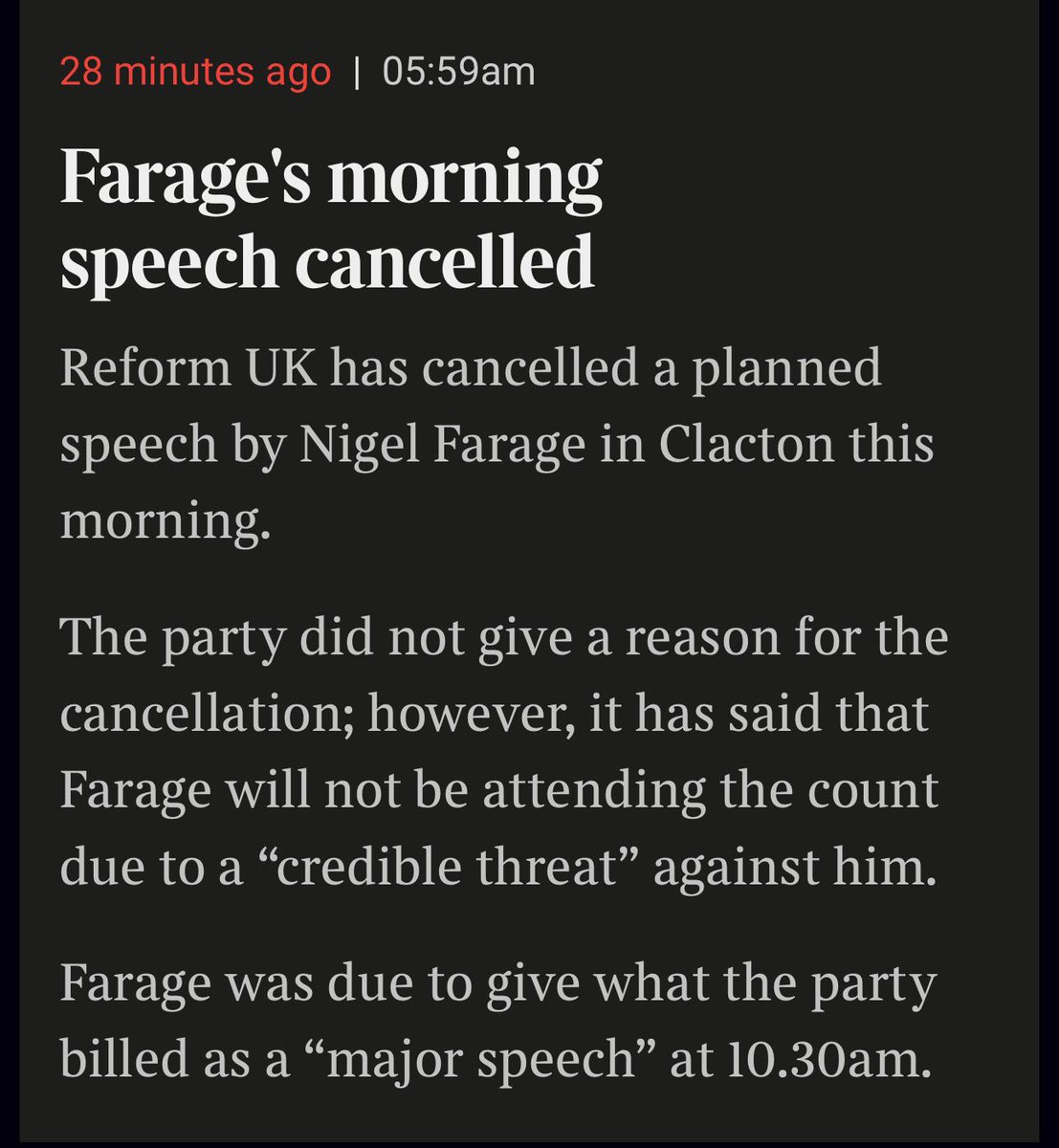
Farage didn’t attend the declaration and his planned “major speech” this morning has now been cancelled.
Some resounding triumph.
Iga Świątek: „Chcę zadedykować ten tytuł wszystkim, którzy mierzą się z niesprawiedliwą oceną, negatywnością i hejtem - czy to w sporcie, czy w innym obszarze życia. Wiem, jak przytłaczające potrafi to być”. Te słowa ważą więcej, niż sam tytuł. Brawo Iga!❤️