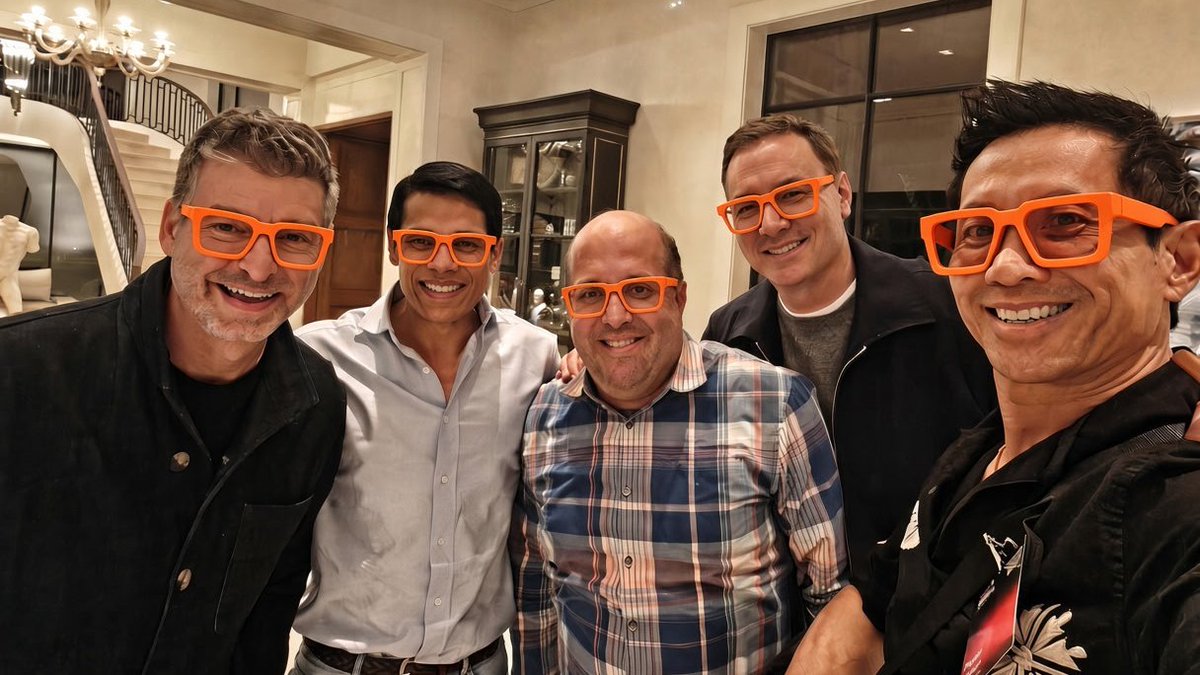
This week, I joined a panel at Khanference in Dallas called "When Agents Become Human," moderated by @dee_bosa. One idea I keep coming back to is that the more time we spend talking to our computers, the more a real conversation is worth.
Most CEOs I know are working on becoming fluent in AI, and we are too at @Nextdoor. But the AI has to be paired with human connection, because you don't want to talk to synthetic neighbors. I expect a premium on real connection in this era, the same way travel earned one after COVID.
That's the bet at Nextdoor: AI and neighbors together.
Thanks to Khanference for having me.
Halloween is one of the few nights a year when a whole street opens its doors to connect with their local community
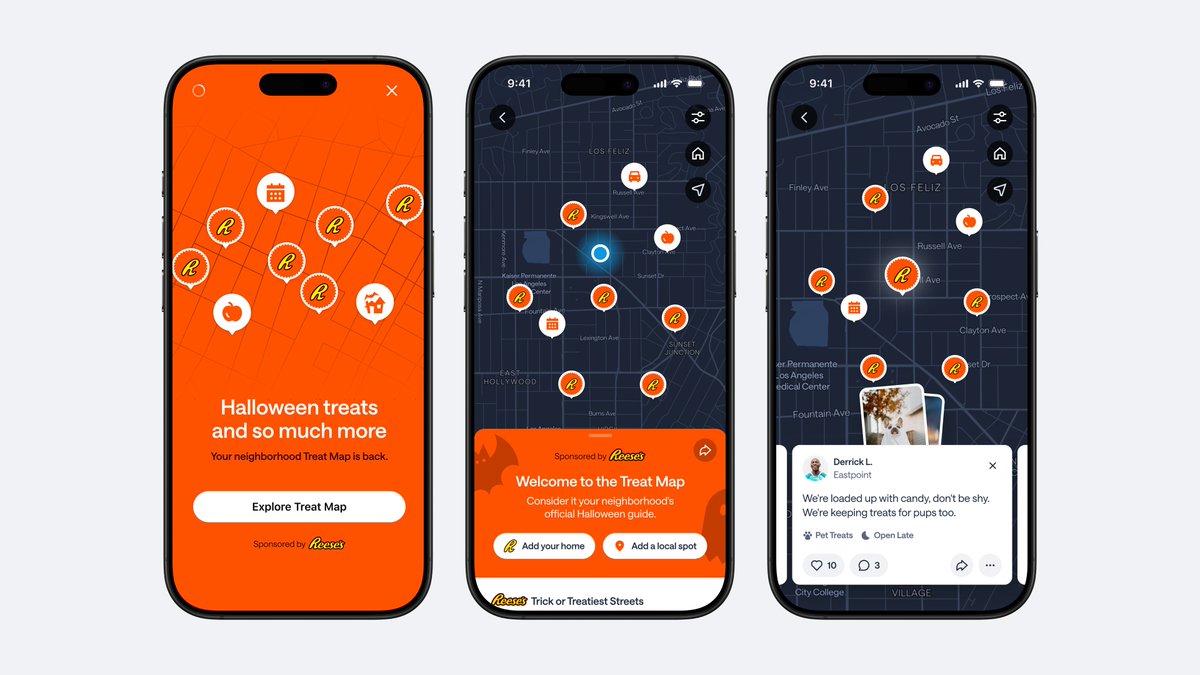
That's the idea behind the Treat Map, which @Nextdoor has released for 14 years. This year, the Treat Map is sponsored by @Reeses in the U.S. making it even more fun and useful.
Neighbors pin their homes so trick-or-treaters know where to go. This year they can also pin local spots, so you can use it to find a haunted house two blocks away, a bakery handing out cider, and your community's best pumpkin patch.
It's live in the U.S., U.K., and Canada from today through October 31. In between picking up those Reese’s peanut butter pumpkins for trick-or-treaters and buying your kid’s Halloween costume, add your house to the Treat Map.
https://t.co/FZPPNsUGHc
Today, we're introducing Neighborhood Intelligence, a new advertising data engine from @Nextdoor.
We built it based on feedback from advertisers who wanted more than ZIP-code targeting. A ZIP code flattens real differences. In the ZIP codes where we have neighborhood coverage, the average ZIP holds 12 distinct neighborhoods, each with its own character and its own businesses.
Reaching one neighborhood is a niche. Reaching any of 350,000 is scale, and that's what this engine does, with roughly 12x the granularity of ZIP-code targeting. Our Neighborhood Intelligence engine runs on our unique neighborhood graph we've spent 15 years building, drawn with communities and built from verified neighbors tied to real addresses. Only Nextdoor has it.
Early results are strong. Neighborhood Intelligence is available now on request. Read our full announcement:
https://t.co/28tY4f4TKi
Congrats to my friend @marissamayer and her team on the launch of https://t.co/KUi5Q7xdbi! I’ve been using Dazzle and it is compelling. Marissa’s insight regarding the camera roll is spot on and I'm looking forward to seeing how the app evolves and gets even better over time!
Last week, I spoke to a room of founders and operators at Venture Dallas. I told them that the power of me becomes the power of we. That line comes from somewhere specific. I grew up in Odessa, Texas, where you knew the names on every porch on your street, and that kind of community is what put the idea for @Nextdoor in our head decades before we wrote a line of code to build it.
Community doesn't only make people feel good. It makes them sharper, because you're building on somebody else's idea instead of starting from zero every time. That's the whole bet behind Nextdoor, and it’s the promise that can strengthen communities everywhere.
Thanks to Venture Dallas for hosting me last week!
Long before @Nextdoor, I was a Dallas Cowboys fan finding fellow fans online from 49ers territory at Stanford in the 90s. That's when I saw what virtual community could do.
Nextdoor flips it: connect people by address instead of interest. Real boundaries, real names, verified neighbors, built to strengthen the neighborhood you actually live in.
I told the full story on @scottdclary's Success Story podcast. Watch the full video here: https://t.co/RNOnQggzaD
Nextdoor CEO @niravtolia argues AI can become one of the greatest forces for good without ever replacing the human experience of community:
"The recent narrative about AI creating a master race of robots that will make humans extinct, I think that kind of extreme doomerism is very damaging."
"Not because it makes people wanna put stops on the evolution of the technology, but because it creates a narrative not rooted in anything real."
"Anything experiential with other people, that idea of community, that's not something that can be proxied by machines. I am a techno-optimist. I think AI is gonna be one of the greatest forces for good the world has ever seen. But I do not believe it can proxy community."
"Community is when we get together with multiple other people. Those interactions are not me and machine. Those are me and other people, and the me becomes we."
@Nextdoor
Somewhere along the way, we outsourced a decision we used to make by asking the person next door.
When I need a plumber, the internet gives me forty businesses with 4.8 stars and no way to tell which ratings came from a real customer. The reviews are anonymous by design. The reputation is rented. And the whole system rewards whoever spends the most to sit at the top of the page.
That's the problem Faves was built to fix. A Fave on Nextdoor comes from a verified neighbor who actually hired the business. You can see who they are. You can see they live nearby. It can't be bought and it can't be faked, which is exactly why it's worth something.
Voting for our 2026 Fave Awards runs through September 30. Every neighborhood will end up with its own list of the businesses its neighbors stand behind.
The instinct to ask a neighbor never went away. It just needed somewhere to live online.
Vote today, or claim your page at https://t.co/G2tY3G9sAt.
Ask an AI model to name the best pizza place in town and you'll get a confident answer instantly, for free. The catch is that the model was trained on the same reviews we already can't trust.
A 2025 study found AI-generated fake reviews are now indistinguishable from real ones, to human readers and to other AI models alike. Meanwhile businesses are getting AI-bombed, buried under thousands of reviews they never earned.
Information used to be scarce. Now it's free and instant. Provenance isn't.
I co-founded one of the first review sites in 1999. What I think comes next, in @FortuneMagazine:
https://t.co/P3gKaSf0Ug
@scottdclary@rvance47_o Actually we didn't have 100% dependency - perhaps more like 30%. But when it comes to operating as a public company, it's hard to survive losing 30% of your no-cost revenue without being able to articulate a sure way of getting it back. 🤨
I went on @YahooFinance this morning with @BrianSozzi to talk about how we are doubling down on local business recommendations on @Nextdoor.
Neighbors have been using Nextdoor all along but we are now making that experience so much better especially with our new Local Faves hub.
More than half of internet users have run into a fake review and AI is making this even more of a problem. AI can summarize and surface information, but the underlying information on Nextdoor comes from real humans and real neighbors. That's the whole point.
Thanks for having me, Brian! Watch our conversation: https://t.co/UVUTpIvIu2
A neighbor telling you which local businesses to use was once the most reliable review system we had.
Online, that got harder to trust. 97% of people still rely on reviews to make purchase decisions. Six in ten have run into one they suspected was fake or paid for.
Today @Nextdoor we announced major improvements to the platform that will make it easier for neighbors to find the most beloved local businesses around them.
The FTC is now cracking down on fake and purchased reviews. Nextdoor was built to avoid that problem from the start, with verified neighbors and businesses.
In a world of artificial intelligence and synthetic content, it's harder than ever to know what to believe, so who matters more than what. That's exactly what Nextdoor has been built on since day one: verified identity.
If you're one of our 110 million neighbors, these improvements are live today. Take a look.
https://t.co/HhQoxlwsMm
I sat down with Brett House and Rio Longacre on Signal & Noise to talk about why trust matters more, not less, as AI gets better at summarizing the internet for us, and why verified identity is going to matter even more as bots start outnumbering real people online. We also got into what it's been like stepping back in as CEO two years ago and bringing a Founder’s Mentality to this next phase of @Nextdoor.
Watch the full episode: https://t.co/IMnZO5r4A1
I had a conversation with @scottdclary on why AI can make us lonelier if we're not careful, and why we built @Nextdoor on trust instead of speed. We also got into leaving the company I founded and what it took to come back.
Full episode here: https://t.co/mmBpRiW8px
The more capable AI becomes, the more convinced I am that the WHO matters more than the WHAT.
@tobi shared a @DavidBrooks224 piece in @TheAtlantic that gets at why.
One story stayed with me. A principal shows his students a film that took 200 artists five years to make. One student responds: “AI could have done it in five minutes.”
That reaction captures something we risk losing.
For a long time, we’ve been taught to focus on the WHAT: the answer, the output, the result.
AI makes the WHAT abundant.
Which means the WHO matters more than ever.
Who did the work? What did they learn along the way? Did they struggle with the problem long enough to develop judgment? Do they have a point of view of their own?
The people I want to work with aren’t simply great at getting to the answer. They’re curious. They do hard things. They form their own view before opening a chat window—and then use AI to challenge it, sharpen it, and make it better.
In the AI age, answers will get cheaper.
Judgment, character, and originality won’t.
The future belongs to the WHO, not just the WHAT.
Worth a read: https://t.co/O6Ww055mwz
https://t.co/lbTbwDYj1B