For years, the Indian private FM radio industry has been sounding the alarm. With @ht_media_group now surrendering multiple FM licenses across key markets, the long due wake-up call for the government and policy makers is required NOW.
This is not an isolated case. It follows TV Today’s exit from radio, @bigfmindia's insolvency and even @RedFMIndia surrendering Magic FM in Mumbai earlier this year. Station by station, the medium is being hollowed out.
Eight months ago, when @TRAI recommended reforms, I had said: “What truly matters is timely implementation. Over the years, many favorable policy suggestions have been made for radio, but haven’t been implemented yet.”
Unfortunately, that remains true even today. For years now, in AROI representations, policy discussions, boardrooms and industry forums, we have repeating the same urgent asks:
→ 4% AGR model for Phase III extensions post-2030, without fresh auctions
→ GST reduction from 18% to 5% for parity with other media sectors
→ Mandatory FM receiver activation on smartphones
→ Permission for regulated news and current affairs on private FM
The smartphone point alone reflects the irony of the situation. Nearly 90% of FM listening today happens on phones, yet millions are forced onto paid data because FM receivers were quietly deactivated and advisories were never enforced.
Another point to note is that while global streaming platforms boom in India, why is radio, our century-old homegrown medium, still struggling despite the government's push for Make in India initiatives?
Radio at its core remains the common man’s medium. It reaches millions in local languages, across cities, small towns and even areas where other mass mediums fail. It is also the medium chosen by the Hon’ble Prime Minister for Mann Ki Baat.
My point, as I speak on behalf of a medium that is dearest to me and millions who rely on it, is that radio has never asked for sympathy. Only a fair ground to play on. As simple as that.
So now the question is: will reforms finally come before the last frequencies go silent?
@narendramodi@PMOIndia@AshwiniVaishnaw@MIB_India@GoI_MeitY@PIB_India@PrasarBharati@airnewsalerts@AkashvaniAIR@FeverFMOfficial@IndiaToday
#FMRadio #RadioIndia #MediaPolicy #RadioReforms #AROI
We lost Poomani this week. Most headlines referred to him as "the writer behind Asuran."
He deserved better than that.
Yes, Vekkai became one of Tamil cinema's most powerful films. But to remember him only for the movie is to miss the mountain for its shadow.
Poomani was the son of marginal farmers from a village near Kovilpatti. He spent his life writing the karisal bhoomi - the arid, black-soil land of southern Tamil Nadu and the ordinary people whose struggles and dignity rarely make it into literature. His Sahitya Akademi - winning Agnaadi spanned nearly two centuries of that land's history. That was his real monument.
There's a lesson here for all of us who work with stories. The adaptation travels far and fast. But the source - the patient, rooted, unglamorous original is where the truth actually lives.
A film introduced Poomani to the world. His words are what will keep him here.
May the soil he wrote about so tenderly hold him gently now. 🙏
#Poomani #TamilLiterature #Storytelling
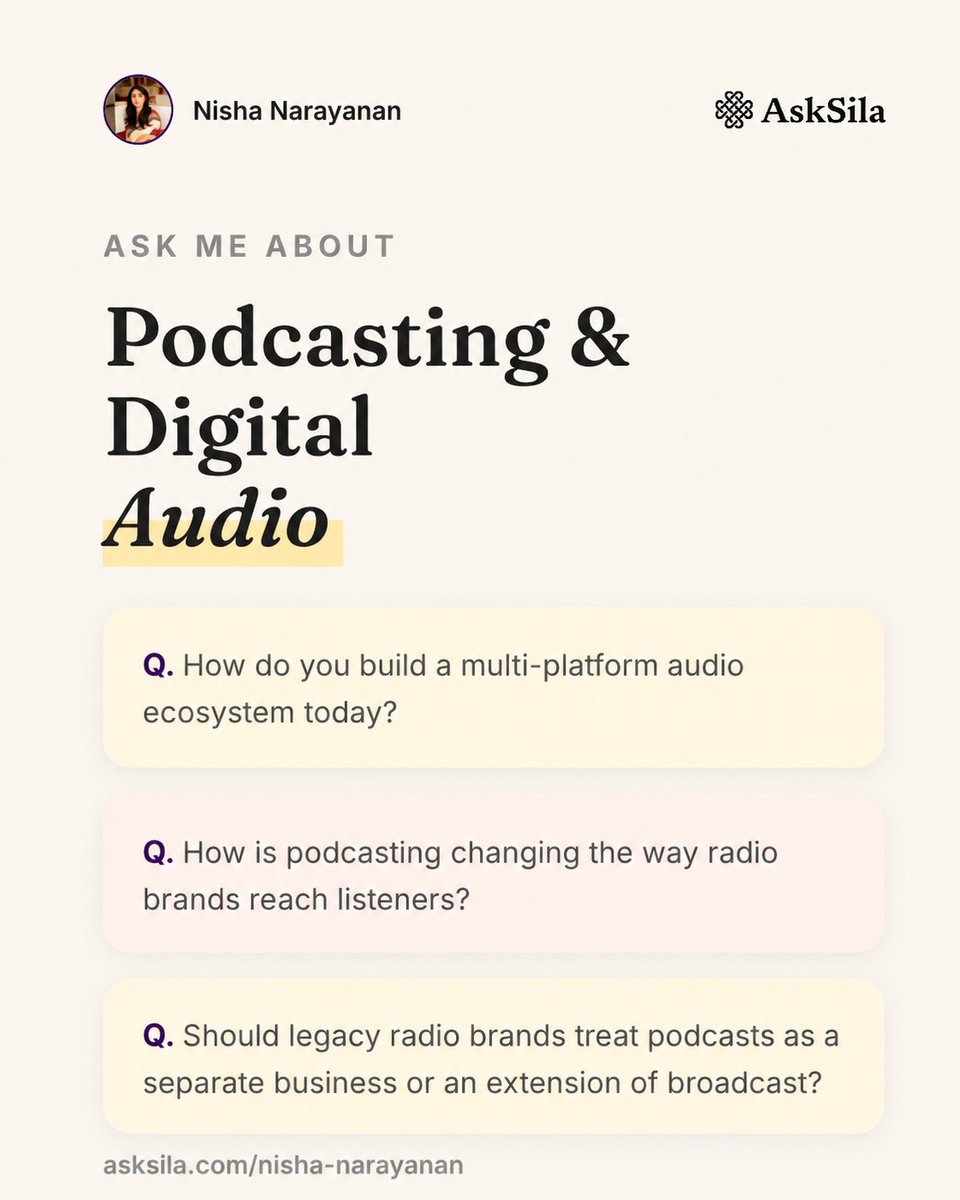
Stepping into something new today, with my AI twin now live on @asksila_ai. Over three decades, my journey across the broadcast and audio ecosystem has been shaped by conversations, choices, experiences and instincts gathered along the way. Seeing some of that knowledge take a new form through AI is worth exploring.
As the adoption and curiosity around AI mushrooms, it could be taken as a significant opportunity, but so is the responsibility to engage with it consciously.
It will be interesting to see the intersection of experience and emerging technology. Curious… Special thanks to @india_singhal.
Remembering the words of the great Maya Angelou, "You can't use up creativity. The more you use, the more you have."
https://t.co/7mJ5DeckvV
#GenAI #ThoughtLeadership #FutureOfTech
Radio and audio are often called the most intimate of mediums, reaching people without ever needing to be seen. That reach means something only when it's built with care, credibility, and a genuine sense of community.
For over three decades, @nisha_narayanan has dedicated her career to building brands and communities around the power of audio and storytelling. Today, she embraces Artificial Intelligence with that same audience-first spirit. Her fully secure Sila (Digital Twin) is built on trust and authenticity. Every interaction is rooted in Nisha's own experience, values, expertise, and voice.
A Sila extends her presence, making her insights on media, leadership, and storytelling accessible to anyone, anytime, anywhere. We invite you to experience this meaningful confluence of media wisdom and modern innovation.
Celebrating three decades of storytelling and leadership through conscious technology.
https://t.co/X1Um9H8g6y
#AskSila #DigitalTwins #ArtificialIntelligence #Radio #DigitalAudio #Podcasting #MediaLeadership #Storytelling #BrandBuilding #CommunityBuilding #FutureOfMedia #ResponsibleAI
This video made me smile...
Watching @VikrantMassey get genuinely excited to meet the man behind Mawali Bhai was a lovely reminder of why radio continues to fascinate me.
Aakash Singh joined @RedFMIndia as an intern 12 years ago. Today, he's the Assistant Programming Head of our Mumbai station and the voice behind one of our most loved characters.
Mawali Bhai is witty, street-smart and so unmistakably Mumbai. Perhaps that's why the character has struck such a chord with Mumbaikars.
But for me, this moment is also about the power of a voice. A character you may have never seen can become so familiar, so real, that meeting the person behind it feels like meeting someone you've known for years.
That's the magic of radio. It leaves enough room for imagination to do the rest.
Radio truly is theatre of the mind.
#Radio #AudioStorytelling #TalentDevelopment #MawaliBhai
For over three decades, #SonuNigam has given India a song for every mood and every generation. From timeless film soundtracks to unforgettable live performances, his voice today has become an integral part of our routines.
Which is why we are incredibly excited to announce the Revolution India Tour 2026 with Sonu Nigam, in partnership/collaboration with @ITWSports and @ITWPlayworx Media & Entertainment Pvt. Ltd.
Over the years, we've celebrated emerging voices, championed independent music and built platforms for artists and audiences to connect in meaningful ways. Every once in a while comes an artist whose music doesn't belong to one generation alone and brings them all together. That's Sonu Nigam.
The journey begins this October, and we can't wait to bring this experience across the country.
See you at the concerts! #BajaateRaho
#SonuNigamTour #TheRevolutionTour #LiveEntertainment
https://t.co/9465MD1cvY
I have spent nearly 34 years in the broadcasting and radio industry and watched it survive floods, elections, pandemics and the rise of every platform that was supposed to replace it.
Radio didn't disappear. It adapted quietly, consistently and it continues to reach millions every single day.
What it cannot survive is being taxed, restricted and regulated into irrelevance by the very government it serves during every national emergency.
Over the past few weeks, it has been heartening to see the media engage with the challenges facing private FM radio while also exploring the opportunities that lie ahead for the medium. More importantly, it has brought together the perspectives of industry leaders, policymakers and industry bodies into a larger public conversation.
Thank you to every journalist, editor and publication that has contributed to this growing conversation. I hope it continues with openness, urgency and a shared commitment to strengthening the future of a medium that continues to be the voice of millions.
Read about it here:
https://t.co/rOSXiGdAXn
@PTI_News@ET_Marketing@thetribunechd@Storyboard18_@TelanganaToday@afaqs@e4mtweets
#RadioReforms #MediaPolicy #PublicServiceMedia #MediaIndustry
My thoughts in @thetribunechd today on why radio, despite reaching over 40 crore listeners and consistently demonstrating its public value, continues to operate within a regulatory framework designed for a different era. I also share my views on the recently released Ministry of Information & Broadcasting's Draft Telecommunications Rules, 2026 on what it gets right, where it falls short and the room to unlock full potential.
Ultimately, this conversation isn't just about an industry. It's about the millions of people who tune in every day and the thousands of professionals and local voices for whom radio remains an invaluable platform with an independent mike.
Meaningful reform is always a collective journey. From policymakers and broadcasters to advertisers, businesses and creators, we all have a role to play in strengthening and shaping the future of radio. The intent is there, and the roadmap exists.
What we need now is the collective will to act before the window of opportunity closes.
@narendramodi@PMOIndia@AshwiniVaishnaw@MIB_India@GoI_MeitY@PIB_India@PrasarBharati@airnewsalerts@AkashvaniAIR@FeverFMOfficial@IndiaToday
#Radio #BroadcastingReform #PrivateFM #IndianMedia
@DeutscheWelle Global Media Forum 2026 opened this week with a theme worth sitting with: Journalism Out Loud.
The reasoning, as DW’s Director General @BarbaraMassing put it, is simple. Journalism needs to remain audible in a world that is becoming increasingly noisy.
A new DW Akademie study backs the urgency. Every dollar invested in independent journalism can generate over a hundred dollars in public value through recovered funds, better governance and reduced corruption. Disinformation, by contrast, costs societies an estimated 350 to 500 billion dollars a year. The numbers make a case policy conversation often missed: credible content is not a cost. It is an asset.
The sharper point came next. Digital platforms and AI systems benefit enormously from journalistic content created by others, something no other industry would simply accept. The forum’s call: build business models that reward quality content and let creators share in the value they generate.
This pattern is familiar. Different geography, different technology, same root issue: the people creating value are rarely the ones positioned to capture it, until the conversation forces that imbalance into the open.
Radio in India has been having a version of this conversation for years. Reach, trust and relevance have never been the problem. Fair value and a level playing field have.
The forum is a reminder that this fight is not unique to one country or one medium. It only gets resolved when it stays loud enough, for long enough.
Full coverage: https://t.co/RKySmPn46N
#GMF26 #MediaPolicy #SustainableMedia #IndependentJournalism
@DeutscheWelle Global Media Forum 2026 opened this week with a theme worth sitting with: Journalism Out Loud.
The reasoning, as DW’s Director General Barbara Massing put it, is simple. Journalism needs to remain audible in a world that is becoming increasingly noisy.
A new DW Akademie study backs the urgency. Every dollar invested in independent journalism can generate over a hundred dollars in public value through recovered funds, better governance and reduced corruption. Disinformation, by contrast, costs societies an estimated 350 to 500 billion dollars a year. The numbers make a case policy conversation often missed: credible content is not a cost. It is an asset.
The sharper point came next. Digital platforms and AI systems benefit enormously from journalistic content created by others, something no other industry would simply accept. The forum’s call: build business models that reward quality content and let creators share in the value they generate.
This pattern is familiar. Different geography, different technology, same root issue: the people creating value are rarely the ones positioned to capture it, until the conversation forces that imbalance into the open.
Radio in India has been having a version of this conversation for years. Reach, trust and relevance have never been the problem. Fair value and a level playing field have.
The forum is a reminder that this fight is not unique to one country or one medium. It only gets resolved when it stays loud enough, for long enough.
Full coverage: https://t.co/RKySmPn46N
#GMF26 #MediaPolicy #SustainableMedia #IndependentJournalism
Today, we celebrate the passion, freedom and community that bring riders together, the same spirit that powers Riders Music Festival.
After an unforgettable RMF 2026, it’s time for the next chapter.
RMF 2027 is coming to Delhi NCR on 13th & 14th February 2027. 🤘🔥
Gear up for another unforgettable weekend of music, machines and all things RMF. Stay tuned for more.
#RidersMusicFestival2027 #RMF2027 #WorldMotorcycleDay #RedFM #BajaateRaho
Radio has always been a safe space for voices that weren't welcome elsewhere. Think about it, late night shows, anonymous caller stories, RJs who built trust over years. That intimacy is rare. We have a medium that can reach someone in a small town at 2am, when they feel most alone. That is a gift. And this Pride Month, let us remember to use it wisely.
In media, we reach millions every single day. And if our airwaves, our content, our stories don't reflect the full spectrum of who our listeners are, we're not really doing our job.
We believe that belonging is not a once-a-year conversation. It's in who we hire, what we play, whose story we tell, and how we tell it.
This Pride Month, let’s not just celebrate, but ask: what are we building that lasts longer than June? To every member of the LGBTQIA+ community who has listened to us, worked with us, or simply felt seen through us, this one's for you. Always.
#PrideMonth #InclusionMatters #Pride #Radio
Recently we have been receiving updates from the Cell Broadcast System from the Department of Telecommunications, primarily around strong winds and weather-related advisories.
The Cell Broadcast System is a welcome addition to India's emergency communication toolkit. More ways to reach people during a crisis can only be a good thing.
Though resilience is rarely about one platform replacing another. It is about building layers of communication that work together.
Radio has spent decades doing exactly that. Through cyclones, floods, extreme weather events and public emergencies. In fact, even during Operation Sindoor, emergency preparedness advisories recommended keeping a radio set as part of the emergency kit. A reminder that resilience is rarely built on a single channel of communication.
Even in an age of smartphones and instant alerts, reaching people during a crisis still requires multiple layers of connectivity and information dissemination. Which is why this should not be a conversation about Cell Broadcast versus radio. It should be a conversation about collaboration.
A truly resilient, Made In India public alert system would combine the speed and precision of mobile alerts with the reach, trust and reliability of radio.
For policymakers, the opportunity is not to create parallel systems doing similar jobs. It is to build an integrated framework where every available medium strengthens the other. In the end, emergencies do not test technologies. They test reach.
The success of an alert is ultimately measured not by how it was sent, but by how many people received it in time.
https://t.co/qb2VvhXOjX
#EmergencyCommunication #DisasterManagement #MadeInIndia
The recent draft consultation paper by the Ministry of Information & Broadcasting on broadcasting rules is a moment worth acknowledging and examining honestly. There are real positives.
Like the rationalisation of the annual authorisation fee based on Adjusted Gross Revenue, if confirmed unambiguously by MIB, would be the most meaningful financial relief the radio industry has seen in years. The expansion of permissible content categories including civic information reflects a more contemporary understanding of what radio does and what its listeners truly need.
The case for independent news on private FM is rational, not emotional. Indian Radio is nearly a century old, the original common man's medium, genuinely Made in India in every sense. Every other platform reports news freely and notably, news is not restricted under the satellite TV, DTH or IPTV guidelines under this very same convergence Act. Radio alone remains the exception. That inconsistency within the same legislative framework is worth addressing directly.
The draft also mandates one hour of daily government-directed programming. Now this is in absolute contradiction at a time when government advertising, a key revenue stream for radio, is already declining year on year.
There are other recommendations like FM activation on smartphones, GST rationalisation on radio advertising, relief from the co-location mandate with Prasar Bharati. Again none complicated but all of them overdue.
The update is an encouraging push and the intent is appreciated. The road ahead needs action, since the asks are clear and the solutions are well within reach. While on the surface this seems like only for large players but it is equally for the niche and community radios. They are the authentic voice of local India and deserve to be equally part of this reform story.
A medium that has held the trust of nearly a century is ready to serve generations to come. What remains is a regulatory framework that finally gives it the opportunity its potential deserves. Is that really too much to ask?
@narendramodi@PMOIndia@AshwiniVaishnaw@MIB_India@GoI_MeitY@PIB_India@PrasarBharati@airnewsalerts@AkashvaniAIR@FeverFMOfficial@IndiaToday@TRAI@bigfmindia@ht_media_group
#FMRadio #RadioIndia #MediaPolicy #RadioReforms #AROI
Over the last few weeks, we have spoken about auctions, policy reforms, digital adoption and the many changes the radio industry has been advocating for.
During the lockdown and in moments of uncertainty, many people instinctively went looking for a radio set. Not an app or platform. A radio.
It remains one of the few mediums that asks nothing of its audience. No subscription. No data plan. No algorithm deciding what deserves to be heard. It simply reaches people. Interestingly, a new question "Whether your household owns a radio/transistor" has now found its way into the ongoing Census survey. That, to me, is significant. It signals an acknowledgement. Important enough to be counted.
There are still cities across India waiting for more choice, more voices and more opportunities. We need to focus on cities like Dehradun/Muzaffarpur for greater participation. This will only strengthen the ecosystem and create more opportunities for listeners, independent artists and creators, advertisers and local talent.
The intent, the audience, the stations and most importantly the trust that has been built over almost a century exists. What is needed now is a practical and forward-looking roadmap that supports growth, encourages participation and recognises the role radio continues to play as a medium of public interest.
This conversation was never really about radio alone but about what kind of media ecosystem we want to build for the future.
The question is whether we are willing to act on what we already know.
Thank you to those who participated in these conversations, shared their views and kept the discussion alive. The industry has made its case. The audience has never stopped listening. #BajaateRaho #Radio
@narendramodi@PMOIndia@AshwiniVaishnaw@MIB_India@GoI_MeitY@PIB_India@PrasarBharati@airnewsalerts@AkashvaniAIR@FeverFMOfficial@IndiaToday@TRAI@ht_media_group@bigfmindia@RedR_India@RedFMIndia
India’s live events story is entering a new chapter.
The Live Events Development Cell’s roadmap to position India as a global hub for live events signals a shift from viewing concerts, festivals and experiences as standalone events to recognising them as economic and cultural engines. With a focus on infrastructure, policy support and industry collaboration, the intent is clear: create an ecosystem that can attract global talent, scale local IPs and unlock tourism, employment and investment opportunities.
What makes this particularly exciting is how far the industry has come. Over the years, we have seen live experiences evolve from being a supporting pillar of entertainment to becoming a powerful medium in their own right; bringing together audiences, creators, brands and communities in ways few other platforms can.
As audiences increasingly seek connection, participation and shared moments, India's diversity gives us a unique advantage. The opportunity ahead is not just to host more events, but to create experiences rooted in culture, creativity and local storytelling that can resonate globally.
That is why initiatives like South Side Story are especially meaningful to us at @RedFMIndia. They celebrate the richness of regional voices and demonstrate how strong cultural narratives can create experiences that are authentic, engaging and truly memorable.
Article: https://t.co/Ej4GdAmINt
@Storyboard18_ #LiveEvents #ExperienceEconomy #EntertainmentIndustry #CulturalExperiences #CreatorEconomy
India’s startup story is no longer about how many companies we’ve created. It’s about how far entrepreneurship has travelled.
In 2016, India had a few hundred recognised startups. Today, we have over 2 lakh DPIIT-recognised startups, 125+ unicorns, 21 lakh jobs created, and one of the world’s largest startup ecosystems. But the most important shift isn’t the scale. It’s the mindset.
What stands out in @the_hindu 's recent analysis is how innovation has moved beyond the metros. Nearly half of new startups are emerging from Tier 2 and Tier 3 cities, proving that ambition is now far more distributed than ever before. Women founders are also playing an increasingly significant role in shaping this ecosystem.
The funding correction of the last few years may have been rough, but it also brought focus back to fundamentals. The conversation is shifting from valuation to value creation, from growth at all costs to sustainable businesses.
The next decade, however, will be defined by deeptech, climate tech, spacetech and advanced manufacturing. These sectors need patient capital, stronger research-industry linkages and long-term conviction.
India’s first startup decade built momentum. The second will determine whether we can turn that momentum into enduring innovation.
https://t.co/lcZ29bG1Wc
Vector illustration - Startup | Photo Credit: akindo
#StartupIndia #Innovation #Entrepreneurship #DeepTech #SpaceTech
In our previous conversation, we spoke about the policy reforms the radio industry urgently needs. Beyond policies and regulations, lies a larger question: Why does radio still matter so deeply today?
The answer lies in what radio continues to do best: building trusted local connections at scale. Radio is not a “one-size-fits-all” platform. Its strength lies in local languages, regional culture, city-specific conversations and personalities that audiences have trusted for years.
Long before "influencer marketing" became mainstream, radio jockeys were already shaping opinions with credibility, accountability and genuine community engagement...and they still continue to do.
We’ve seen this resilience firsthand whether it's when cellular networks fail during natural disasters, or during lockdowns when radio stays on air, informing and supporting communities when they need it most.
At a time when the broader audio ecosystem is booming, the conversation should not be about whether radio remains relevant. Instead, it should be about providing a viable runway, especially from a business perspective.
The mindset must shift from viewing radio as just a song-playing medium. Today, its role goes far beyond chartbusters. It’s about giving indie and upcoming artists a mic and a stage and operating across cultural IPs, live experiences, branded content and digital amplification.
@narendramodi@PMOIndia@AshwiniVaishnaw@MIB_India@GoI_MeitY@PIB_India@PrasarBharati@airnewsalerts@AkashvaniAIR@FeverFMOfficial@IndiaToday@TRAI@ht_media_group@bigfmindia@RedR_India
#RadioMatters #FutureOfRadio #AudioIndustry #LiveExperiences
Over the last few weeks, we’ve spoken at length about the critical policy recommendations currently on the table for the radio industry. From the inclusion of independent news and current affairs to the mandatory reinstatement of FM receivers in smartphones, the road map for a level playing field is clear. If we step back from the technicalities, the question remains: Why do these reforms matter so deeply right now?
For the medium to unlock its true potential and expand its coverage to the remaining half of the population, the industry requires a collaborative, forward-looking intervention.
True reform isn't about seeking sympathy but about enabling sustainability. We need to ensure that not just the big players but the smaller regional players who are the voice for tier-2, tier-3 and rural India can survive and thrive.
The future of India's audio ecosystem, public broadcast and a common man’s medium depends on it.
@narendramodi@PMOIndia@AshwiniVaishnaw@MIB_India@GoI_MeitY@PIB_India@PrasarBharati@airnewsalerts@AkashvaniAIR@FeverFMOfficial@IndiaToday@TRAI@ht_media_group@bigfmindia@RedFMIndia
#RadioReforms #MediaPolicy #IndianBroadcasting #AudioEcosystem #TRAI