Introducing Atlas:
The world's first multimodal world model that generates image and video frames with pixel-perfect camera control and reconstructs them in 3D.
Model the world, move the camera, and simulate space & time.
We’re sharing the next major milestone in our non-invasive brain-to-text decoder research: Brain2Qwerty v2.
Building on v1, which was published today in @Nature, Brain2Qwerty v2 is the highest-performing end-to-end pipeline capable of real-time sentence decoding from raw brain signals. It advances beyond character-level performance to decoding words and semantics, enabling accuracy for overall communication.
We believe this research has the potential to make a real difference for the millions of people who suffer from brain lesions or disorders that prevent them from communicating.
🧵👇
If it’s real-time → WebSockets
If it’s scale → Kafka
If it’s simplicity → REST
If it’s chaos → GraphQL
If it’s AI → Python
If it’s infra → Go
If it’s logs → ElasticSearch
If it’s low-latency → Redis
If it’s high-availability → Postgres
If it’s streaming → Flink
If it’s low-level → C
If it’s high-performance → C++
If it’s enterprise → Java
If it’s frontend → React
If it’s styling → Tailwind
If it’s fullstack → Next.js
If it’s backend → Node.js
If it’s type safety → TypeScript
If it’s auth → OAuth
If it’s payments → Stripe
If it’s search → Meilisearch
If it’s caching → CDN
If it’s queues → RabbitMQ
If it’s containers → Docker
If it’s orchestration → Kubernetes
If it’s monitoring → Prometheus
If it’s dashboards → Grafana
If it’s CI/CD → GitHub Actions
If it’s version control → Git
If it’s testing → Jest
If it’s API testing → Postman
If it’s secrets → Vault
If it’s messaging → gRPC
If it’s event-driven → Pub/Sub
If it’s data warehouse → BigQuery
If it’s vector DB → Pinecone
If it’s serverless → AWS Lambda
8 AI model architectures, visually explained!
Everyone talks about LLMs, but there's a whole family of specialized models doing incredible things.
Here are their architectures mapped out:
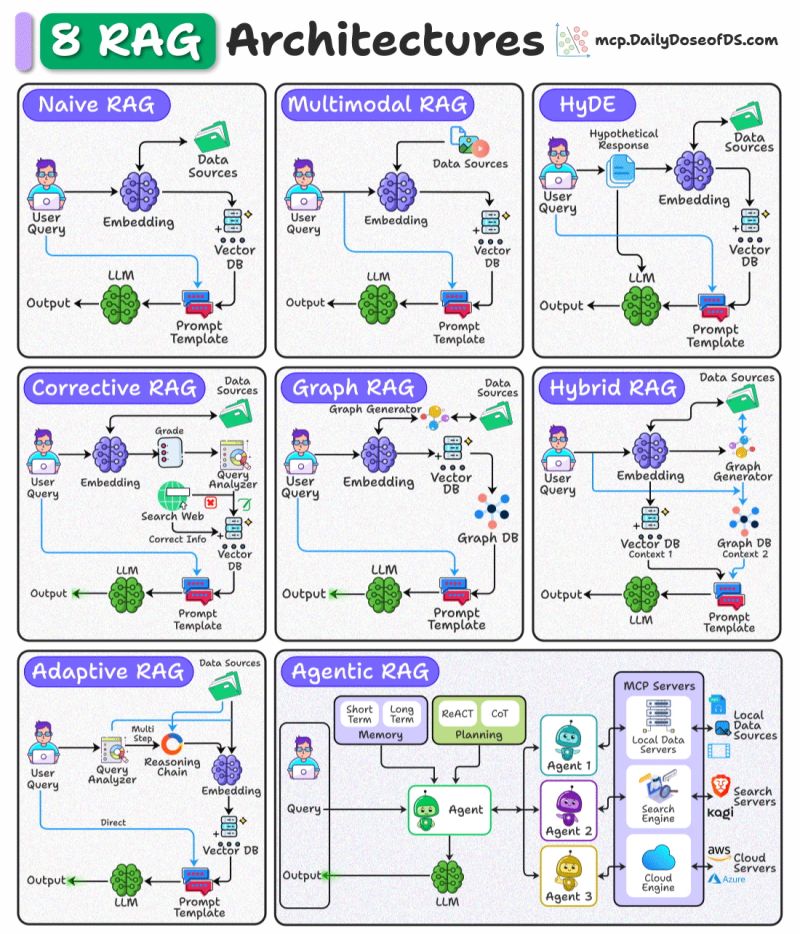
8 RAG architectures for AI Engineers:
(explained with usage)
1) Naive RAG
↳ Retrieves documents purely based on vector similarity between the query embedding and stored embeddings.
↳ Works best for simple, fact-based queries where direct semantic matching suffices.
2) Multimodal RAG
↳ Handles multiple data types (text, images, audio, etc.) by embedding and retrieving across modalities.
↳ Ideal for cross-modal retrieval tasks like answering a text query with both text and image context.
3) HyDE (Hypothetical Document Embeddings)
↳ Queries are not semantically similar to documents.
↳ This technique generates a hypothetical answer document from the query before retrieval.
↳ Uses this generated document’s embedding to find more relevant real documents.
4) Corrective RAG
↳ Validates retrieved results by comparing them against trusted sources (e.g., web search).
↳ Ensures up-to-date and accurate information, filtering or correcting retrieved content before passing to the LLM.
5) Graph RAG
↳ Converts retrieved content into a knowledge graph to capture relationships and entities.
↳ Enhances reasoning by providing structured context alongside raw text to the LLM.
6) Hybrid RAG
↳ Combines dense vector retrieval with graph-based retrieval in a single pipeline.
↳ Useful when the task requires both unstructured text and structured relational data for richer answers.
7) Adaptive RAG
↳ Dynamically decides if a query requires a simple direct retrieval or a multi-step reasoning chain.
↳ Breaks complex queries into smaller sub-queries for better coverage and accuracy.
8) Agentic RAG
↳ Uses AI agents with planning, reasoning (ReAct, CoT), and memory to orchestrate retrieval from multiple sources.
↳ Best suited for complex workflows that require tool use, external APIs, or combining multiple RAG techniques.
👉 Over to you: Which RAG architecture do you use the most?
OPENAI, ANTHROPIC, AND GOOGLE DON’T PROMPT LIKE YOU
They use internal techniques that turn LLMs into precision machines
Accuracy jumps. Hallucinations drop.
Here are 10 of those techniques (Bookmark this for later):
A new camera has been developed in China that uses a lidar-based system and can click a picture of you from 45 kilometers away.
(Not developed by Huawei.)
#AvengersEndgame emerges a game changer... Sets new benchmarks on Day 1... An eye opener for the industry that feels national holidays/festivals yield best results at the BO... Fri ₹ 53.10 cr Nett BOC. India biz. Gross BOC: ₹ 63.21 cr. NON-HOLIDAY RELEASE.