Day 1 of #100DaysOfCode 🛠️
Started my journey to become an AI/ML Engineer. Today’s focus:
✅ Setting up my roadmap for August job prep.
✅ Diving into Linear Regression basics.
✅ Solving 1st DSA problem in Java.
The goal is big (Google 2028), but the grind starts today.
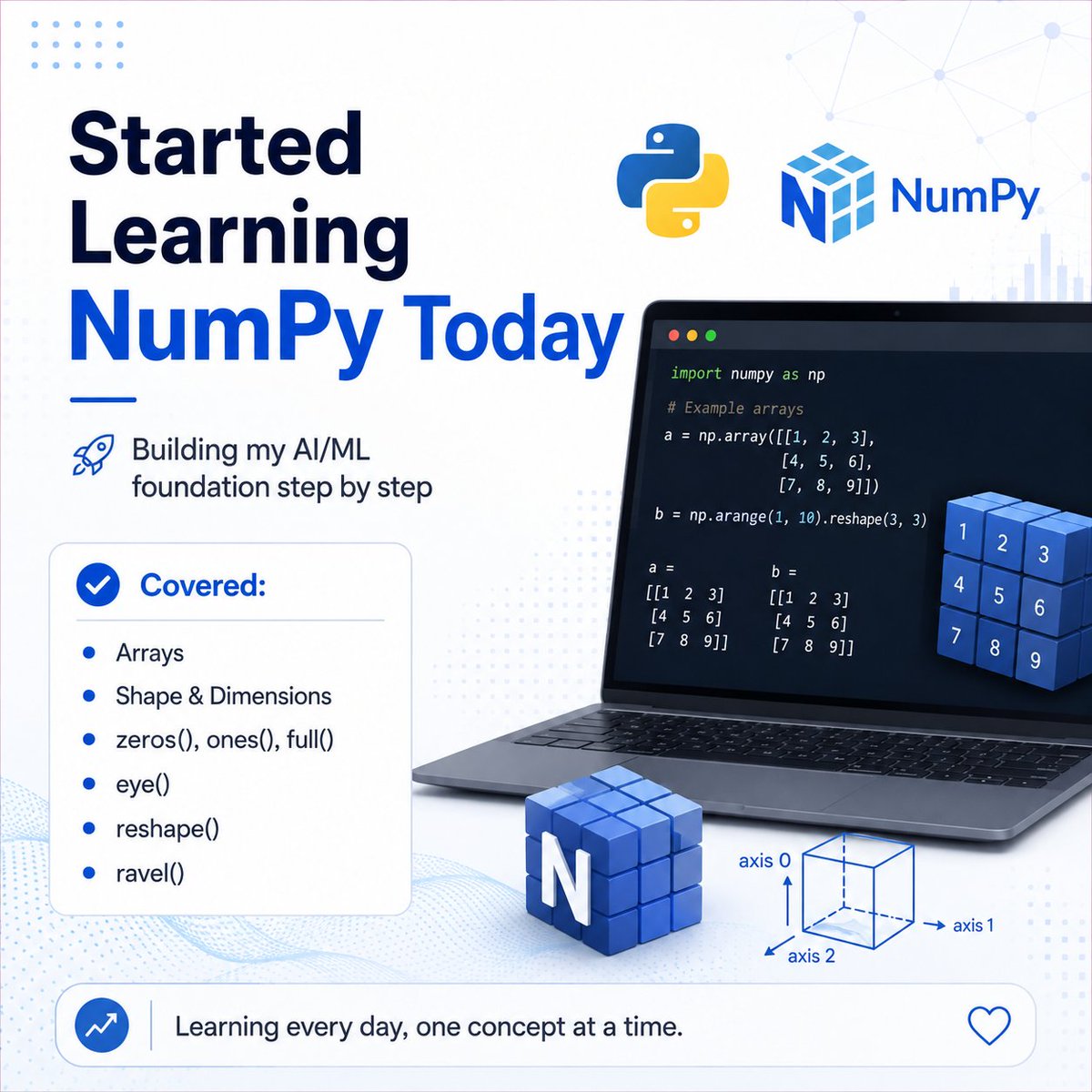
Started learning NumPy today 🚀
Covered:
• Arrays
• Shape & dimensions
• zeros(), ones(), full()
• eye()
• reshape()
• ravel()
Building my AI/ML foundation step by step.
Next goal: become comfortable with NumPy through practice, not just theory.
#NumPy #Python #MachineLearning #AI #100DaysOfCode
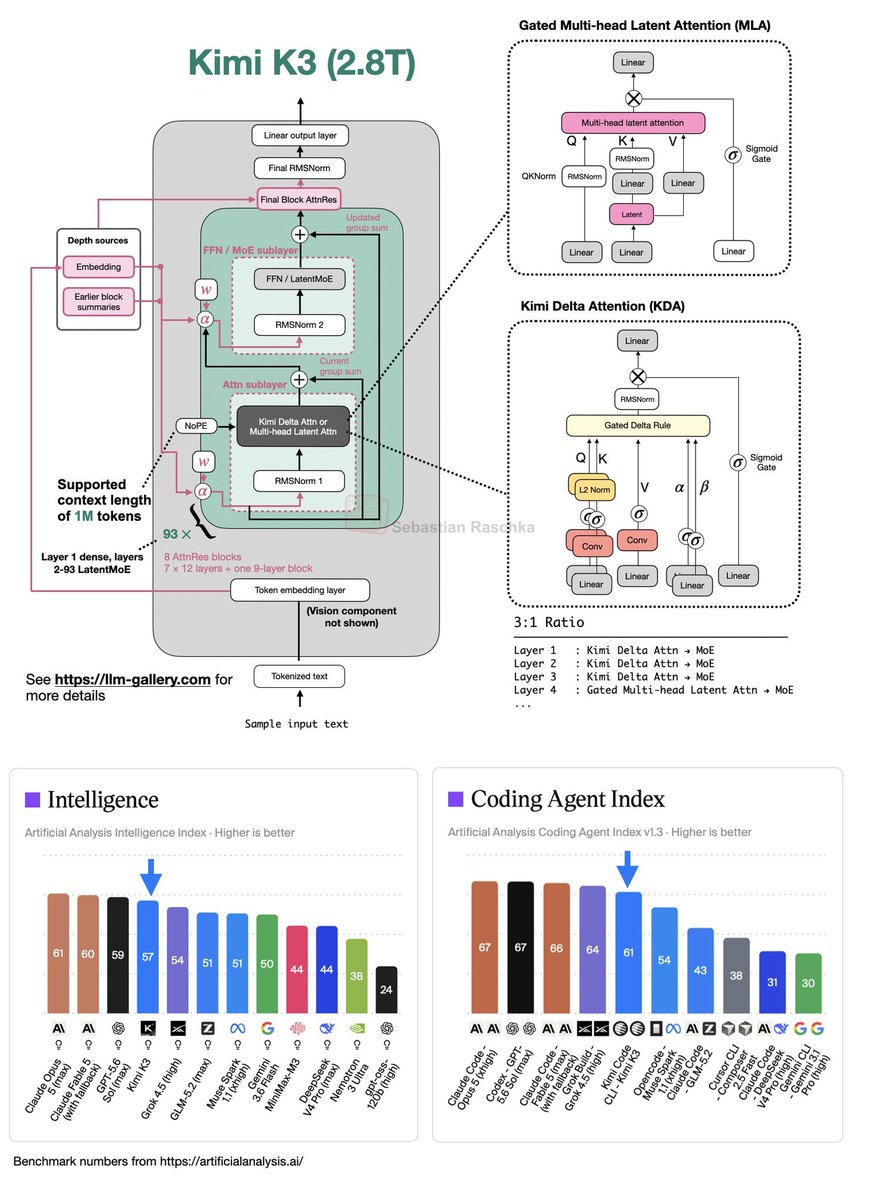
The Kimi K3 architecture figure for yesterday's big open-weight model release, along with some observations and thoughts.
1. Yes, it looks relatively complicated, but it's essentially a scaled-up production version of their Kimi Linear model they released last year (scaled up from 48B -> 2.8T; K3 is by far the biggest open-weight model right now)
2. The one new component compared to Kimi Linear is the LatentMoE. I omitted it in the figure below since it's already very crowded, but that's essentially the same LatentMoE as in Nemotron 3 Ultra (you can find it in my LLM Architecture Gallery if you are curious). The idea here is to compress (down-project) large linear layers similar to multi-head latent attention.
3. Kimi K3's overall trend (similar to Nemotron 3, DeepSeek V4, and others) is also towards better inference efficiency. That is, there are many components that replace existing components with efficiency-tweaked versions. I.e., MoE -> LatentMoE, regular attention -> multi-head latent attention and Kimi Delta Attention. (I also have short tutorials and write-ups in my gallery if you are curious about additional details).
4. The one component change that is not an efficiency tweak is attention residuals. Like DeepSeek V4 improved the residual path with mHC (manifold-constrained Hyper-Connections), attention residuals are a way to improve the residual path, but it works a bit differently. I.e., mHC made the residual path wider. Attention residuals (also already part of Kimi Linear) connect the residuals across layers; the connection itself uses an attention score for an important/contribution weight. According to the report, it improves the validation loss and downstream performance (a bit) consistently and adds about 4% in training cost and 2% in inference cost.
5. Interestingly, Kimi K3 got rid of all RoPE layers and uses NoPE (No Positional Embeddings) everywhere instead. (Again, this is inherited from Kimi Linear). In other architectures, the recent trend was towards RoPE in local attention layers (like sliding window attention) and NoPE in the global layers. There were a few architectures that only used NoPE everywhere, but this is the first frontier-level one as far as I know.
6. Kimi K3 now also has native multimodal support, which is great!
@MingDynastyVase Thank you! Building it locally with Ollama made the project even more exciting because I could experiment without worrying about API costs. I’m learning a lot by building these workflows step by step, and I’m already working on the next project! 🚀
🚀Built my first Multi-Agent AI workflow in n8n!
Workflow:
💬 Chat Trigger → 🧠 Content Agent → ✍️ Writer Agent → ✅ Review Agent
The agents collaborate to generate and refine a LinkedIn post automatically using a local Ollama model.
Learning by building every day. 🔥
#n8n #AIAutomation #Ollama #BuildInPublic #OpenSource
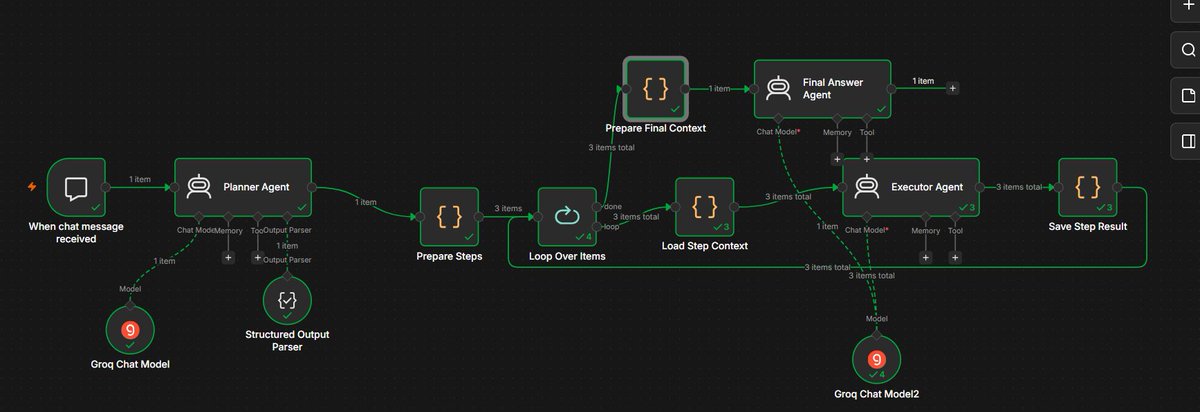
Built a Dynamic Planner Agent in n8n 🚀
It can:
→ Break a complex goal into steps
→ Execute each step sequentially
→ Use previous step results
→ Generate one final clean answer
Planner creates the plan.
Executor completes it.
#n8n#AIAgents#Automation
🚀 Built a Smart Multi-Agent Router in n8n.
Features:
✅ Detects file or text input
✅ Routes requests using AI
✅ Specialized Agents for:
• Coding
• Writing
• Research
• Resume Review
• PDF Analysis
Powered by Groq + n8n 🤖
Learning how real AI agent orchestration works.
#n8n #AIAgents #AIAutomation #Groq #BuildInPublic #LLM
🐍 Python Decorators Simplified in 1 Image!
Ever wondered how @decorator actually works behind the scenes?
Here's the quick breakdown:
🔹 Takes a function as input
🔹 Adds extra power (Logging, Auth, Timing)
🔹 Returns an enhanced function—without touching original code!
Bookmark this visual cheat sheet! 🔖
#Python #100DaysOfCode #DevCommunity #Coding
🚀 Built a basic AI Social Media Automation
using n8n + Ollama. Reads from Google Docs,
generates LinkedIn posts, and saves them to Google
Sheets automatically. 🤖⚡
#n8n#AI#Automation#Ollama
I designed this complete cheat sheet covering:
Core Requests: Mastering GET, POST, PUT, and DELETE.
Secure Auth: Setting up Headers, Query Params, and OAuth2.
Data Flow: Handling dynamic JSON payloads.
Error Handling: Managing status codes and building smart alerts.
Today's Python topics:
✅ Time Module
✅ f-Strings
✅ Modules
✅ Packages
Every small step is bringing me closer to building AI applications with FastAPI, n8n, and LLMs.
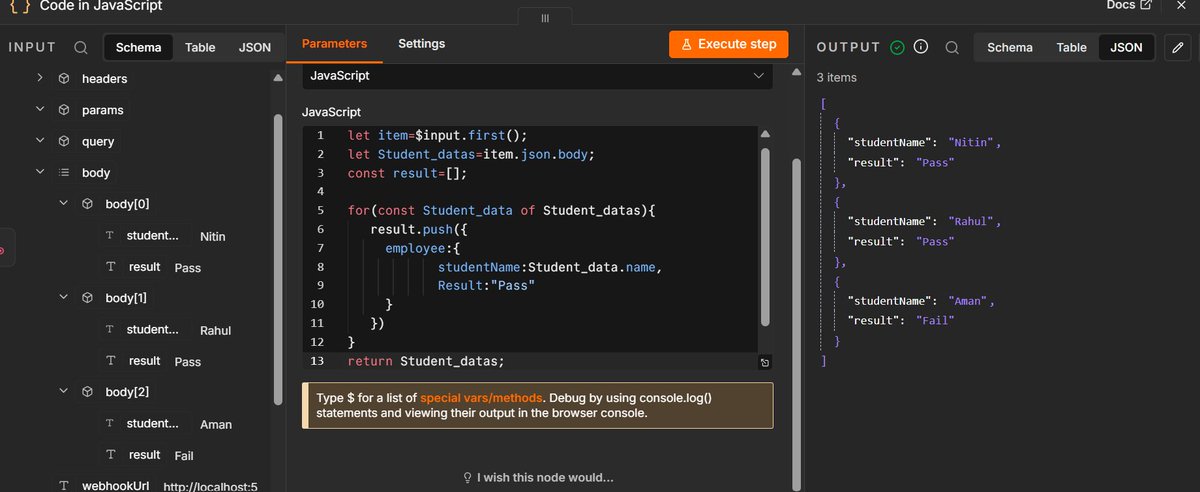
Day X of learning n8n 🚀
Practiced JavaScript in the Code Node:
• $input.first()
• Loops
• JSON transformation
• Custom API responses
Small progress every day. 💪
#n8n#Automation#JavaScript#BuildInPublic