You cannot hurt someone who has read Tolstoy, Dostoevsky, Kafka, Nietzsche, Kierkegaard, and Camus for fun.
They've been emotionally unavailable since the nineteenth century.
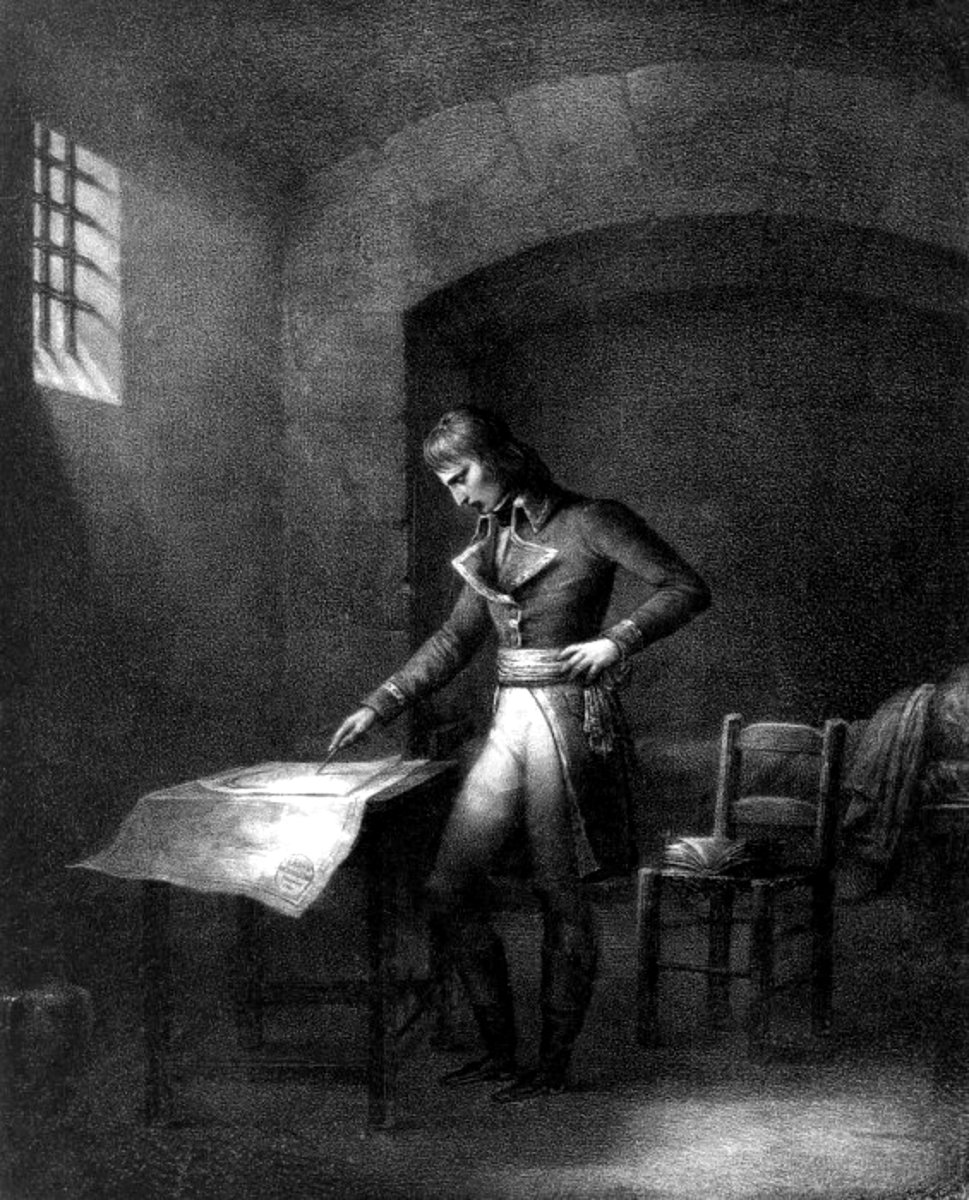
The Poverty, Pride, Humiliation and Isolation of Young Napoleon:
Napoleon was teased for not speaking refined French, for having a father who had to certify to his nobility, for coming from a conquered nation, for having a relatively large head on a thin frame and for being poorer than most of his school contemporaries.
'I was the poorest of my classmates, they had pocket-money, I never had any. I was proud, I was careful not to show it..
I didn't even know how to smile or play like the others.' (his own words)
When he spoke in later life about his schooldays, he remembered individual teachers he had liked, but few fellow pupils.
People don’t understand just how workaholic Napoleon was, even as a schoolboy:
Napoleon used to borrow many biographies and history books from the school library, devouring Plutarch's tales of heroism, patriotism and republican virtue. He also read Caesar, Cicero, Voltaire, Diderot and the Abbe Raynal, as well as Erasmus, Eutropius, Livy, Phaedrus, Sallust, Virgil and the first century BC Cornelius Nepos' Lives of the Great Captains, which included chapters on Themistocles, Lysander, Alcibiades and Hannibal. One of his school nicknames - 'the Spartan' - might have been accorded him because of his pronounced admiration for that city-state rather than for any asceticism of character. He could recite in French whole passages from Virgil, and in class he naturally took the side of his hero Caesar against Pompey. The plays he enjoyed as an adult also tended to focus on the ancient heroes, such as Racine's Alexandre le Grand, Andromaque,
Mithridate and Corneille's Cinna, Horace and Attila.
A contemporary recalled Napoleon withdrawing to the school library to read Polybius, Plutarch, Arrian ('with great delight') and Quintus Curtius Rufus (for which he had 'little taste'). Polybius' Histories chronicled the rise of the Roman Republic and offered an eyewitness account of the defeat of Hannibal and the sack of Carthage; Plutarch's Parallel Lives included sketches of Napoleon's two greatest heroes, Alexander the Great and Julius Caesar; Arrian wrote the Anabasis of Alexander, one of the best sources for Alexander's campaigns; Quintus Curtius Rufus produced only one surviving work, a biography of Alexander. A powerful theme thus emerges from Napoleon's adolescent reading.
While his contemporaries played sports outside, he would read everything he could about the most ambitious leaders of the ancient world. For Napoleon, the desire to emulate Alexander the Great and Julius Caesar was not strange. His schooling opened to him the possibility that he might one day stand alongside the giants of the past.
This sentence by Nizar Qabbani never fails to hit hard:
"Not everything in the heart can be said, so god created sighs, tears, long sleep, cold smile and shivering hands."
The General Napolean Left Behind:
When Napoleon secretly sailed back to France in 1799. he left General Jean-Baptiste Kleber to command the
stranded French army in Egypt.
When Kléber discovered that he was furious. He called Napoleon a ‘Corsican runt' and 'that bugger has deserted us with his breeches full of shit. When we get back to Europe we'll run his face in it'.
That pleasure was denied him, for in June 1800 a twenty-four-year-old student named Soliman stabbed him to death.
(Later, Soliman was executed with a pike driven into his rectum up to his breast;
Just imagine this punishment in your head).
Napoleon marched into Russia with 612,000 soldiers. He walked out with 112,000. Russian completely destroyed his army. People say this was Napoleon's biggest blunder. And it was. But it goes deeper than that. Because few people actually understand the full story.
Napoleon marched into Russia with a clear strategy. The same one he always used. He was looking for a singular battle that would end the war. A swift win that would bring Russia to it's knees. The Tsar knew this so he kept retreating and retreating. Napoleon knew the winter was coming, but at the same time all he needed was one win. He continued forward with one single miscalculation. That if he cornered the Russian army at Moscow then the Tsar would have no choice but to fight. Some of his officers warned him to turn back and strengthen to army for winter, but this would prolong the war. Other officers sided with him to win the one battle and then go home.
One miscalculation.
When the Russian's reached Moscow they burned it to the ground. The capital. The city with much of their food supply. Gone. They burnt it to a crisp. When Napoleon entered the city he was stoic. But he knew that the Russians were serious now. The harsh winter made the journey back a nightmare. And Russian soldiers picked the army off from the sides. Some of the French Soldiers simply went to sleep by the fire to never wake up.
This one single blunder cost him the war. People like to say that it's clear cut. They claim that if they were in his position they wouldn't have marched into Russia. They say things like "Oh it was clearly pride that led to his downfall." I think it's quite stupid to say this. There was very little indication Russia would go to this extent to defeat Napoleon. Any rational person imo would've made similar decisions as Napoleon. But in this case he was wrong.
The lesson of the story: In order to be great you have to get as close to the edge as possible. But if you keep getting closer to the edge, eventually you fall off.
Greatness is made by those who get to the edge without falling off.
Two decades after Napoleon’s Egyptian campaign, someone asked him whether he had ever truly embraced Islam.
Napoleon reportedly laughed and replied:
“Fighting is a soldier’s religion, I never changed mine.”