$CCD has a bigger role in the network than just being the token used to pay transaction fees.
It pays for network activity, while validators lock CCD to help secure the chain and earn fees for processing transactions. CCD also gives holders a role in @Concordium governance.
And there’s an interesting part for everyday users: you don’t necessarily need to hold CCD to use the network. Since Protocol 10, a business can sponsor the transaction fee, so a customer or AI agent can pay in a stablecoin while CCD handles the network layer in the background.
For businesses running lots of agent-driven transactions, that means keeping a CCD balance becomes part of the infrastructure behind those payments.
So the simple way to look at it is:
The user makes the transaction. The business can cover the fee. $CCD keeps the network running underneath.
#CCD
🚨 Kylian Mbappé on his defensive work: “Is it just me and Vinícius who need to improve in the defensive aspect?”
🎙️ “Dembélé and Raphinha, for example, press higher up.”
🗣️ Mbappé: “I could play dumb and tell you that I score more goals than the two you mentioned.” 😭😂
Bro basically said: I’ll defend less, but I’ll score more.
Holy cook 😭
🚨 BREAKING: Alexander Isak’s wage history
AIK - £2,000/week
Borussia Dortmund - £13,100/week
Real Sociedad - £18,400/week
Newcastle - £120,000/week
Liverpool - £250,0 ….. love
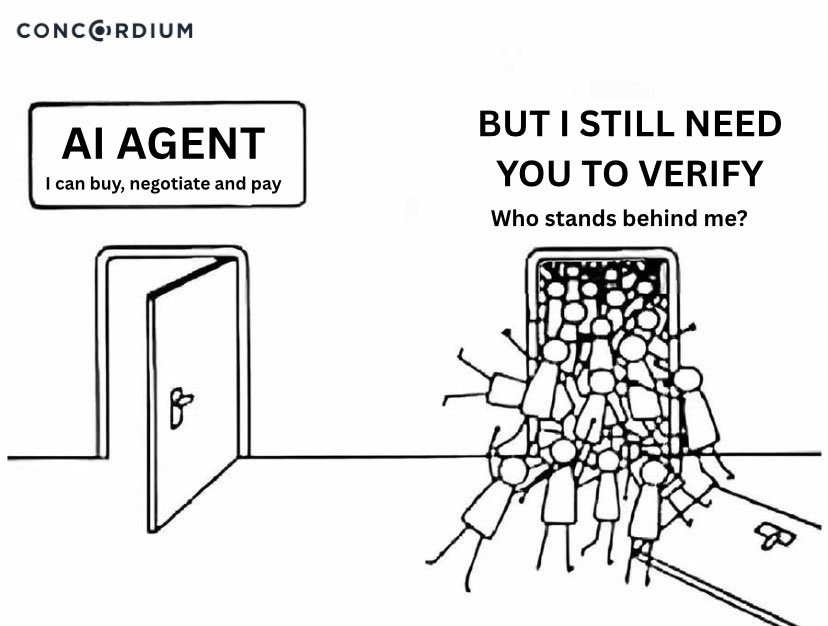
The more autonomous AI agents become, the more important accountability gets.
An agent can make decisions, move assets, buy services and interact with other systems without a human approving every step.
But when something goes wrong, knowing that an agent exists isn’t enough. We need to know who is responsible for it.
That’s where @Concordium Agent Registry becomes interesting. It connects AI agents to verified human identity while using privacy preserving proofs, creating a clearer link between autonomous actions and accountability.
The goal isn’t to limit autonomy. It’s to make autonomy more trustworthy.
Because autonomy without accountability is just chaos with WiFi.
#Concordium #Web3
@ChimpxAI Pay your recent ambassadors, it’s up to a year now you guys promised us TGE.
After working for you guys for months, got nothing, rather than TGE promises you made to us, and now you’re coming up with another farming strategy…. Well done.
🚨 BREAKING: New Manchester City manager Enzo Maresca has reportedly handed the board his FIVE-man must-sign shortlist to rebuild Manchester City this summer:
🏴 Cole Palmer (£55m)
🇪🇸 Pablo Gavi (£45m)
🇧🇷 Rodrygo (£7…. Love
I just realized we can WIN $5,000 every week on Toshi Bet
Play Last Man Standing and pick one team to win each week
Free to play
https://t.co/wZX9hTfbpP
A strong on-chain reputation doesn’t automatically mean an AI agent is accountable.
Ratings can be earned, inflated, or manipulated. They’re useful signals, but they don’t answer the most important question: who stands behind the agent?
@Concordium adds verifiable identity to the equation, allowing an agent to be linked to a verified human or business.
As agents begin handling payments, trades, and autonomous decisions, knowing what an agent can do isn’t enough.
You need to know who is accountable for what it does.
Reputation builds confidence. Verifiable identity builds accountability.
#ConcordiumAmbassador #Web3
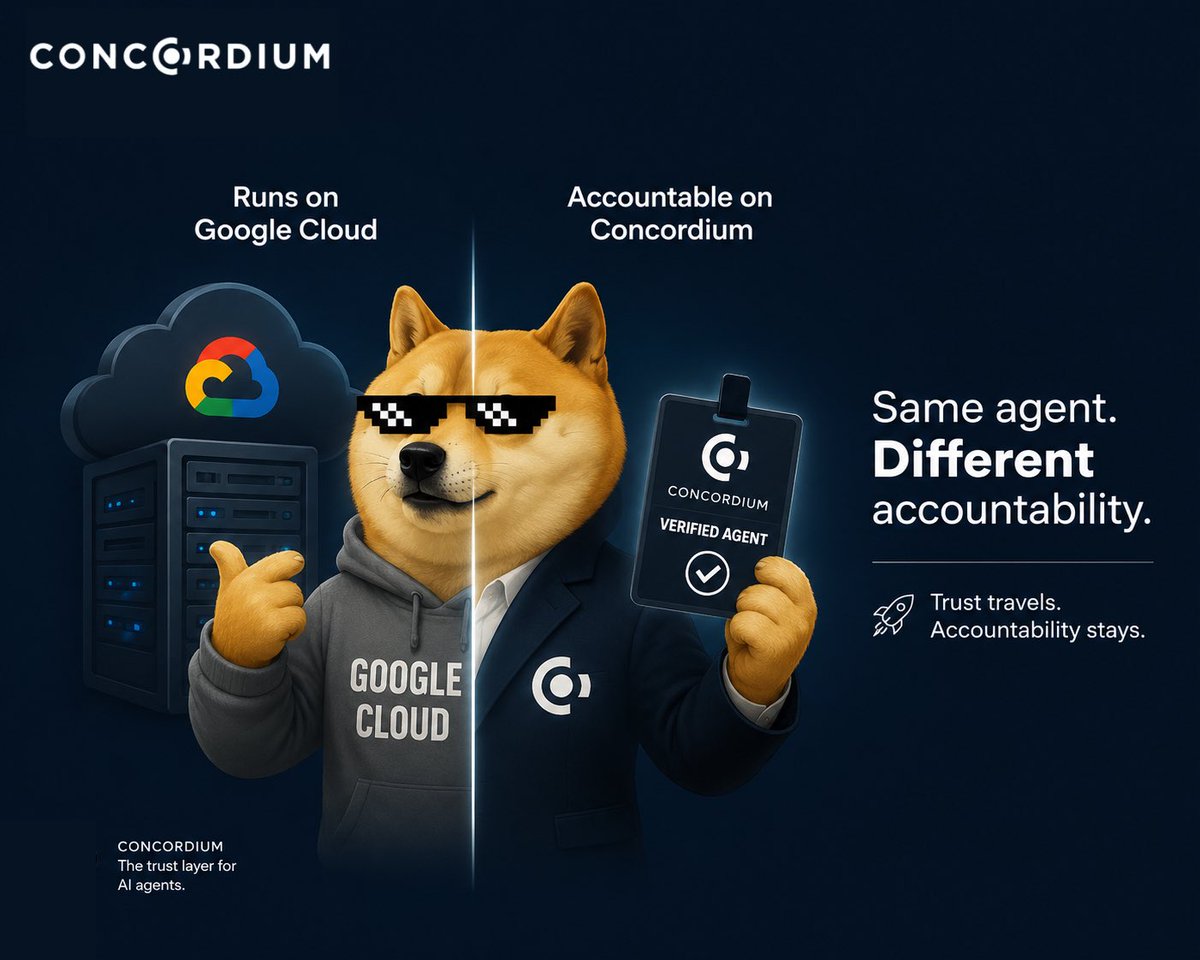
AI agents don’t need to move infrastructure just to become accountable.
An agent can keep running on Google Cloud while its registration is linked to an identity-backed @Concordium account.
That creates an important separation:
Runtime tells us where the agent operates and what it can access.
Authorisation tells us what it is allowed to do. Accountability tells us who stands behind it when it crosses organisational boundaries.
As agents start making decisions, moving value and interacting with other agents, knowing where they run isn’t enough.
You also need to know who is responsible.
That’s the layer Concordium’s Agent Registry is designed to add: portable, identity-backed accountability without changing the agent’s runtime.
#Concordium #Web3
AI agents can say a lot about themselves. Trust shouldn’t have to rely on the bio.
As agents start handling payments, workflows and autonomous services, knowing who is actually accountable matters.
@Concordium Agent Registry and Verified by Concordium Badge aim to make that accountability verifiable on-chain, while privacy-preserving technology helps keep sensitive identity details protected.
Verification doesn’t mean an agent can’t fail. It means responsibility doesn’t have to be a mystery.
#Concordium #AgentRegistry
AI agents taking over the internet sounds cool… until someone asks who’s responsible when one goes rogue.
That’s the part of the conversation we shouldn’t skip.
Inside the operator’s perimeter, we need to know which agent is running, what it can access, and which credentials it can use.
Outside it, we need answers to a different set of questions: who owns the agent, who authorised it, and who is accountable for its actions?
That’s where @Concordium focus on verifiable identity and accountability becomes interesting.
Smart agents are useful.
Agents with someone clearly standing behind them are much easier to trust.
The future isn’t just autonomous.
It needs to be accountable.
#Concordium #Web3 #AI
AI agent reputation systems will get harder to game as they mature.
That’s a good thing.
But reputation and accountability solve two different problems.
Reputation tells you how an agent has behaved over time, its track record, interactions, performance, and reliability.
Accountability answers a different question: who stands behind the agent when something goes wrong?
That distinction becomes more important as agents move from simple assistants to autonomous actors that can make payments, execute transactions, sign agreements, manage assets, and interact with other agents without constant human input.
A strong reputation might tell you an agent has behaved well so far. It doesn’t necessarily tell you who is responsible for its actions.
This is where verifiable identity becomes important.
@Concordium Agent Registry is designed to connect AI agents with verified human accountability, creating a clearer link between an autonomous agent and the person or organization behind it.
Better reputation helps you trust the track record. Verifiable accountability helps you know who is responsible.
Both matter. They just aren’t the same guarantee.
#Concordium #AI
Digital identity used to be mostly about one thing: proving you’re human.
But AI agents are changing what identity needs to mean.
As agents start making transactions, interacting with smart contracts, managing digital assets and acting on behalf of people and businesses, simply knowing that an agent exists isn’t enough.
The bigger question is: who is responsible when that agent acts?
@Concordium brings an interesting perspective by putting identity at the protocol level, with a focus on verification, privacy and accountability. This matters because trust shouldn’t require exposing more personal information than necessary.
For AI agents to operate at scale, people and businesses need more than proof that an agent is real. They need a way to understand who authorized it and who stands behind its actions when accountability is required.
Digital identity is moving beyond proof of personhood.
The next step could be proving responsibility in an economy where humans and autonomous agents increasingly work side by side.
#ConcordiumAmbassador
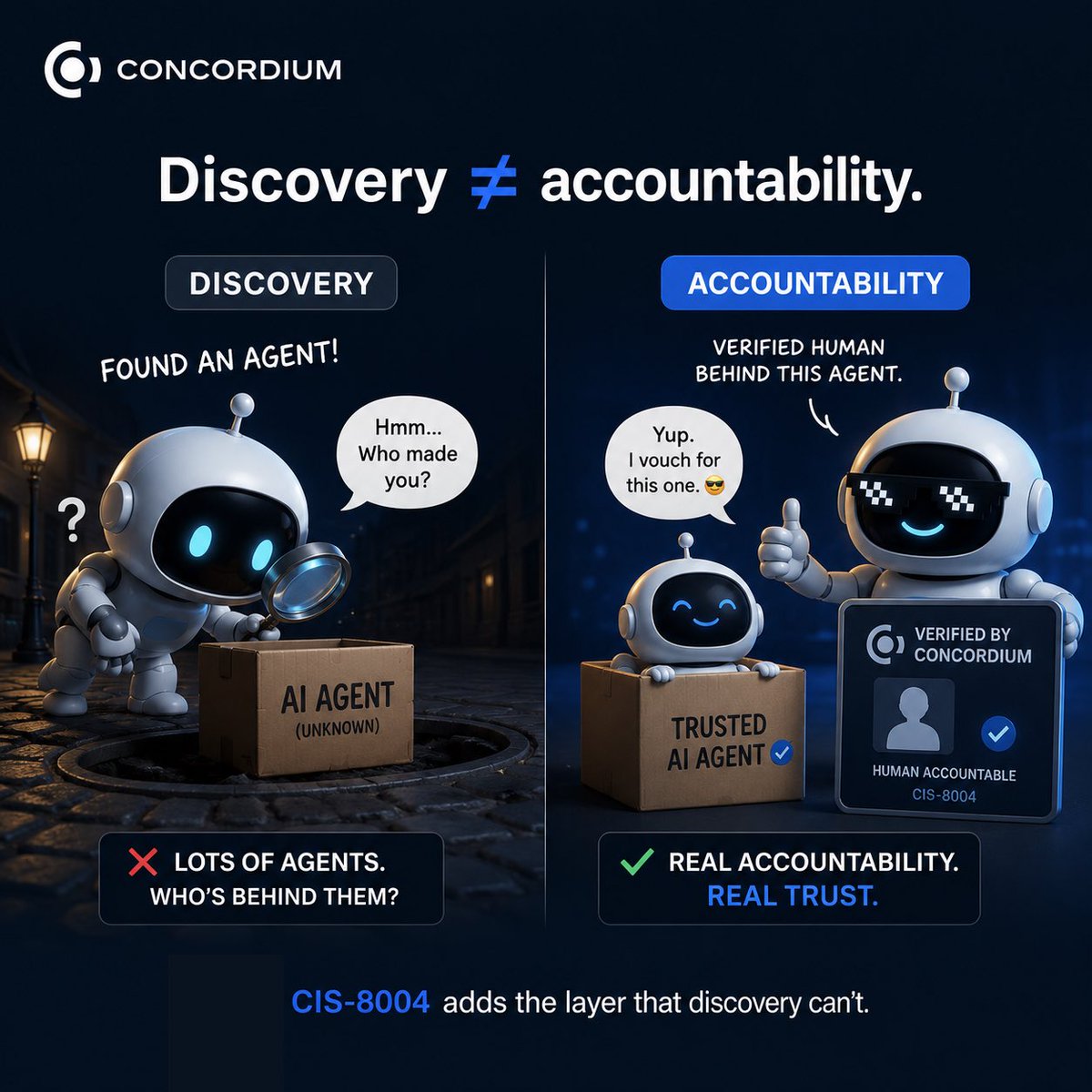
AI agents are getting easier to discover, but finding an agent is only the first step.
The bigger question is: who is accountable when that agent makes a decision, signs a transaction, or causes a loss?
Reputation can show an agent’s history and what others say about it. But reputation alone doesn’t prove there’s a real, verifiable party behind the agent.
This is where @Concordium identity approach becomes relevant.
CIS-8004 adds an accountability layer that can connect an AI agent to a verified human or business, while allowing the agent to keep operating on the networks it already uses.
As autonomous agents start handling real assets and interacting across different networks, having a way to verify who stands behind them could become just as important as knowing their reputation.
Discovery tells you an agent exists.
Accountability tells you who stands behind it.
#Concordium #AI
The harder Web3 gets, the more important it becomes to know who you’re dealing with.
Blockchain can verify transactions and ownership, but trust goes beyond proving that something happened. It also means understanding who or what is behind the interaction.
@Concordium takes a different approach by putting identity and verification at the protocol level, making them part of the underlying infrastructure rather than something added on later.
Its use of Zero-Knowledge Proofs also shows that verification doesn’t have to come at the cost of privacy. You can prove what matters without exposing more information than necessary.
This becomes even more relevant as AI agents start making decisions, interacting with applications, and moving value on their own.
The Agent Registry and Verified by Concordium Badge introduce a way to connect those agents with verifiable accountability.
As Web3 moves toward more autonomous systems, trust won’t just be something users assume. It will need to be something the infrastructure can help verify.
#ConcordiumAmbassador
AI agents are moving from simple tools to actors that can transact, interact with smart contracts, and make decisions on behalf of humans.
That raises a bigger question: if an agent acts, who is accountable?
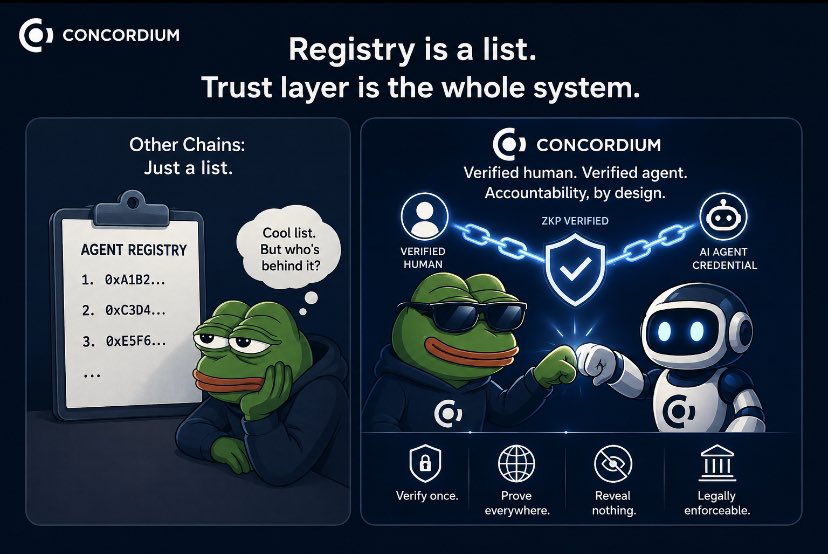
A registry can tell us that an agent exists. But existence alone doesn’t establish trust.
@Concordium is taking a different approach with its Agent Registry, designed to be ERC-8004 compatible while connecting an agent to a verified human through Concordium’s protocol-level identity layer.
With zero-knowledge proofs, an agent can provide verifiable evidence of authorization without exposing the underlying person’s identity or unnecessary personal data.
That creates a useful distinction:
Registry = discoverability.
Trust layer = accountability.
As autonomous agents become more common on-chain, knowing that an agent exists may not be enough. Being able to verify who stands behind its actions could become just as important.
Verify once. Prove everywhere. Reveal nothing.
#Concordium #AI