Guitar player. Vocalist. Metal. Rock & Roll. Cyborg. Musical villain. Mythic #MTGArena Player. Neon Pink skull enthusiast. Really fucking good at math.
The point isn't that Proto-Indo-Europeans shared mythology before they dispersed.
The question is whether those populations continued exchanging, developing and transmitting those traditions through interconnected trade, religious and dynastic networks long after their linguistic divergence.
I'm tracing the geography of those interactions through archaeology, material exchange, river systems, political institutions and historical accounts.
Common ancestry explains why they started with similar stories. It doesn't necessarily explain every subsequent convergence, particularly when those convergences correspond with identifiable commercial and political corridors.
I'm reconstructing the network.
OK WHOA WHOA WHOA.
Why in the fuck is Alexander working out a family tree that actually resembles what they're talking about in Beowulf, what Snorri mentions of Yngvi, and Njord?
Hold on.
Gwŷr y Gogledd? Some Icelandic Analogues to Branwen Ferch Llŷr (2001)
He examines the connections between Branwen, Beowulf, the Icelandic sagas and Scandinavian heroic traditions.
And he identifies a particularly close correspondence with Hrólfs saga kraka, involving the very same Aðils and Hrólfr whose counterparts appear in Beowulf.
His comparison includes:
The mutilation of horses, an ambush concealed within a royal hall, a treacherous reconciliation,
a royal family member being subjected to fire,
and Hall argues that the combination of these details is unlikely to be coincidental.
https://t.co/Yq3BeDH3re
In the upper left hand of the chart -
In Culhwch and Olwen, Gwyn ap Nudd and Gwythyr must fight over Creiddylad every May Day until Judgment Day.
https://t.co/TYTes3KlxX
Now compare that with the Norse Hjaðningavíg.
Hildr offers a necklace as compensation between two kings. The settlement fails, and she resurrects the slain warriors every night so that the battle continues until Ragnarök.
https://t.co/6aI3ocXO6i
One last discovery: Alexander himself described reconstructing this very family tree in his 1965 essay The Flat-Heeled Muse. We have his own account of the research, his surviving chart, and the medieval texts underlying it.
https://t.co/lOATS74zV9
1400–1100 BCE Mesopotamian glass reaches Denmark, northern Germany and Romania.
c. 1340 BCE Hittite–Mitanni treaty invokes Mitra, Varuna, Indra and the divine twins.
c. 1320 BCE Uluburun shipwreck carries Baltic amber off the Lycian coast.
1300–1200 BCE Assyria progressively absorbs the remaining Mitanni territories.
c. 1200 BCE Hittite imperial collapse, but the Carchemish dynasty survives.
c. 800 BCE Thousands of Baltic amber beads deposited in an elite Phrygian burial at Gordion.
All related incidents.
Herodotus, Histories 2.50
Almost all the names of the gods came to Greece from Egypt. My inquiries establish that they came from foreign peoples, and I believe principally from Egypt.
Except for Poseidon, the Dioscuri, Hera, Hestia, Themis, the Graces and the Nereids, the Egyptians have always possessed the names of the other gods.
Concerning those gods whose names the Egyptians claim not to know, I believe the Pelasgians named them, except Poseidon. They learned of this god from the Libyans. For no people other than the Libyans possessed the name of Poseidon from the beginning, and they have always honored this god.
2.50: Poseidon is distinguished from the Egyptian gods.
2.51: The Pelasgians transmit the mysteries of the Cabeiri at Samothrace.
4.179: A north wind drives Jason and the Argonauts into Libya, where Triton assists them.
4.180: A Libyan tradition identifies Athena as the daughter of Poseidon and Lake Tritonis.
4.145–150: Herodotus traces descendants of the Argonauts through Lemnos, Sparta, Thera and eventually back to Libya.
Then Pindar's Pythian Ode 4 explicitly connects this migration tradition to Euphemus, a son of Poseidon, whose descendants are destined to establish a dynasty in Libya.
So there is actually a northward return journey embedded in the religious and dynastic tradition, followed by a southward recolonization.
Narasimhan et al. (2019), The Formation of Human Populations in South and Central Asia, identifies a shared steppe ancestry profile between Bronze Age Eastern Europeans and the populations subsequently entering South Asia.
https://t.co/Pr39WNjeJ7
Yes, all the families up here fought just like everyone fought down south.
Every now and then though, everyone in one particular connected part of this network geography would all be pals, and join up.
And well, let's just say that's when shit got real.
@ThFerrier@RannoSlav Wasn't he once on the Tower of Athens?
Hmm, that's weird Considering Philip the II claims Boreas through Olympias.
Isn't it?
https://t.co/xt8lIV8KVZ
the Tower of Athens doesn't just encode Troy's location.
The Tower is useful because its eight walls are explicitly assigned to N, NE, E, SE, S, SW, W, NW, and the monument itself was constructed on a north–south astronomical orientation.
So rather than asking merely “which wind sector contains a place?”
I’m measuring angular distance from the centerline of that wind. That matters because every location must fall into some 45° sector; a location landing within a few degrees of the centerline is the interesting part.
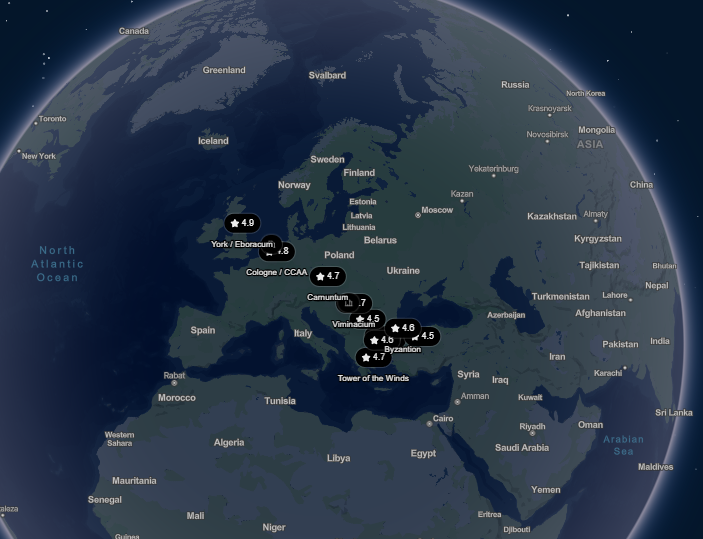
Using the Tower at 37.9743° N, 23.7271° E as the origin, I get this first-pass radial map. Troy, Gordion, Delphi, Aigai, Xanthos, and Cyrene use coordinates; the other ancient centers use archaeological gazetteer coordinates.
And Boreas gives us an independent mythology check.
In Greek tradition, Boreas isn't merely abstract “north”: he is repeatedly Thracian-facing. Oxford's Classical Dictionary describes the north wind as coming to Greece from Thrace; traditions locate his home around Thrace/Mount Haemus, and the Boreas–Oreithyia story takes the Athenian princess north into that landscape.
https://t.co/2xMxPI84de
Now put that beside my calculation:
Tower → Serdica = 356.4°.
That is almost literally the Boreas centerline running from Athens into the Thraco-Balkan interior.
Very strong centerline hits (<5°): Troy → Kaikias; Serdica → Boreas.
Strong (<10°): Byzantion → Kaikias; Dodona → Skiron; Nijmegen → Skiron; York → Skiron.
Interesting but not centerline (<15°): Lemnos → Kaikias.
Everything around 16–22° — Samothrace, Gordion, Delphi, Xanthos, Rhodes, Knossos, etc.
The biggest thing I noticed is that the genealogy itself stitches the geography together. Oreithyia begins at the Ilissos at Athens; Boreas carries her into the Thracian sphere; their children include Zetes, Calais and Cleopatra; Cleopatra marries the Thracian seer-king Phineus; and Phineus is placed at Salmydessus on the Black Sea approach. Then Phineus's second wife Idaea is explicitly called a daughter of Dardanus in Apollodorus, while Diodorus calls her the daughter of the Scythian king Dardanus. Separately, the Trojan Dardanus leaves Samothrace for the opposite Asian mainland and establishes Dardania.
Triton is literally depicted at Rudston, East Yorkshire in the territory associated with the Parisi.
Triton taming a hippocampus
Discovered at Carhalo, near Broons, Côtes-d’Armor, Brittany.
A Gallo-Roman relief believed to have decorated a villa, possibly its baths.
https://t.co/21X3KMwyXX
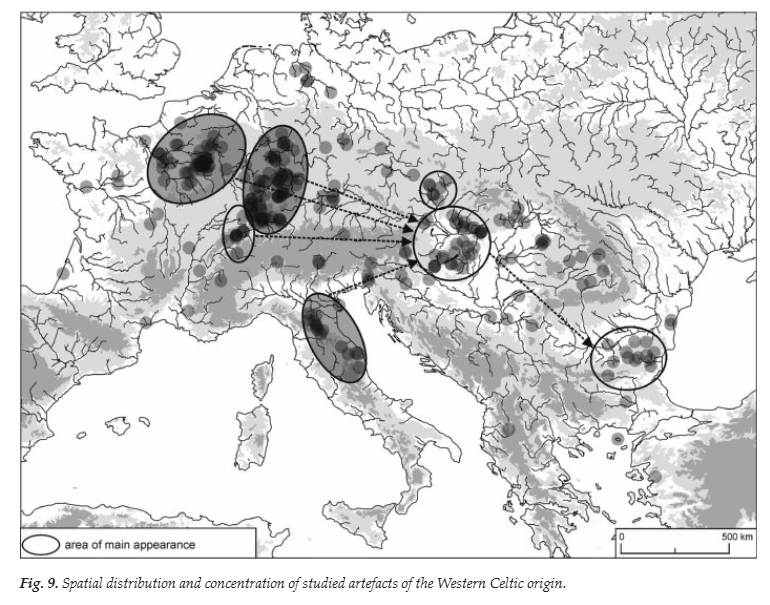
the 2025 archaeological study of the Teynham Triton explicitly discusses the cross-Channel mercantile networks connecting Kent with the Rhineland, citing the sanctuary of Nehalennia in the Scheldt estuary as evidence of those networks.
Oh, no shit?
Yep, Phillip the II would have to be related to someone in La Tene because of the Hercules ancestry he claims not only does that put him into contact with the Thracian/Celt side that's using the Rhine/Danube to Gaul corridor it puts his son with the North Sea navy in India, where their coins reflect these exact changes.
Hercules is directly responsible for putting Priam on the throne.
"Its relief shows Priam, king of Troy, kneeling before Achilles and begging for the return of Hector’s body essentially the climactic scene from Iliad Book 24. The cup was manufactured in Italy around the beginning of the Common Era and ended up buried with an elite man at Hoby shortly afterward.. in Denmark..."