Mariana van Zeller spent a long stretch of Joe Rogan #2567 on scams. Read through John Boyd, a scam is cognitive warfare aimed at one person. Inset: The Joe Rogan Experience #2567 episode art. https://t.co/lHtpiE9cTi
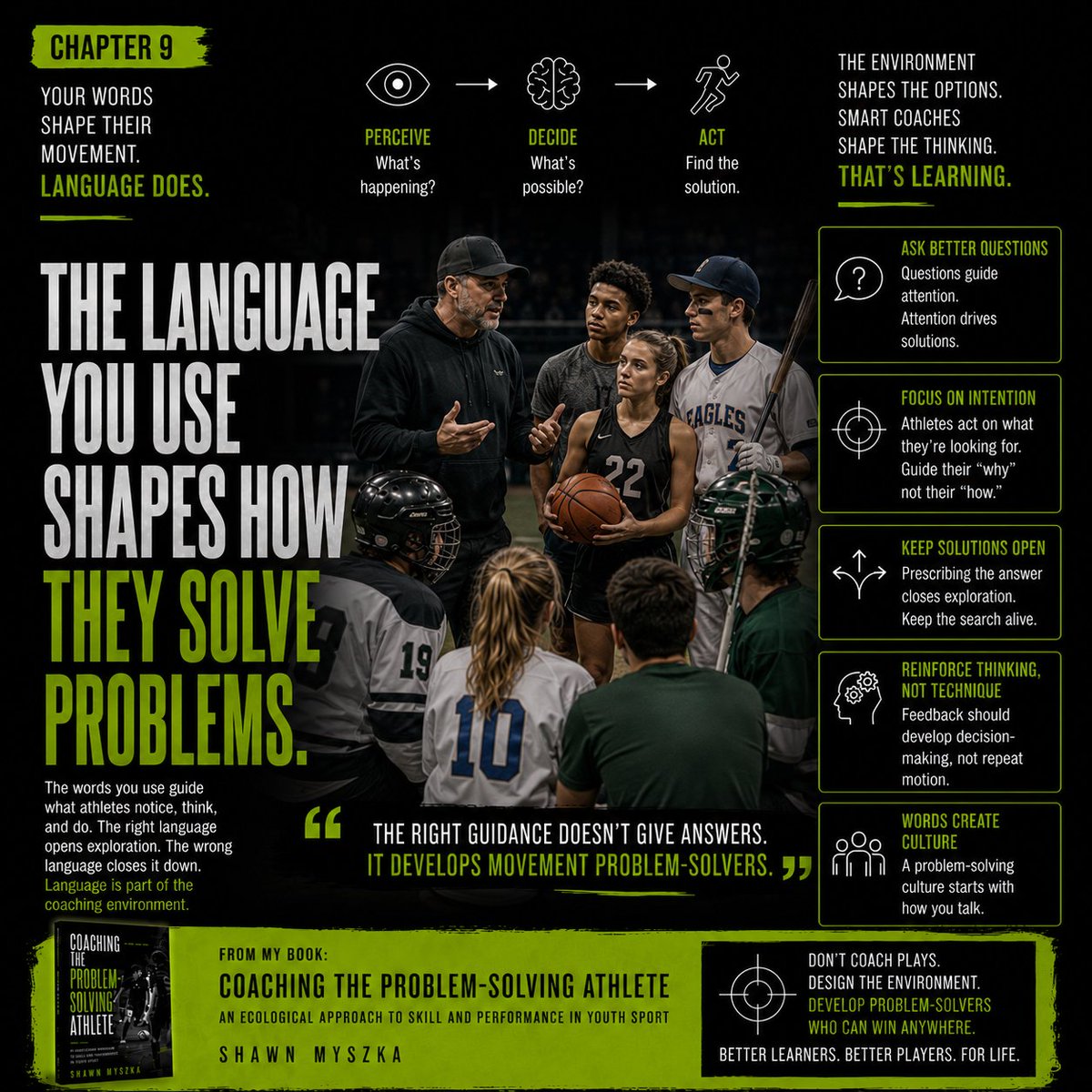
The language you use shapes how your athletes solve movement problems.
Guide their “why” — not their “how.”
Ask better questions — don’t prescribe answers.
Reinforce thinking — not just technique.
The right guidance doesn’t give answers. It develops movement problem-solvers.
Chapter 9 is all about this in Coaching the Problem-Solving Athlete.
https://t.co/UV5MWDUaiy
"What's in a name? From Norbert Wiener's Teleology to Artificial Intelligence"
For those interested in my teleology-cybernetics-S/AI explorations, I have a talk upcoming at SCiOs UK virtual meeting 16 Nov
https://t.co/yrPOezxpiP
1/4 @RUGBY_STR_COACH
You described the linear OODA loop, one from doctrine. Not the real OODA loop. Karl Friston, one of the world's most cited neuroscientists, said on No Way Out that 99% of the way we actually move and engage with the world is fast and reflexive. Deliberate choice is the 1%.
Continuing the @learntotackle series:
Coaches throw around buzzwords like timing and coordination in tackle training, but what do they mean? Timing and coordination in relation to what? We can't define these terms until we've linked them to our perception of the outside world.
Perception and action are inextricably linked and we can't optimally train for skill by training one without the other. This is one reason why I think bags and sleds are wholly incomplete solutions for tackle training.
Today, we continue our critique of the OODA look, examine the relationship between perception and action using real-game examples of missed tackles, and discuss three practical changes you can make to better preserve the relationship between perception and action when you coach the tackle.
Key learning points
-Timing and coordination only matter relative to an external result, so you need something real to time against
- Perception changes the landscape of affordances: narrow focus means fewer movement options
- Action changes perception: head position and movement shape the information you take in
- Feel matters just as much as sight: pressure and tension give valuable information about our opponent
-Why stationary bags and sleds conflict with perception-action coupling
- Why tackling often regresses in the off-season
- Three vital coaching changes: game-like sensory information, coupled perception-action drills, and training with breadth
Chapters
0:00 Welcome and series intro
0:19 Recap: critiquing the OODA loop
1:18 Perception and action are inextricably linked
1:53 How perception changes affordances
2:10 A real-game example: Blake Grupe's ACL injury
3:00 Common missed tackles: feet, QB, blockers
3:19 How action changes perception
3:41 Feeling the ball carrier: pressure and weight distribution
4:49 What good timing and coordination actually look like
6:17 Why sleds and bags conflict with perception-action coupling
7:10 Off-season regression and the FUD problem
7:36 Three changes to how we coach the tackle
8:43 Wrap-up
🏈 Wrestling for Football programming drops 1st December. Subscribe to this channel for a special discount when it drops.
👉 Subscribe to the channel and switch on notifications so you don’t miss a video.
#LearnToTackle #TacklingFootball #FootballCoaching #TackleTechnique #FootballTraining #SkillAcquisition #TimingAndCoordination #SportsScience #CoachingFootball #SafeTackling
3/4
Feel belongs there too. The pressure and weight shift you pick up on contact is information orientation uses in real time. That is the same ground the constraints-led approach covers, with orientation at the center.
@RUGBY_STR_COACH@learntotackle 5/ Your fix already describes orientation: breadth of movement options, depth for timing, live opposition, and letting the environment give the athlete feedback. Boyd tied orientation to "previous experiences, previous training." Coaches who like the loop can keep it.
@RUGBY_STR_COACH@learntotackle 4/ One history note. Boyd's canopy case was Korea, 1951 to 53. At Quantico in 1989 he said, "The -86 had a super bubble canopy; the MiG had a very constrained one." The 10 to 1 ratio is a US claim from Korea, and later research puts it near 2 to 1.
@RUGBY_STR_COACH@learntotackle 3/ On the next page, Boyd calls it all a "process of self-organization, emergence and natural selection." Put that next to ecological dynamics and the Constraints-Led Approach: skill emerging from individual, task and environment constraints, tuned by experience.
@RUGBY_STR_COACH@learntotackle 2/ Here's Boyd's 1995 sketch. Orientation sits at the center: genetic heritage, cultural traditions, previous experiences. Two arrows labeled "Implicit Guidance & Control" run from orientation to observation and to action. The one to action skips the Decision box.
@heynavtoor Great work!
Four step OODA loop is not the real OODA loop. The real one represents how living systems interact with their environment. Novelty seeking agents.
Real OODA: connects to RL, RSI, Active Inference, +++
@heynavtoor put John Boyd in front of 150k people who build with AI. Worth your time. The next step is loops. Boyd's ideas on orientation, mission command and the strategic game fit how people and agents learn together. More on that soon.
In the 1950s, a US fighter pilot made an outrageous challenge.
He let other pilots start behind his jet in simulated combat. If he couldn’t reverse their positions within 40 seconds, he’d pay them $40.
Nobody ever collected.
They called him 40-Second Boyd.
Flying wasn’t his biggest contribution. He helped shape the F-15 and F-16, fought the Pentagon for years, and never published a book.
He left behind one framework. You already know its four words:
Observe. Orient. Decide. Act. (OODA)
Almost nobody uses it the way he meant.
His name was John Boyd.
I turned his thinking into 9 Claude prompts. Here are all 9:
@XRPeaceOfMind@YouTube Thanks for sharing this one. Zach Elwood brought a lot to the table on reading people and what happens in orientation before anyone acts. Glad it landed.
Last week Kent Clizbe, a former CIA case officer, explained why he stopped trying to catch lies and started judging credibility. Context does the work. https://t.co/qHiXtsYHxX
For two days one of the biggest podcasts in the country has been in a public fight with a guest over who is telling the truth. Most people picked a side in ZachElwood on the first hour.
@apokerplayer wrote the books on poker tells. His warning: a story can be captivating and still be false.
Van Zeller spent another long stretch of this episode on scams, and it’s the same pattern. A system makes money, the incentives reward looking away, and the people who pay are the ones with the least information. Reuters reported that Meta’s own documents projected about 10% of its 2024 revenue would come from scam and banned-goods ads.