We need some sort of water meter that lives next to the AI chat dialogue (and other AI tools) to serve as a continuous reminder of the resource waste that is being generated to create AI slop.
For the want of a nail the shoe was lost,
For the want of a shoe the horse was lost,
For the want of a horse the rider was lost,
For the want of a rider the battle was lost,
For the want of a battle the kingdom was lost,
And all for the want of a horseshoe-nail.
This design change is so annoying that it’s enough to post about. I can’t tell you how many times I’ve gotten these buttons confused, even after using the new OS update for several weeks.
#Apple#wtfUX#Design
Fascinating paper just published in Science.
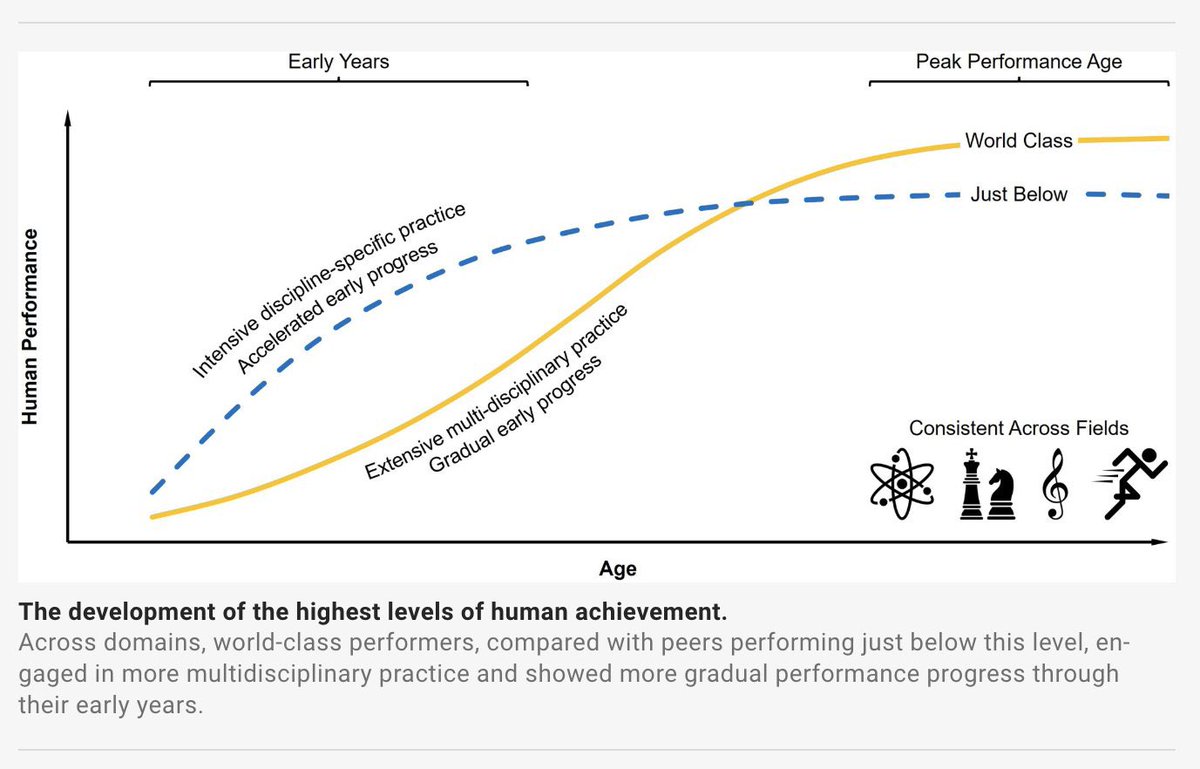
The authors analyze the career trajectories of top performers across multiple domains, including Nobel laureates, elite chess players, Olympic gold medalists, and more.
Their central finding challenges a common belief.
Intensive, single-discipline training at a young age does confer an early advantage, but this advantage fades over time.
By contrast, individuals exposed to multidisciplinary practice early in life tend to start more slowly. Yet, over the long run, they are more likely to reach world-class performance, eventually overtaking early specialists, who often plateau just below the very top.
An important reminder that breadth early on can be a powerful investment in long-term excellence.
Link to the paper in the first reply.
Mastering control at very short time scales.
A platform balancing a ping pong ball by continuously adjusting its motion.
What looks simple highlights a hard problem in control.
• Tight sensing, compute, and act loops running at millisecond scale
• Smooth, stable corrections without overshoot
• A clear example of how latency and control quality dominate performance
Systems like this are less about the demo and more about what they reveal.
When feedback loops get fast and precise enough, entirely new classes of behavior become possible.
—-
Weekly robotics and AI insights.
Subscribe free: https://t.co/dsa6wcvq6n
“…(1) folks who are in over their heads when their breadth of experience (in methods, approaches, products, and politics) doesn’t match expectations of senior stakeholders…”
Things I'm Hearing about UX Research
{ by Chris Chapman } from @hashnode https://t.co/k2NGKeyb0r
Today in Cell, we published new research showing how AI can help accelerate cancer discovery. With GigaTIME, we can now simulate spatial proteomics from routine pathology slides, enabling population-scale analysis of tumor microenvironments across dozens of cancer types and hundreds of subtypes.
Developed in partnership with Providence and the University of Washington, our hope is that this work helps scientists move faster from data to insight, revealing new links between genetic mutations, immune activity, and clinical outcomes, and ultimately improving health for people everywhere.
Google Scholar Labs, akademik dünyada kartları yeniden dağıtıyor!
Artık alanyazın taramalarınız sadece kelime bazlı değil, yapay zeka destekli olacak.
Yani iğneyle kuyu kazma devri bitiyor; araştırma yapmak hiç olmadığı kadar hızlı ve akıllı hale geliyor.
Bekleme listesine dahil olmayı unutmayın!
https://t.co/TH0SvMVQ9l
The Zildjian Company is the oldest cymbal maker in the world. For 400 years, the family business survived migration, a world war, and the worst economic crisis in America.
(Source: The Zildjian Company, 2023)
This is work that deserves massive amounts of resources and could actually bring measurable value. This is what I want to see AI used for. This is what I want updates on. Solve the problems that are deeply painful and matter to humanity.
An exciting milestone for AI in science: Our C2S-Scale 27B foundation model, built with @Yale and based on Gemma, generated a novel hypothesis about cancer cellular behavior, which scientists experimentally validated in living cells.
With more preclinical and clinical tests, this discovery may reveal a promising new pathway for developing therapies to fight cancer.
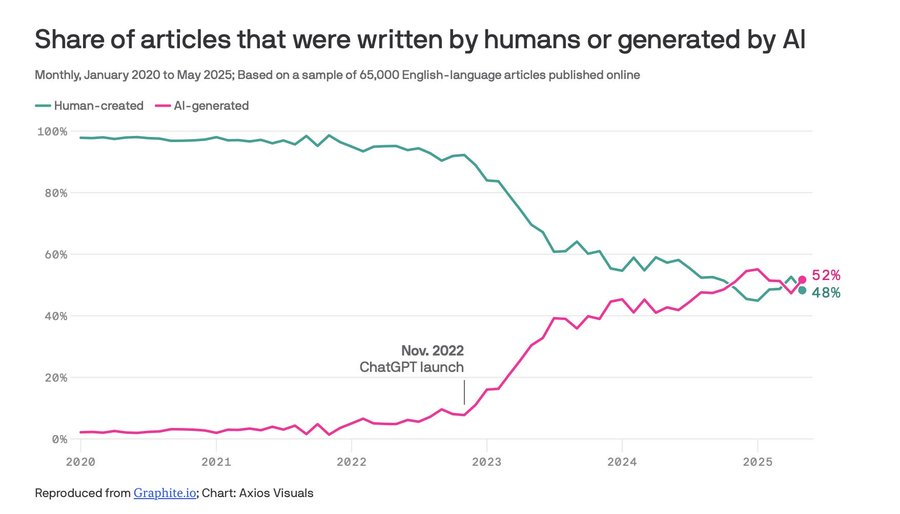
Oxford researchers just confirmed what we feared:
The internet as we knew it is dying.
AI content went from ~5% in 2020 to 48% by May 2025. Projections say 90%+ by next year.
Why? AI articles cost <$0.01. Human writers cost $10-100.
But the real crisis is model collapse. When AI trains on AI-generated content, quality degrades like photocopying a photocopy. Rare ideas disappear. Everything converges to generic sameness.
It's recursive. Today's AI slop becomes tomorrow's training data, producing worse output, which becomes training data again.
Customer service in 2030: “You have the basic package, which only includes taking out the trash and vacuuming. If you want the dishes and laundry done you need to upgrade to the premium package.”
#figure03#robotics#humanoids
I hope AI developments create a boon for the arts. I hope people seek out spaces that are void of 1s and 0s. I hope human error and imperfection become commodities. I hope convenience is shunned. I hope all the things that remind us of our humanness are held sacred.
Working hypothesis: forms that break norms are less trusted than forms that conform.
If there is a strong categorical reference for a device’s form, large deviations from that reference may lead to consumer distrust, especially when brand equity has not been established.