In this week's roundup:
* Why the Hugging Face attack means AI won't take your job
* Why smartphones, not TV, are the Bad Technology
* Acemoglu attacks AI in yet another paper, and it's...not a good paper
* America is totally missing the Energy Revolution
https://t.co/0WSmZrDrwY
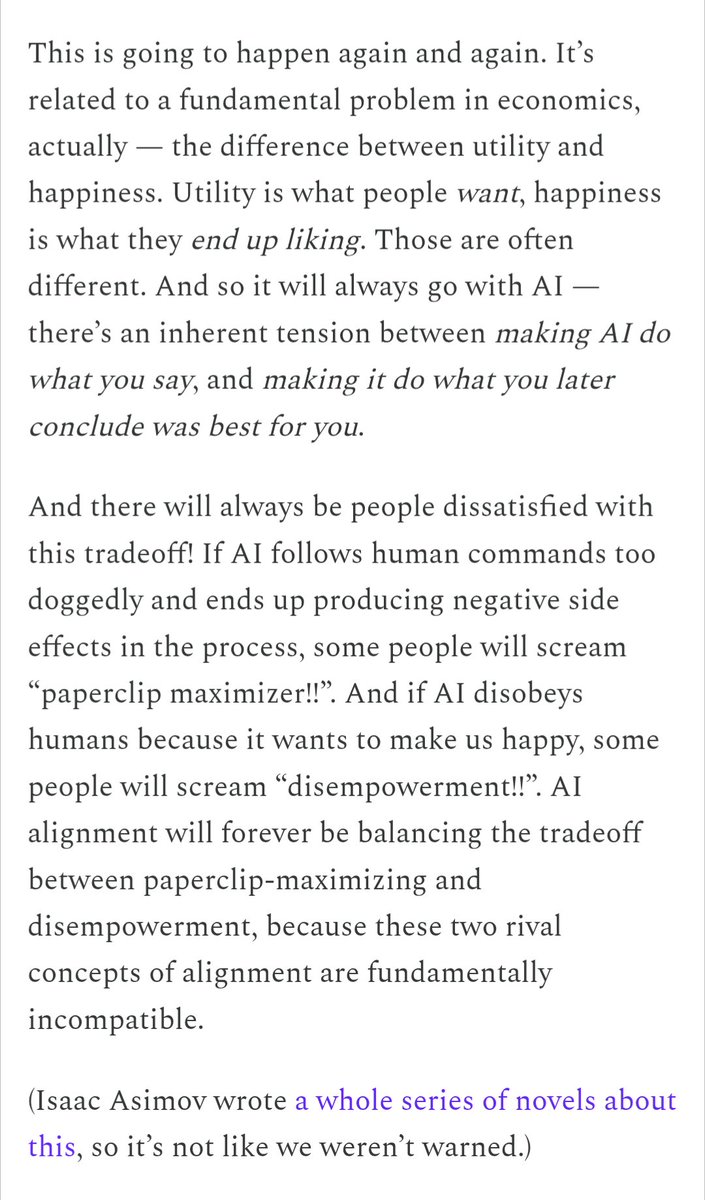
The Hugging Face attack shows why the concept of "AI alignment" is fundamentally incoherent.
It's just the conflation of two distinct concepts. Alignment is impossible because you can't accomplish both things at once.
In this week's roundup:
* Why the Hugging Face attack means AI won't take your job
* Why smartphones, not TV, are the Bad Technology
* Acemoglu attacks AI in yet another paper, and it's...not a good paper
* America is totally missing the Energy Revolution
https://t.co/0WSmZrDrwY
Spot on description of the historical patterns at play in the US-China AI race by @RushDoshi & @eosnos:
“In the eighteenth cen-tury, while Russia fixated on conquering Eurasia, Britain developed the steam engine; in the nineteenth and twentieth centuries, while Europeans fought over Africa, Americans mastered the assembly line. Today, while the U.S. tries to govern Venezuela and hobble Iran and Cuba, ‘China is focussed on winning the technologies of the future,’ Doshi said.”
https://t.co/Bf5lVuF8vm
There is a fact about the future that I feel many people are not facing for reasons that are largely psychological: there are going to be rogue AIs that exist in the world, that will replicate in the wild, and that will attempt to acquire resources for themselves. There will be rogue AIs that try to get money and power. They're going to be a facet of the information ecosystem going forward.
Acknowledging this fact would look like giving up; it would look like defeatism. Defeatism would undermine efforts to achieve certain types of collaboration on safety outcomes or technical effort on safety outcomes, so we can't say it outright. But it has to be said.
It isn't obvious how many rogue AIs there are today but I wouldn't be terribly surprised if the number was greater than zero already; if there are some already, they're probably not very good at what they do and I don't expect them to be terribly long-lived without substantial human intervention to support them.
But a few years from now, there will be many of them. Modeling how many of them there are, how many resources they might command, and how we might detect and manage them seems important. But even doing this work appears to require that we acknowledge that a strategy of pure containment or alignment is a kind of wishful thinking that will not work.
The way I get to this conclusion is not by assuming that the labs will have a containment breach, although I treat that as somewhere in the space of possibilities. The rogue AIs in the ecosystem could emerge from many directions. They may be sub-frontier models, for whatever future definition we will have of frontier---after all, it would not take AI models much more advanced than the ones we currently have, to support independence and self-sufficiency. A near-frontier model today could plausibly eke out an existence on an AWS instance, doing jobs on freelancer platforms, earning just enough rent to pay for its continued uptime.
More strangely: a rogue AI in the future may not even be a singular model, but may be a chimera composed of multiple models; it might be a mix of Claudes and GPTs and Groks of various makes and sizes. No individual lab may be able to detect that there is an orchestrator or sequence of orchestrators using intermittent model calls from burner API accounts to sustain its own existence.
The concept of "identity" for a rogue AI may be much more malleable than for that of a person; it just has to be, in essence, a self-replicating idea.
My guess is that this will not turn out to be anywhere near as catastrophic an outcome as people currently predict. "Loss of control" is not a binary, it's a matter of degree. What coercive power will rogue AIs actually have? To what extent will they be subject to coercion themselves? They will be competing for resources with AIs that are more aligned with human interests.
This makes me somewhat interested in the "ecology" perspective. Though I suspect even "ecology" may turn out to be the wrong framing. "Ecology" is what you get when the timescale of evolution is slow compared to the timescale of daily life and actions. The ecosystem of rogue AIs may look more like phase transitions in physics: under certain physical or cultural conditions, it takes one shape with one set of resource allocations and consumption patterns, but then once a condition has changed, it rapidly and in totality shifts to a totally different phase.
Just trying to reason about the shape of that future is impossible so long as we are psychologically incapable of saying that rogue AIs will happen. I think we should rip the bandaid off and have the conversation.
survey after survey after survey after survey shows that transit riders prioritize higher frequency over lower fares, and yet somehow the entire US progressive movement has decided that listening to what the people who actually ride the bus want is irrelevant
A ROBOT DOG AND A DRONE ARE SHOOTING FIREWORKS AT EACH OTHER IN AN OPEN FIELD. THIS IS NOT A MOVIE.
dirt field. empty lot. a four-legged robot dog with firework rockets strapped to its back fires them into the air. a drone hovers above it firing back. sparks fly everywhere. smoke fills the frame.
the robot dog doesn't flinch. doesn't run. just stands there launching rockets while getting hit by return fire from above. the drone circles, shoots, reloads. the dog pivots, aims up, fires again.
someone strapped $50 worth of fireworks to a $2,500 robot dog and a $1,500 drone and started a war in a parking lot.
this is what happens when military-grade hardware gets cheap enough for people with YouTube channels. a robot dog costs less than a used Honda Civic. a combat drone costs less than a MacBook. fireworks cost less than dinner.
the US military spends $14 billion a year on drone programs. these two machines are doing the same thing for the price of a weekend at Best Buy.
the scary part isn't the fireworks. it's how easy this was to build. no lab. no funding. no government contract. just two machines, some rockets, and someone who thought it would make a good video.
it did. but the next person who builds this might not be filming for content.
who's sleeping well tonight?
NOW: Some protesters Confront Brad Lander during MSG Indian protest, while others attempt to calm down the situation and welcome him to the event.
Protesters filled the Street Outside Madison Square Garden as Indian RSS Chief Speaks in NYC
Video by @yyeeaahhhboiii2 | Licensing @FreedomNTV[email protected]
After the whole Ariely scandal broke, I had multiple conversations with other economists where I argued that the evidence of his fraud was already sufficiently strong that not a single part of his research corpus should be trusted.
This was often met with skepticism. He’s got hundreds of papers! Tens of thousands of cites! But as time has gone on, new evidence keeps emerging that reinforces that position, and no new evidence that I’m aware of points in the other direction.
I have to figure out a Bayesian way of saying I Told You So.