I ASKED A BILLIONAIRE HOW HE NEVER PANICS DURING CRASHES. HE SENT ME THIS
No explanation, no context, just the framework.
Price falls 5% → Hold
Price falls 15% → Buy 10%
Price falls 25% → Buy 20%
Price falls 40% → Buy 30%
Price falls 60% → Buy 40%
Price rises 5% → Hold
Price rises 20% → Hold
Price rises 25% → Sell 10%
Price rises 40% → Sell 20%
Price rises 50% → Sell 35%
Price rises 70% → Sell 40%
Price rises 100% → Sell 90%
Always keep 10% as a moonbag
Never go all in, never go all out
Took me one read to understand it.
Took me one crash to believe it.
Follow me - the people who do tend not to regret it
⚡️🚨 IRGC statement (Communique No. 40): Iranian forces struck a compound housing US forces in Jordan, reportedly killing a number of soldiers, marking a casualty claim in the ongoing wave of attacks on American-linked sites in the region. (IRGC statement via IRIB News, Iran Militarism)
I can see the Japanese minions are back from their holidays and have resumed their meddling in the crude oil market. This move, which happens every day, did not occur when Japan market was closed.
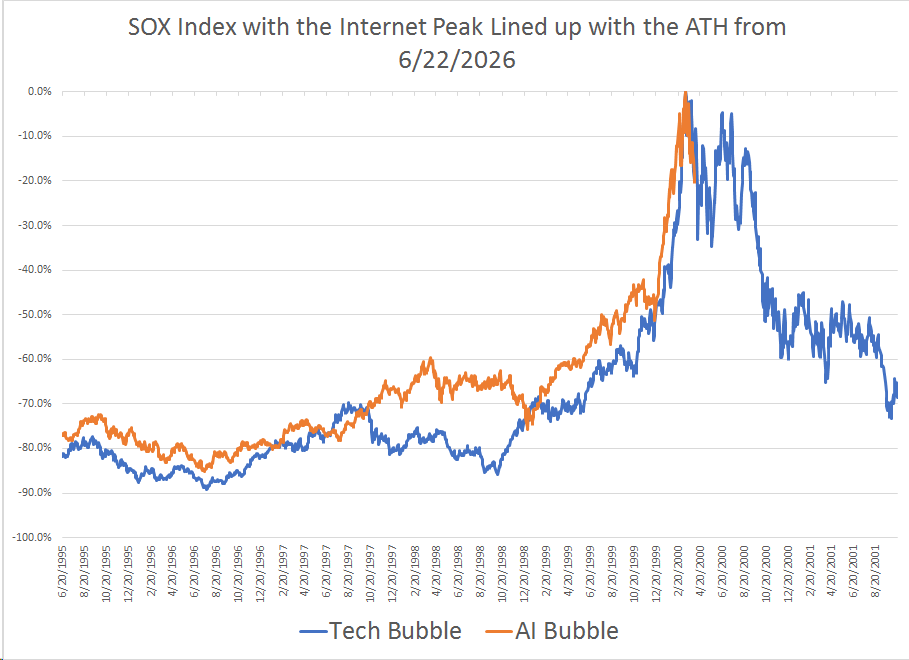
As mentioned 6 weeks ago we are in a bubble. If it popped. Don't know and probably not. But if it popped heres how the Internet bubble played out. Choppy for a few months. Don't hate. No chart crime just lining up the top and the potential top on a single y axis. This is a bubble whether the top or not. https://t.co/0ZfbHMkuRo
I don’t believe that. It would be a stupid move that would frame Iran as the aggressor state and motivate even more actors to join the war.
I’m treating this as hoaxes.
What does exist, however, are Iranian troop movements aimed at countering a possible invasion through Khuzestan.
🦔The Wall Street Journal reports that multiple data center builders are simultaneously trying to sell majority stakes in their companies. Netrality, DataBank, Edged, and EdgeCore are all working with bankers to find buyers this summer. DataBank alone could go for $25 billion. These aren't companies selling a few properties. They're selling control of their entire businesses to private equity while the AI buildout is supposedly booming.
My Take
If AI data centers are the gold mine these companies have been telling investors they are, why are the people who built them racing to sell? The WSJ said they're "cashing in on a hot asset class." I'd read it differently. The people closest to the actual economics of building and operating these facilities all decided at the same time that they'd rather have someone else's money than their own equity. That looks a lot more like an exit than a diversification play.
Huang just said a gigawatt of AI compute could cost $100 billion, GPU hardware goes obsolete every 18 months, and local opposition is killing permits in state after state. The customer base is mostly unprofitable AI companies signing leases with investor money, not earned revenue. The builders see all of this up close every day, and they've collectively decided this is a good time to let someone else own the risk going forward.
Hedgie🤗
https://t.co/oP45o6Om1G
BREAKING: The average US gas price officially rises back above $4.00 per gallon as the Iran War returns and the “Memorandum of Understanding” collapses.
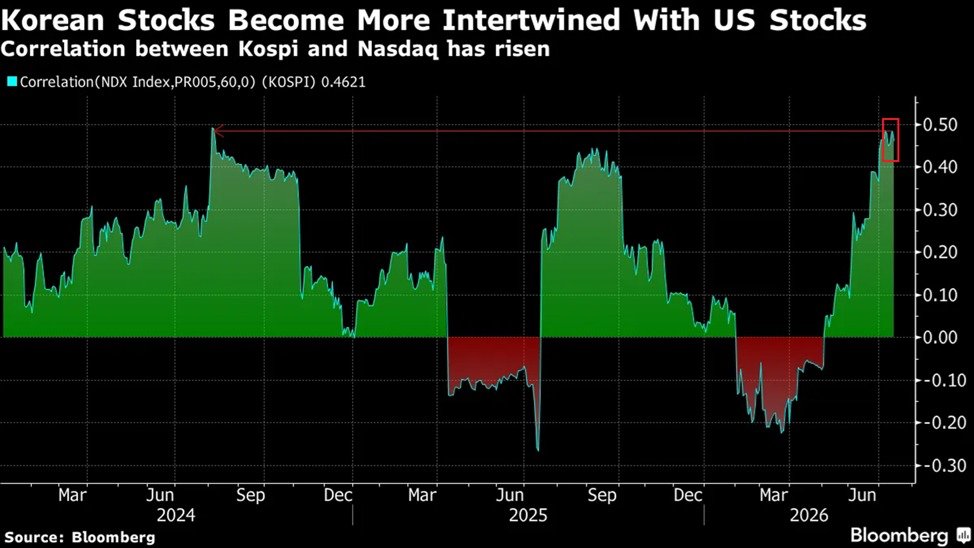
The South Korean and US AI trades are becoming increasingly synchronized:
The 60-day correlation between the KOSPI and Nasdaq 100 index is up to +0.46, the highest since July 2024.
This marks a sharp reversal from a negative correlation of -0.20 recorded in March.
By comparison, the 5-year average is just +0.16 or nearly one-third the 60-day metric.
Furthermore, the Nasdaq 100's sensitivity to declines in South Korean stocks is up to its highest level since 1990.
At the same time, the MSCI World Index's sensitivity to the South Korean market is up to its highest in 4 years.
In other words, declines in South Korean equities are increasingly serving as an early read on US and global equity risk appetite, particularly in technology stocks.
The AI trade has never been more global.
Following today’s announced “blockade” of Saudi Arabia by the Iranian-backed Houthi terrorist group in Yemen, chances that the Bab el-Mandela Strait will once again be closed have begun to steadily rise on Polymarket’s betting market, with chances that the strait will be effectively closed by August 31 sitting at 19%.
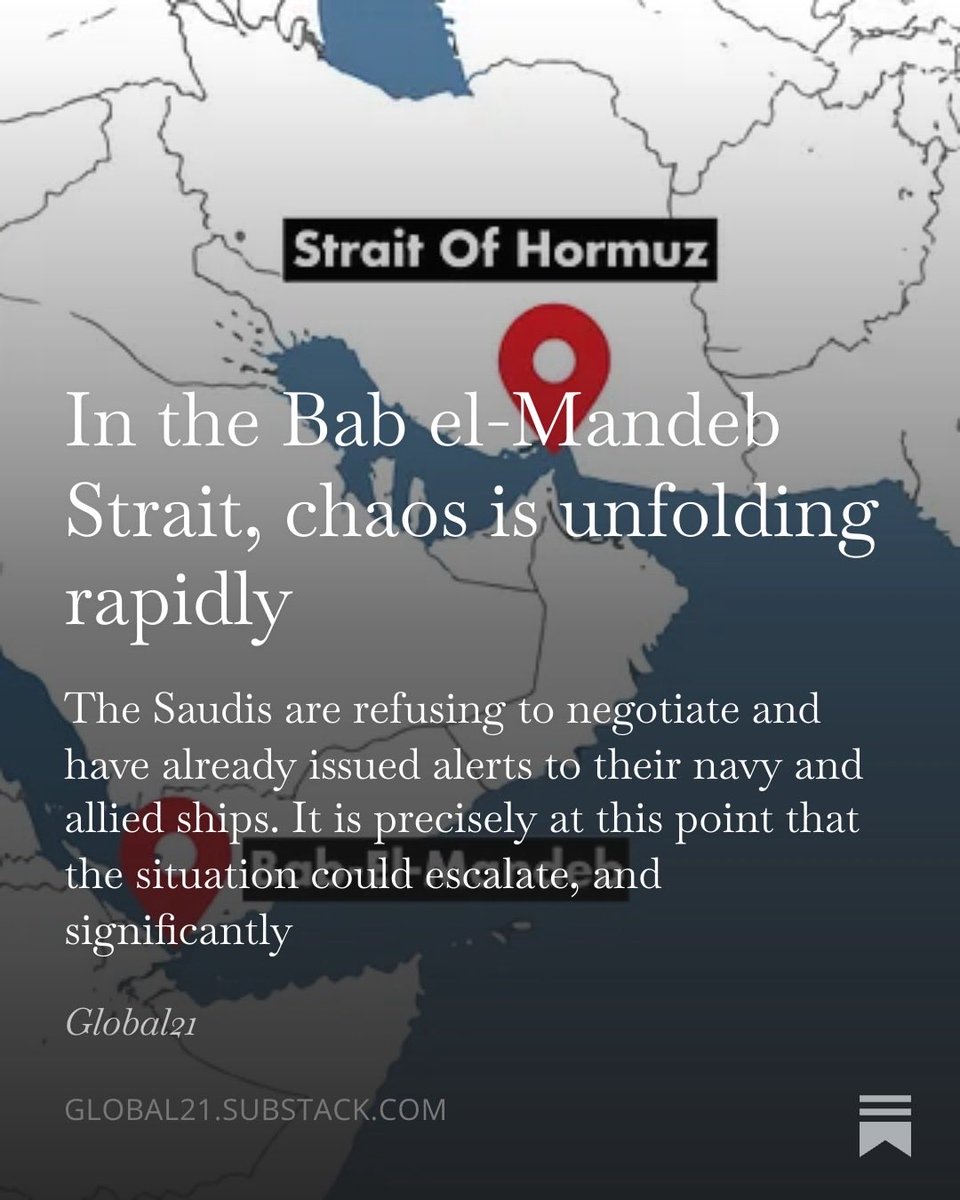
In the Bab el-Mandeb Strait, chaos is unfolding rapidly
The Houthis announced this week the closure of the strait to Saudi vessels, escalating a naval blockade in response to the air and land blockade that Saudi Arabia imposes on Yemen.
Until last week, Saudi Arabia was exporting around 4 to 4.5 million barrels per day through the port of Yanbu on the Red Sea. Of that total, approximately 2.5 million barrels needed to sail south, crossing the Bab el-Mandeb Strait to supply the Asian market.
That route is now interrupted. The alternative, circumnavigating the African continent, adds between 6,000 and 6,500 kilometers to the journey, equivalent to 10 to 14 extra days of continuous sailing. The additional cost, solely in fuel and crew operational expenses, could reach up to US$1.5 million per vessel.
The cost of maritime insurance has also skyrocketed and some insurers are refusing coverage.
The Saudis are refusing to negotiate and have already issued alerts to their navy and allied ships. It is precisely at this point that the situation could escalate, and significantly.
The European Union maintains Operation Aspides, with a strictly defensive mandate: protection of legitimate commercial traffic in the region, without authorization for strikes on Yemeni territory.
In contrast, the United Kingdom and the United States, which also operate in the area, act under separate commands with missions of an offensive nature targeting sites in Yemen.
Years ago, a coalition of around 30 ships in the region already faced difficulties containing the Houthis, who at the time possessed an arsenal inferior to the one they have today.
Now, with the ongoing conflict involving Iran, the political will led by the US could drag European countries into a broader escalation, beginning with attempts to force the reopening of the strait.
Read more:
https://t.co/F5WA90kLql
Thread: U.S. SPR Approaching Legal Floor – Critical Timeline
1/ The U.S. Strategic Petroleum Reserve has hit a 43-year low of 311.4 million barrels (as of July 17, 2026). In just 4 days, we’re already seeing further pressure. Current trajectory suggests we’ll breach the Congressional mandate of 252.4 million barrels within 2-3 months. This is structural.
How Iran Appears to Have Engineered the Embargo on Saudi Vessels in the Bab el-Mandeb
On July 3, a Mahan Air plane took off from Sanaa bound for Tehran, defying the Saudi air embargo on Yemen. The same aircraft tried to return on the 13th but was denied landing authorization.
Faced with the pilot’s defiance in maintaining course and disregarding warnings, the Saudi-led coalition struck the Sanaa airport runway, forcing the aircraft to divert to a nearby airfield.
This immediate escalation provoked a severe Houthi backlash, triggering retaliatory strikes against key Saudi facilities that handle 60% of the kingdom's Red Sea exports.
Since 2022, Yemen had been under a fragile but relatively stable truce that had calmed fighting between Saudi Arabia and the Houthis. The Yemeni government backed by Riyadh allowed only limited commercial flights out of Sanaa, and only to Egypt and Jordan.
Iran knew that forcing the flight would create the exact friction needed to reignite the conflict between the Houthis and the Saudis. That friction would generate attacks and disrupt Saudi shipping traffic through the Bab el-Mandeb Strait, as the Houthis have positioned dozens of anti-ship missile batteries along the Red Sea coast.
They operate more than 10 distinct models of anti-ship missiles, some of which, such as the Sayyad and Quds Z-0, are derived from the Iranian Quds family and have estimated ranges of up to 800 km, in addition to the Al-Mandeb 1 and Al-Mandeb 2 missiles. These are modern missiles with local assembly assisted by Iranian technicians.
Read more:
https://t.co/Ip8tfOJLkY
Consequential for the British economy:
Once again, the UK is experiencing the largest move in government bond yields (Bloomberg data below).
This coincides with the new Prime Minister, Andy Burnham, recommitting to existing fiscal rules while also seeking "flexibility" within them.
#economy #uk #markets #bonds
MORGAN STANLEY: DIESEL MARKET STAYS TIGHT
Morgan Stanley says Europe’s record-high diesel refining margins are being driven by supply disruptions rather than higher crude prices. Refined fuel exports west of the Strait of Hormuz remain well below normal, while more than half of Russia’s refining capacity is offline and diesel exports are restricted. The bank expects European diesel inventories to fall to multi-year lows by year-end but warns the rally is now largely priced in, making prompt prices expensive.
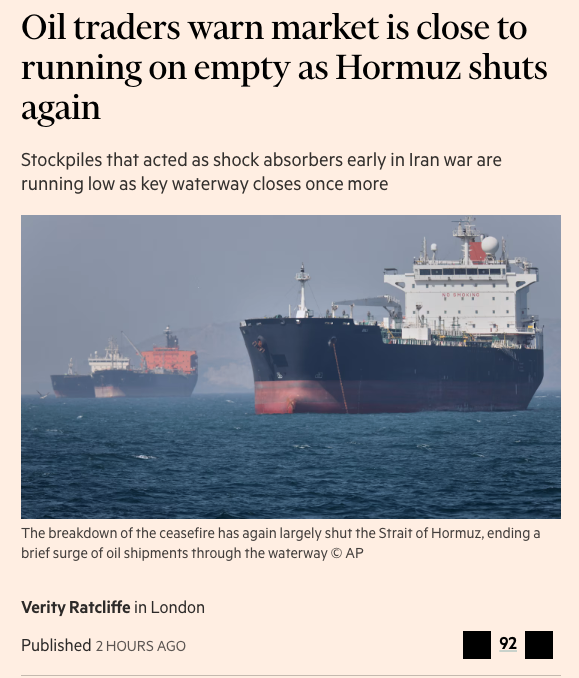
plenty of worrying quotes in this ft article
- unnamed trader: "We’ve burned through all of the buffers we had. Everything. All of that’s now gone."
- Amrita Sen, director of market intelligence at Energy Aspects: "Now we have close to nothing. Market complacency around Hormuz flows is being severely tested."
- Joel Hancock, a senior commodities analyst at Natixis Bank: "Ultimately, the market was pricing an optimistic flow trajectory that now is clearly not on the table."
U.S. military:
"U.S. Central Command (CENTCOM) successfully completed the ninth consecutive evening of strikes against Iran, July 19, at 10 p.m. ET.
CENTCOM assets targeted Iranian military command centers, air defense and coastal surveillance sites, maritime capabilities, missile and drone launch sites, and communications networks to further diminish Iran's ability to attack commercial vessels and civilian mariners transiting the Strait of Hormuz.
The U.S. military is holding Iran accountable at the Commander in Chief's direction. CENTCOM forces remain highly vigilant, focused, lethal, and ready."