Been a bit quiet, work got intense for a while, and I’m also waiting for the next hard fork to settle before continuing.
Didn’t want to rush things. Picking it back up soon.
Quick Noctis update:
Aegis introduced changes to the dusk core and prover flow for shielded transactions.
Finalizing integration once the updated version is available to ensure everything works end-to-end.
In the meantime, continuing to polish the app.
Every institution evaluating onchain settlement asks the same question: who else can see my order flow?
On transparent chains: everyone. Competitors. Counterparties. The entire market.
Dusk solves this. Your positions stay private, but auditable by your regulator.
There’s a massive opportunity right now for whoever builds the first truly optimized native DEX on @DuskFoundation .
When you start digging into the capabilities of Moonlight smart contracts, the architecture practically writes itself. You could design a constant-product AMM where the Pair contracts natively handle their own LP token balances, drastically cutting down on unnecessary Inter-Contract Calls to save on fees.
Pair that infrastructure with the DRC-20 standard, specifically utilizing off-chain BLS signature permits, and you solve DeFi’s biggest UX problem: token approvals. Swapping becomes a seamless, single-click, gasless experience for the end user.
The building blocks for next-generation UX are sitting right in front of us. Who knows, maybe one day Noctis Wallet will natively integrate an exchange that uses this exact architecture... 🦉✨
Every few weeks another protocol has a bridge exploit, a front-end compromise, or an oracle attack.
That doesn't work when the goal is to bring regulated financial markets on-chain.
That's why we're hardening every layer of Dusk before scaling. Not after.
The AEGIS Security Analysis is one of the most detailed reports we've published.
Every critical finding, how it could have been exploited, and what changed.
Full analysis below ↓
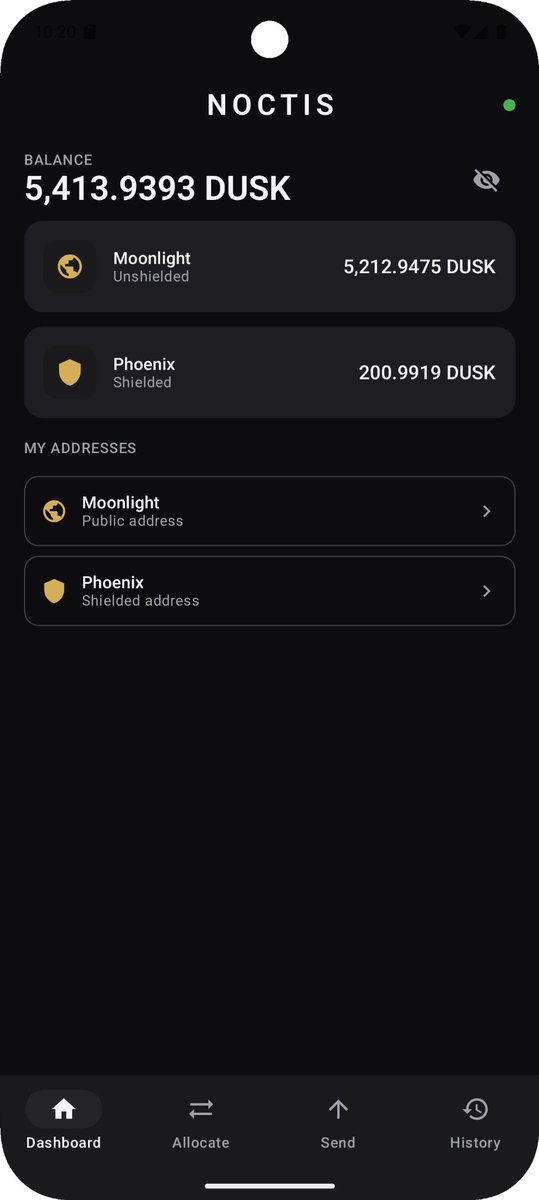
The native wallet core is now stable and powering Noctis. Public beta is coming soon, just finishing the final release setup before opening it up for testers.
Two ways(at least) to build a wallet on Dusk. Same Rust core under the hood, different paths to get there.
The official toolkit for web is w3sper.js.
It compiles Dusk’s Rust wallet core to WebAssembly and wraps it in a JavaScript SDK.
That makes it ideal for browser environments: extensions, web wallets, and dApps. Developers can call high-level functions like transfer() or sync() from JavaScript while the cryptography runs inside WASM in the browser sandbox.
It’s a very clean developer experience and works anywhere JavaScript runs.
Noctis takes a different route.
Instead of compiling the wallet core to WebAssembly, the Rust code is compiled directly to native machine code (ARM / x86) and exposed as a shared library.
A C FFI interface defines the boundary, a JNI bridge connects it to Kotlin(In case of Android app), and the app calls those functions directly. When Noctis scans notes or builds a Phoenix transaction, it’s executing native Rust code on the device CPU.
Why choose that approach?
Performance
WebAssembly is very fast for web environments.
Native execution simply removes another runtime layer, which can help when processing large batches of encrypted notes during shielded sync.
Memory control
Running the wallet core natively allows explicit control over how sensitive data is handled in memory. For example, seed material can be wiped immediately after use using explicit zeroization routines.
In managed runtimes like JavaScript, memory lifecycle is typically controlled by garbage collection, which changes how that type of control is implemented.
Platform integration
Native mobile apps can integrate directly with operating system security features such as Android Keystore, biometric authentication, and OS-level protections like screenshot blocking.
These capabilities are part of the mobile platform itself rather than something accessed through a browser environment.
The tradeoff
The native route is more complex to build and maintain.
It requires defining FFI interfaces, writing bridge code, managing memory boundaries between languages, and maintaining compatibility across platforms. Tooling like w3sper significantly reduces that complexity for web-based applications.
So which approach is better?
Neither, they serve different environments.
w3sper is a natural fit for web applications and browser wallets.
A native Rust integration makes sense when building a mobile-first wallet that needs deep OS integration and full control over the runtime environment.
Noctis chose the native route because a phone wallet operates in a very different environment than a browser wallet, and that environment benefits from an architecture designed specifically for it.
Aegis Protocol Upgrade is live.
All critical findings addressed. Hardened protocol, upgraded tooling, and the foundation for what comes next.
Read the full breakdown ↓
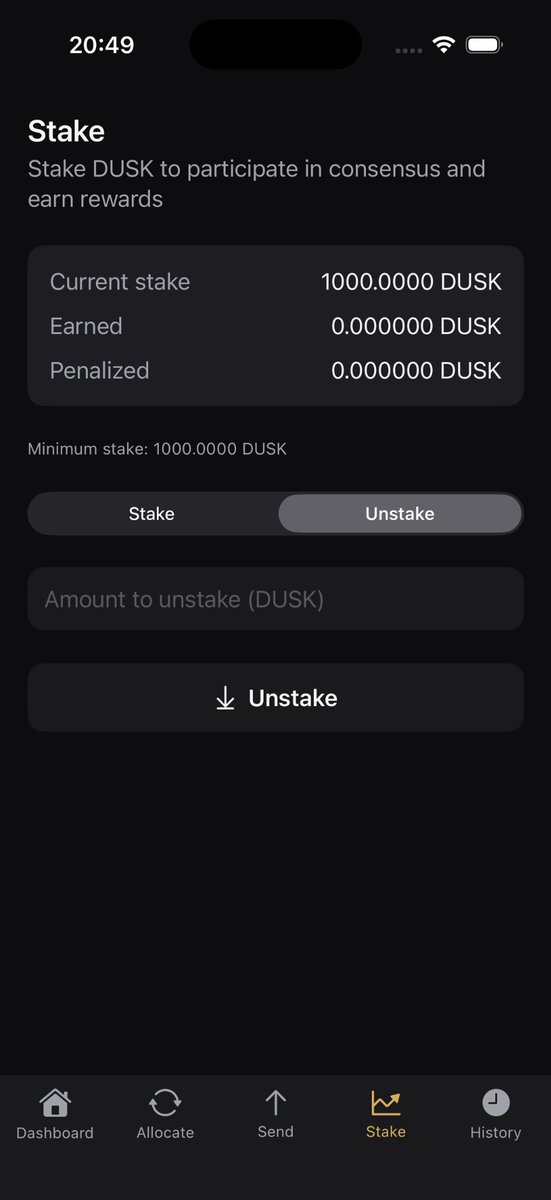
Native DUSK staking support in progress.
View your current stake, rewards, and penalties directly in-app.
Initial beta will focus on core wallet flows.
Native staking and additional features will follow once fully stabilized.
Aegis Protocol Upgrade is coming.
Our most significant upgrade to date that strengthens our network, hardens security and lays the foundation for what's next.
⏰ Activation: 3rd March at 11AM UTC
This is a mandatory upgrade for all node operators.
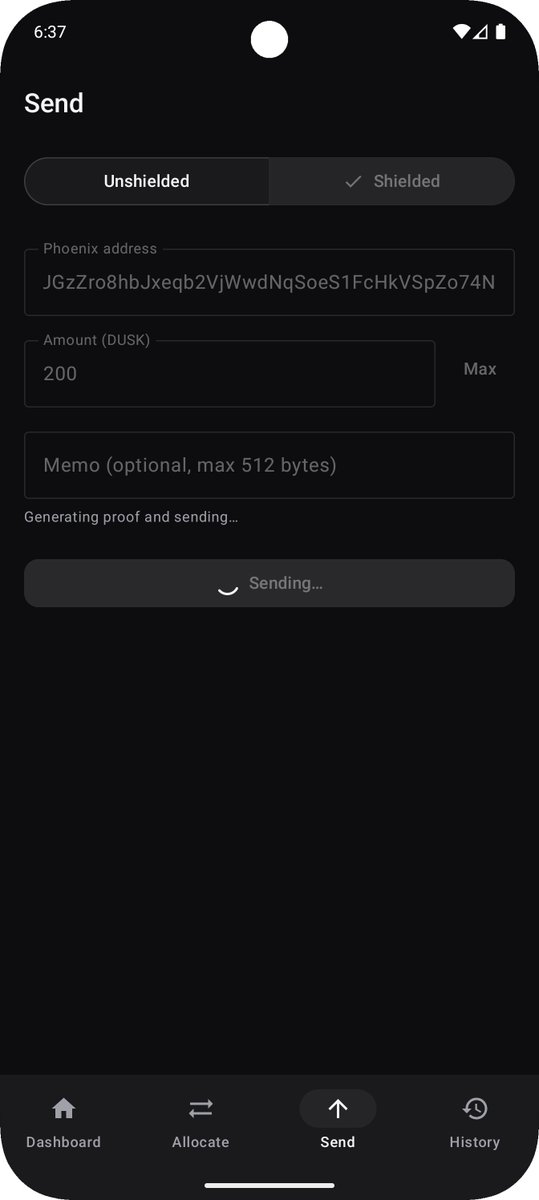
Why do Phoenix transactions take longer than unshielded ones?
Shielded transfers require a zero-knowledge proof before they go on-chain. Your wallet builds the transaction and sends it to an external prover service, which generates the ZK proof. That proof generation is the bottleneck, it can take 30–60+ seconds depending on load, while unshielded txs skip this step and are much faster.
So: a bit more wait for strong privacy. Phoenix keeps your balances and transaction history shielded and unreadable on-chain.
MiFID II requires client confidentiality. GDPR mandates data protection. MiCA enforces operational security.
Privacy in finance is a legal requirement.
Dusk was built for this from day one.
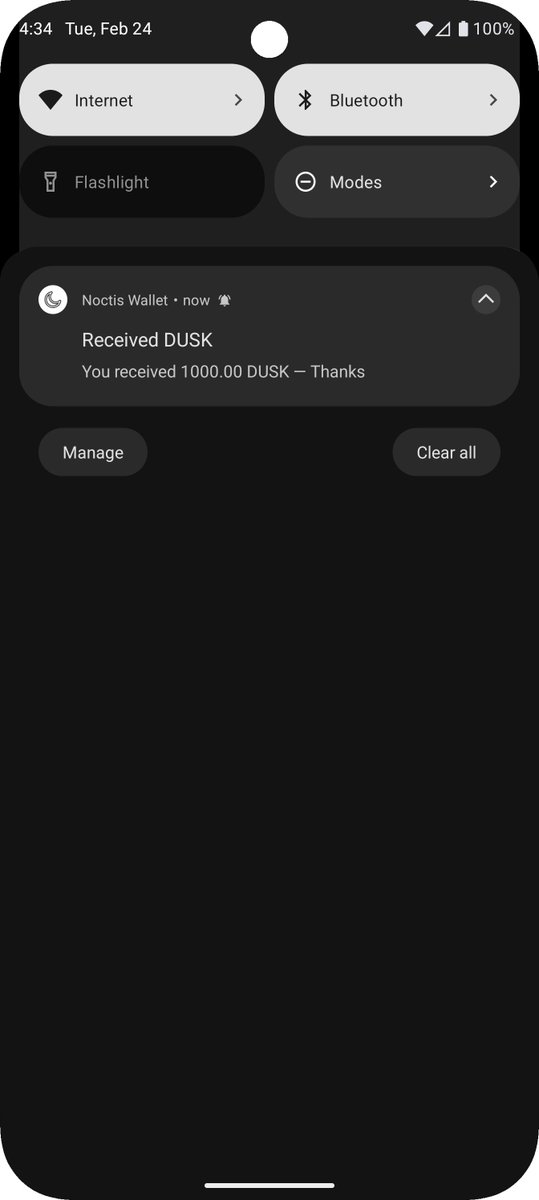
You got DUSK even when the app is closed
You’re not always in the app when someone sends you DUSK.
So we made sure you still find out.
Noctis can notify you of incoming transactions, even when the app is closed.
Tap the notification and you’re straight into History.
How?
A lightweight background check of the public ledger for your address.
No seed. No unlock. No sensitive data.
Just: "You received X DUSK."
Beta coming soon.
@Bimadesage The initial focus is making DUSK more accessible on mobile through a native experience. The goal is to complement existing tooling and give users another way to interact with the ecosystem