$FTAI halved this year ($310 in February to $154 in October) and has bounced back to ~$168. The sell-side is still 11 out of 11 Buy.
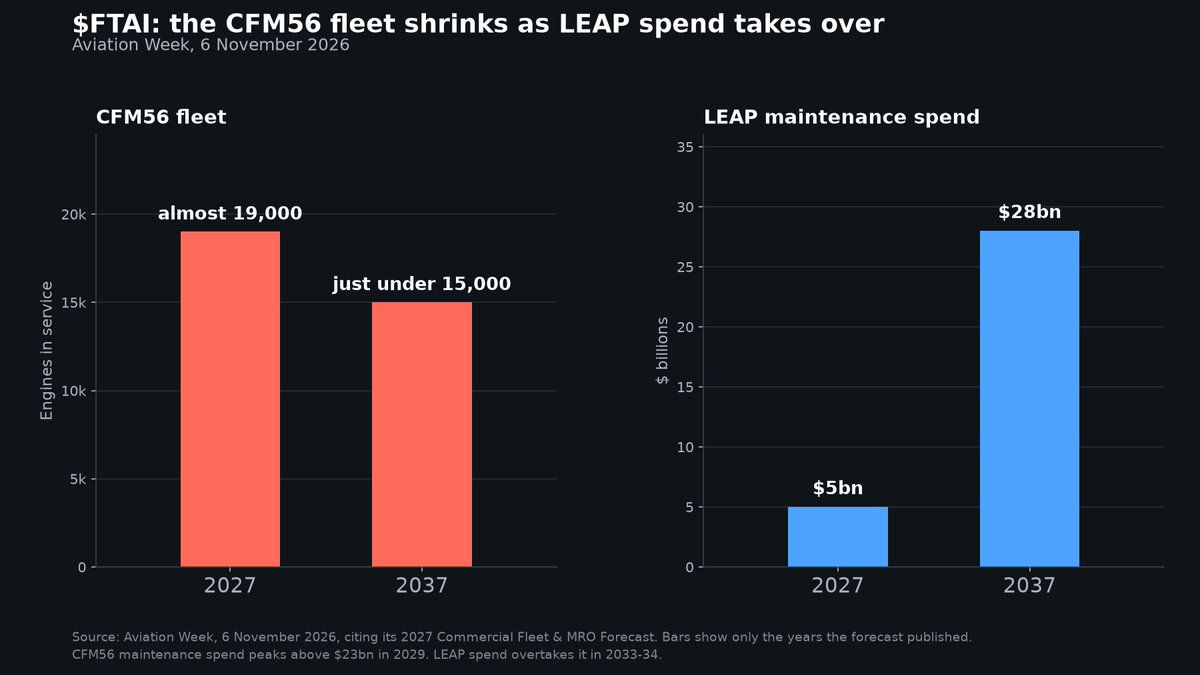
$FTAI lives off one engine family, the CFM56, and that engine is at its peak. About 2,400 shop visits a year in 2026-27 ($GE), and maintenance spend tops out at over $23bn around 2029 (Aviation Week). Today is unusually good: $BA and Airbus are late delivering new planes, so airlines keep old planes flying and spare parts are scarce, which is where $FTAI's margins come from. When deliveries catch up, retirements rise and the scrapped engines flood the market with used parts, as in 2003 and 2009.
So why not do the same on the next engine? Because it's locked for another decade. The LEAP and $RTX's GTF are mostly sold with long-term service contracts, and the engine maker does every overhaul in its own or licensed shops, with its own parts. $FTAI has no LEAP rights today, so there's a 5-10-year gap with nothing to grow into.
Mostly agree, though the 49% is $FTAI's capital interest in J&F, and neither the profit split nor $FTAI's sale price into the JV is disclosed.
The hyperscaler contract is J&F's, so $FTAI's turbine sales ride on it. If DOE pulls J&F into scope, I'd think 2027 timing and the $234m advance from J&F are what's exposed. $FTAI kept the right to package in Miami, so there is a fallback, just not at Jereh's scale.
$GE's own numbers have ~30% of the CFM56 fleet still waiting for a first visit rather than half, and shop-visit revenue up ~30% in a year with the network "oversubscribed", so it doesn't look like they're stepping back.
Agree on LEAP though: $GE sees its installed base passing the CFM56 by the end of the decade at CFM56-level profit dollars, and that's an engine $FTAI isn't in the licensed network for yet.
Fair, a module swap isn't a shop visit, but it replaces one, and $FTAI sizes its own 25% target against ~$22bn of CFM56/V2500 shop-visit spend. The share gains look real (~5% to ~15%), though they've been bought with unit margin.
On LEAP, management says it has licences and plans a Rome test cell for 2028, but $FTAI isn't in CFM's licensed LEAP network yet, and LEAP run-outs, the cheap feedstock its model needs, probably don't arrive in volume until the mid-2030s.
14x the FY27 guide ex-Power comes to ~$215 on segment EBITDA, and closer to ~$180 once you take out ~$150m a year of corporate cost and the ~$125m a year of SCI EBITDA $FTAI doesn't receive in cash (my estimates).
But 14x on FY27 implies something like 4-6% growth forever at a 10% cost of capital, and for earnings tied to one engine family that $GE expects LEAP to overtake by 2030, the multiple seems to be the real question.
The Power piece may be shorter-dated than a free call. Data centres seem to be buying converted engines because new turbines from $GEV and Siemens are years behind and grid connections are slow.
If that clears around 2029-31, they'll likely want grid power or larger, more efficient plants instead.
@justfactstruth Volume is on plan for $FTAI. The part I'd watch is who's buying: in Q3 one customer was 37% of revenue, and the top three were 65%.
With the second SPV filling up, it would help to know how much of the module volume goes to $FTAI's own affiliated vehicles.
The $1.4bn Aerospace guide on 1,700 modules implies about $0.83m of EBITDA a module, down from $0.95m in Q1'25.
A $310 case probably needs growth beyond the CFM56, and $FTAI has no LEAP rights today, so the 10 December meeting may be the first chance to hear how they plan to bridge that.
The bear case on $FTAI is mostly about cash and the engine cycle. Inventory went from $164m to $1.93bn, operating cash flow was negative in 2024, 2025 and the first nine months of 2026, and the 2026 FCF guide has been cut from $1.0bn to about $650m. The EBITDA is growing, but it isn't turning into cash yet.
The bigger issue is that $FTAI lives off one engine family, the CFM56, which is at its peak: about 2,400 shop visits a year in 2026-27 ($GE), with maintenance spend topping out above $23bn around 2029 (Aviation Week). The next engines, the LEAP and $RTX's GTF, are mostly locked into the engine makers' long-term service contracts, and $FTAI has no LEAP rights today.
I wrote up the full bear case here: https://t.co/i2KBeippMJ
$FTAI halved this year ($310 in February to $154 in October) and has bounced back to ~$168. The sell-side is still 11 out of 11 Buy.
$FTAI lives off one engine family, the CFM56, and that engine is at its peak. About 2,400 shop visits a year in 2026-27 ($GE), and maintenance spend tops out at over $23bn around 2029 (Aviation Week). Today is unusually good: $BA and Airbus are late delivering new planes, so airlines keep old planes flying and spare parts are scarce, which is where $FTAI's margins come from. When deliveries catch up, retirements rise and the scrapped engines flood the market with used parts, as in 2003 and 2009.
So why not do the same on the next engine? Because it's locked for another decade. The LEAP and $RTX's GTF are mostly sold with long-term service contracts, and the engine maker does every overhaul in its own or licensed shops, with its own parts. $FTAI has no LEAP rights today, so there's a 5-10-year gap with nothing to grow into.
The core business is growing in volume, but each module is earning less. EBITDA per module went from $0.95m in Q1'25 to $0.91m in Q3'26, and the 2027 guide implies about $0.83m.
$FTAI looks like it is buying market share with margin, so whether it's undervalued depends a lot on where unit economics settle.
Power isn't really $FTAI's. The turbines are sold to J&F Power Systems, which $FTAI owns 49% of. The other 51% belongs to Jereh, a Chinese oilfield-services group. The $1.465bn order is J&F's contract, not $FTAI's revenue, and the DOE rules on foreign-controlled grid equipment are due ~24 Dec.
The market is paying 10x EBITDA for a "compounder" and a free AI option. The sunset after 2029 isn't in the debate yet. On $FTAI's own cash flows I get ~$101 a share. The next test is the investor day on 10 Dec.
$FTAI halved this year ($310 in February to $154 in October) and has bounced back to ~$168. The sell-side is still 11 out of 11 Buy.
$FTAI lives off one engine family, the CFM56, and that engine is at its peak. About 2,400 shop visits a year in 2026-27 ($GE), and maintenance spend tops out at over $23bn around 2029 (Aviation Week). Today is unusually good: $BA and Airbus are late delivering new planes, so airlines keep old planes flying and spare parts are scarce, which is where $FTAI's margins come from. When deliveries catch up, retirements rise and the scrapped engines flood the market with used parts, as in 2003 and 2009.
So why not do the same on the next engine? Because it's locked for another decade. The LEAP and $RTX's GTF are mostly sold with long-term service contracts, and the engine maker does every overhaul in its own or licensed shops, with its own parts. $FTAI has no LEAP rights today, so there's a 5-10-year gap with nothing to grow into.
Meanwhile each unit earns less as volume goes up. EBITDA per module went from $0.95m (Q1'25) to $0.91m (Q3'26), and the 2027 guide implies $0.83m. $FTAI is buying market share with margin.
And the EBITDA isn't turning into cash. Inventory went from $164m to $1.93bn, and the 2026 FCF guide has been cut from $1.0bn to ~$650m.
Your chart shows the pressure point. Q3 operating income was $50.4M and interest expense was $112.5M. The quarter's $7.3bn of capex leaned on $5.75bn of convertibles and about $1.0bn of new shares. Even if prepayments and asset-backed financing cover 75-85% of 2027's $40-45bn, the remaining 15-25% is still $6-11bn.
The >100% figure only covers the capex on deals signed in Q3. The 2027 plan is still $40-45bn of capex against $12-13bn of revenue, with prepayments and asset-backed financing expected to cover 75-85% of it. Part of that recycling is secured debt against the same contracts, so the lenders get paid before the equity does.