Principal Researcher @Microsoft. Ph.D. @WeillCornell. M.Eng. @Cornell. B.S. @Columbia. Machine Learning. Human Physiology. Opinions expressed are my own.
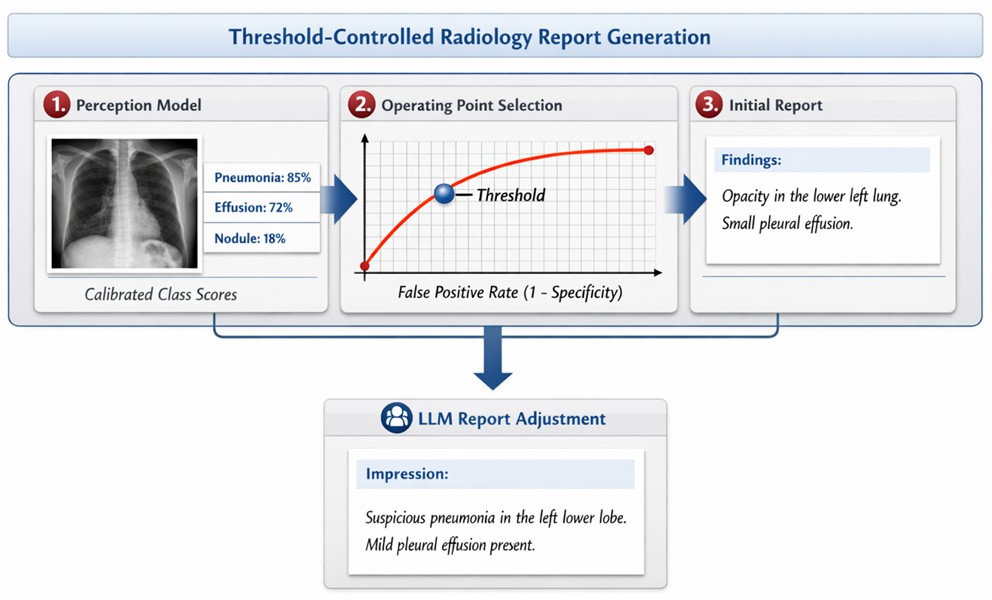
We're proud to release an approach for AI generation of radiology reports in medical imaging that enables controlling the sensitivity and specificity of the output reports. This is a critical function for safety and regulatory compliance. Importantly the method is plug-and-play, and can be attached to any report generation system without the need for additional training. Multiple reports can be generated at different operating points for a multitude of clinical settings.
Check out the paper to learn more.
@Microsoft #Healthcare #MedicalImaging #ArtificialIntelligence #MachineLearning #ComputerVision
RadFusion: Confidence-based control of clinical report generation
https://t.co/gOEClCQFn6
AI-generated radiology report generation has focused on creating a single, best report. But clinical settings have different costs for misses vs. false alarms. Thus, we may want different “operating points,” that is, different thresholds for when findings should be reported.
We are excited to release the weights of @MSFTResearch's COLIPRI, our 3D vision–language encoder for chest CT scans, on @huggingface🤗
Model: https://t.co/qmhZU6zNc8
Demo: https://t.co/uDiz3NDKlq
Paper: https://t.co/hbFWFpaPXv
Why does COLIPRI matter?
🧵0/12 👇
1/🧵 Introducing CancerGUIDE: Cancer Guideline Understanding via Internal Disagreement Estimation. Can LLMs give guideline-concordant cancer treatment advice in data-sparse settings?
🏥Our new framework tests LLMs on guideline adherence in real cancer cases.
👇 #AIinHealthcare
We have seen many ways that generative AI can transform healthcare but over-stretched health-IT teams can’t deploy new software systems to surface the latest advancements fast enough.
But... what if developers could meet clinicians where they already work today, building, deploying, and testing AI capabilities that address challenging complex clinical tasks in minutes, not months?
Thats why today we’re announcing the launch of Healthcare Agent Orchestrator bringing the latest cutting edge AI into the hands of healthcare users leveraging Azure AI Foundry and surfacing into M365 enterprise software that health systems globally already use and trust - check out this blog to learn more: https://t.co/cLRS9R016a
Excited to share our open-source code for cancer survival prediction using radiology (MRI) and pathology (H&E) images - this walkthrough uses our lightweight domain specific multimodal medical imaging embedding models + adapters to produce hazard scores and survival probabilities. Trainable on CPU in minutes!
Details and code: https://t.co/jjdzp3gf2B
Blog post: https://t.co/7VUEikzLAA
Due in part to the large number of runaway takes in medical AI, I'm launching a regular thread to spotlight noteworthy and more leveled research papers in the space and/or related fields with promising applications in healthcare.
RTs appreciated. Let's begin!
Our team within Microsoft Health and Life Sciences is happy to announce the release of MedImageInsight, an open-source medical imaging embedding model. (1/n)
🔥 Our new preprint on biomedical self-supervised learning with images only is out! 🔥
Rᴀᴅ-DINO: Exploring Scalable Medical Image Encoders Beyond Text Supervision
by @MSFTResearch
We show that:
0/3 🧵