Emasculating Evil, IDGOP, Freedom, History, Officials & Agencies, Politics, Ammo, Law Enforcement, Motorcycles, All Things In and Around The Great Outdoors.
The Dirty Little Secret of Wildfire
How America Traded Logging Jobs for a Perpetual Firefighting Economy
For much of the 20th century, the forests of the Pacific Northwest were managed as working landscapes. Private timber companies and federal land managers cut, planted, thinned, and tended the land with the understanding that the trees were an asset to be sustained across generations. Clearcuts functioned as firebreaks. Small crews routinely extinguished ignitions before they became news. The result was a regional economy built on living-wage jobs, steady tax revenue for schools and public safety, and forests that, for the most part, stayed green.
Occasional fires occurred. What did not occur were the annual, multi-hundred-thousand-acre, smoke-choked seasons that have become the new normal.
That changed in the late 1980s and early 1990s. The northern spotted owl was elevated into the most consequential bird in modern American policy. Scientists and environmental organizations argued that the species required large tracts of old-growth habitat. Petitions, lawsuits, and court orders followed. In June 1990 the U.S. Fish and Wildlife Service listed the owl as threatened. Federal Judge William Dwyer’s rulings and the 1994 Northwest Forest Plan locked up roughly 24 million acres of federal forest across Oregon, Washington, and northern California.
Federal timber harvests collapsed—often by 80 to 90 percent from 1980s levels in the key regions. Mills closed by the dozens. Supporting businesses disappeared. Unemployment surged. Some communities never fully recovered. Private industrial landowners continued managing their own ground because they still had direct financial skin in the game. Federal and state lands largely stopped being managed for timber production or for systematic fuel reduction at anything approaching the previous scale.
The forests kept growing. Fuels kept accumulating. An ignition that once would have been contained by a small crew with shovels and a radio now found denser, more continuous fuel beds. Large fires (5,000 acres and up) went from relatively rare events in the 1970s to routine occurrences in the 2000s and 2010s. In multiple recent seasons, more timber has burned than the industry harvested in its heyday. The irony is difficult to miss: forests “saved” from chainsaws have been delivered to ash in far greater volume.
Meanwhile, the northern spotted owl’s population has continued to decline across much of its range. Logging was never the primary driver. Competition from the invasive barred owl has proven far more significant, and habitat loss from high-severity fire now ranks high among the threats. The original crisis was urgent enough to trigger listing and sweeping land-use restrictions. The promised recovery under the Northwest Forest Plan has been, at best, incomplete.
The economic and ecological bill arrived in the form of unmanaged fuels and repeated megafires. And that is where the dirty little secret begins.
Once the timber economy on public land was kneecapped, a new industry rose to replace it. Wildland firefighting—suppression, logistics, aviation, camps, contracts, and the supporting apparatus—became a multi-billion-dollar annual enterprise. Agencies and contractors employ thousands. Budgets are large and sticky. In government, “use it or lose it” is not a slogan; it is an operating principle. A quiet fire season is a budgeting risk. Early, aggressive attack on every ignition that could still be handled by a small crew is expensive in the short term and reduces the later need for the full apparatus. Allowing fires to grow until they justify emergency declarations, large incident management teams, and federal cost-share arrangements is, from a certain bureaucratic perspective, rational and financially advantageous.
Local structural firefighters and many ground-level wildland crews do not share this incentive structure. They want the fire out. Once a fire reaches a certain size or complexity, however, control shifts upward to state and federal incident management teams whose metrics, funding streams, and political realities are different.
Neither major political party has shown a strong appetite for fixing the underlying problem. One side treats any expansion of active management or commercial thinning as an assault on old growth and the owl. The other side speaks frequently about forest health but rarely forces the structural changes in litigation risk, planning timelines, and budget incentives that would actually move the needle at scale. Campaign contributions and jobs flow from the existing system. Admitting that the original policy overcorrected and produced a more dangerous landscape remains politically costly.
Climate change and longer fire seasons are real factors. Drier fuels and hotter summers make everything worse. But denser, less-managed forests on the public estate are the accelerant that policy deliberately chose. Private industrial lands are managed more intensively and still burn, yet the severity is generally lower. Young plantations and certain silvicultural choices create their own risks, but private owners retain a direct financial reason to keep fuels in check and respond quickly. Public lands under the post-owl regime largely do not.
Oregon and the broader region now hold more trees than they did in the 1920s, largely because private landowners continued to replant. They also experience more catastrophic fire. The government did not “save” the forest. It changed who controlled the management decisions and, in the process, swapped a productive industry for a perpetual emergency-response industry. The owl was the symbol. The lasting result is a landscape that burns bigger, rural economies that never fully healed, and a political class with limited incentive to alter the arrangement. Instead of market-driven capital allocation, the new system runs on taxpayer subsidies.
Households and businesses understand that money spent inefficiently is money gone. Government tends to treat the same dollars as an everlasting well. Until the incentives change—until early detection, aggressive initial attack, mechanical thinning where appropriate, and genuine long-term forest management are rewarded more than the sheer size of the suppression effort—the same pattern will continue every summer: more smoke, more lost timber, more money spent, and the same speeches about how hard everyone is fighting the fires that policy helped create.
Is Idaho a Hateful State?
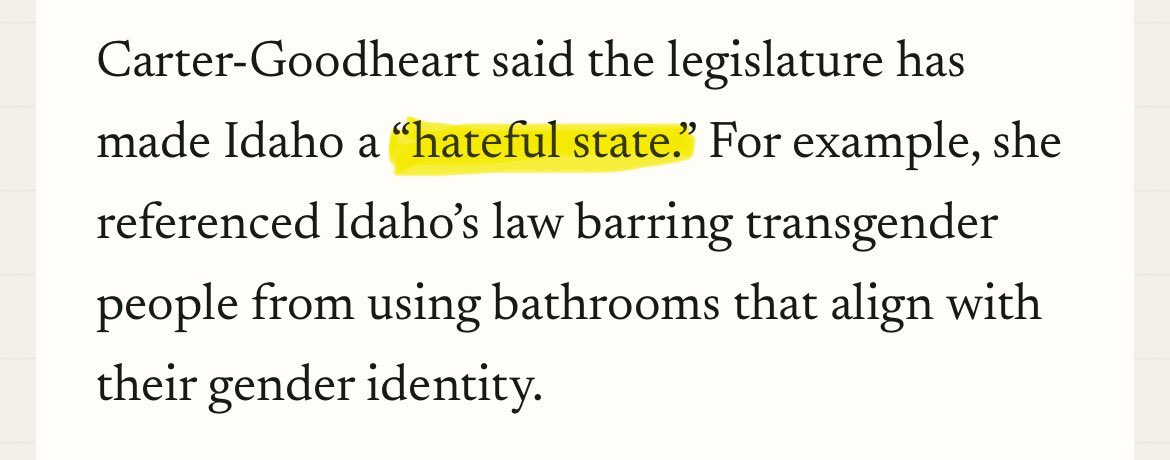
The people of Idaho are some of the most kind, generous, hard working people I’ve ever met. Yet my opponent calls Idaho a “HATEFUL STATE”?
In an interview with the Lewiston Tribune Trish Carter-Goodheart said that laws to protect women’s spaces and privacy is an example of this so called hate.
A statement like that breaks my heart. I love this state, I love my community, and I love the people of Idaho. They aren’t hateful.
We aren’t Portland or Seattle. We are Idaho. Help me keep Idaho, Idaho: https://t.co/EsUXJ1YthA
There have now been at least five foreign migrants that have been arrested for violent crimes in Idaho just in the last month alone.
We could have ended this by passing the immigration bills that I authored-- but the cheap labor Republicans in our legislature simply chose not to.
https://t.co/EtDlKk7tf2
LMAO! President Trump just RAN AFTER and BLOCKED a little boy from running off the stage while his mom was speaking
"I didn't want him to be like BIDEN and fall off the stage" 🤣
There'll never be another like him.
I can’t be the only person that is absolutely SICKENED by the Idaho Grift Gang and their new t-shirts commemorating a mass shooting.
If you want to give money to the victims directly, there are Go-Fund-Me’s to do that (links below).
This shamelessness is just beyond the pale.
The three legged stool (3 forms of taxation) is a fraud introduced to Idaho by deceit and lies and has led to greater and greater theft of YOUR property to the government.
REVEALED: Here Are the Mainstream Journalists on China’s Payroll 🚨
I exclusively uncovered the identities of prominent U.S. journalists flown to China by a CCP-linked influence operation seeking “favorable coverage” and “positive messages” about Beijing. 🧵
@brian_lenney How much money do you think this fraud is making? It's crap like this that really makes me think about joining the scam business.. damn my stupid ethics🤨
It should concern every American that China compromised over 200 million voter registrations and that nearly a quarter of a million non-citizens are registered to vote.
It apparently doesn't concern Idaho's Secretary of State @mcgraneforidaho, who continues to block the Trump admin's efforts to secure our elections.