Jensen wants a world where open source survives, even the Chinese models and here's the stocks that benefits from this (Save this).
Nvidia CEO Jensen Huang told Axios that the U.S. government should not restrict Chinese AI models like Kimi K2, arguing that excellent open source models should be used no matter where they come from.
He rejected the idea that China threatens US AI leadership, saying there's essentially zero chance of China running American companies off the road and argued the market keeps overreacting to Chinese releases the same way it did with DeepSeek.
Huang's logic is that Nvidia profits when more organizations globally are training and running models, so an open ecosystem where anyone can build on strong free models grows total compute demand far more than a closed, restricted one would.
Now here are some of the stocks that will benefit greatly from this.
Nebius benefits because it rents out GPU capacity to companies deploying open source models, and a world where open models keep improving and multiplying means more total rental demand instead of everyone consolidating onto one closed API.
Arista Networks supplies the high speed switches connecting GPUs inside data centers and every new open-source model that gets deployed at scale by a hyperscaler or neocloud requires more of this networking gear, regardless of which chip vendor wins.
Vertiv makes power and cooling systems for data centers and it benefits purely from total AI infrastructure buildout expanding which grows faster in an open ecosystem where dozens of labs are all racing to train and serve models rather than just one or two closed players.
Cloudflare has built infrastructure for running open source AI models at the network edge and it gains customers precisely because businesses want to run open models cheaply outside of expensive proprietary APIs.
Micron benefits since every open model that gets deployed still needs memory chips to run inference, and a world with more competing models running everywhere means more total memory demand across the industry.
Digital Realty and other data center landlords benefit almost mechanically from Huang's vision, since more organizations training and hosting their own open models rather than renting a single closed API means more physical data center space gets leased out globally.
Snowflake has positioned itself as a place where companies can run open-source models directly on their own data, and it benefits when businesses prefer flexible open models over being locked into one provider's proprietary system.
If you want the full list of all the AI trades we are making based on this, you can come join Milk Road Pro for just a dollar using the link below!
@Caffeindated@fornicv@Astuterealm0@3RenChengHu Chinese doesn't drink French wine and Italian olive oil. Those are imported goods. With China catching up or even surpassing on biotechnology, AI, and inevitably semiconductor, the Americans cant keep its artificially inflated income.
@dreams_asi@RnaudBertrand Your itinerary looks fine. I will take train between Zhang jiajie and Chengdu. It is about a 4-5 hour ride. There are 7 rides/day.
@dreams_asi@RnaudBertrand Use Amap 高德 which has an embedded ride hailing function. Alipay app also has public transport code in it. If you have problem, just ask street people. They are friendly! They may even go out of their way to lead you to where you want to go.
@OddStats I am so glad someone pointed this out. I have been inundated by "July" is a strong month tweets. Clearly a lot of these people never lived through 2001, 2002, 2008, 2009...
@EdFoste96342711@DavidLe76335983 China applied the famous Deng Xiao Ping's "black cat, white cat, if it can catch mice, it is a good cat" argument on social ideology.
@quxiaoyin@OpenAI@AnthropicAI It will not happen. Building data centres are capital intensive. Transforming from an asset-light model to a capital intensive model will crush their valuation. However, you are right that building data centre is the way to go. Such a dilemma, eh?
There is a reason why the symmetrical triangle and likely top on the Nasdaq have developed. It is not for aesthetic purposes, but as a warning that time is almost up.
The lower gap, combined with breaking out yields, leaves the highly interest rate sensitive Nasdaq vulnerable to a major sell off.
The chickens are coming home to roost.
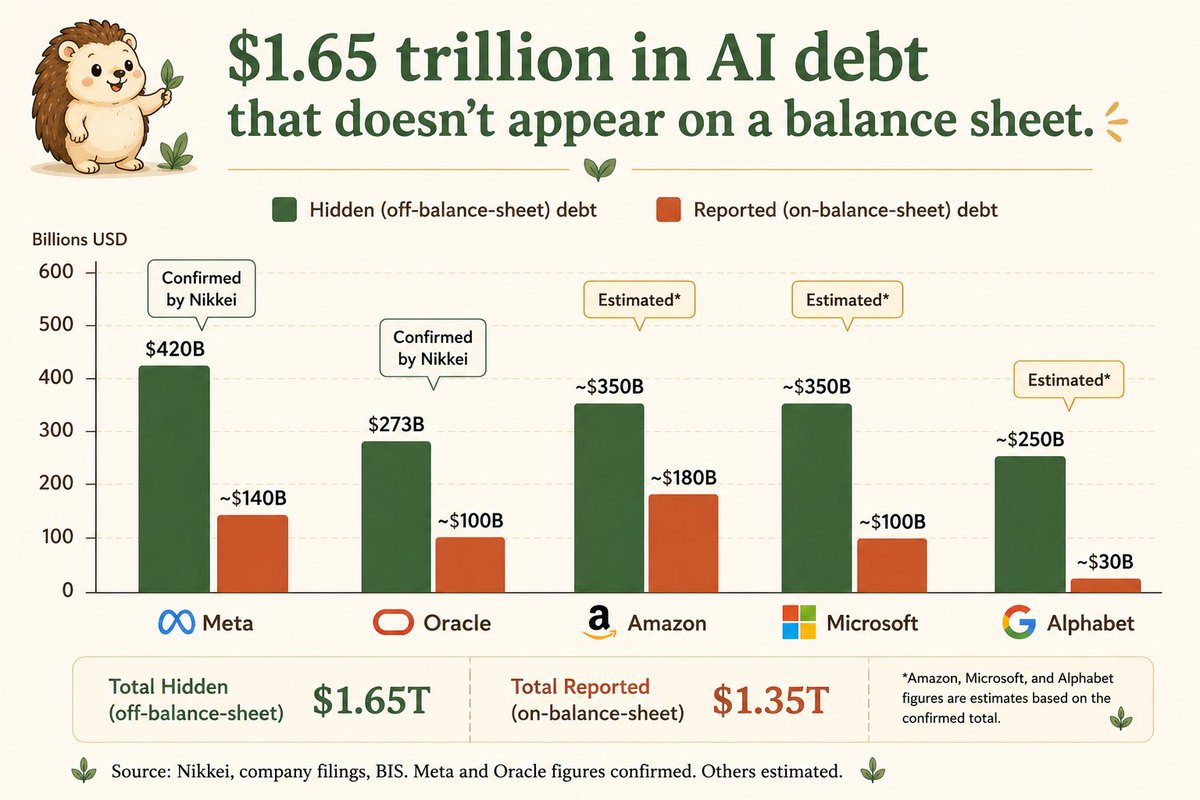
🦔A Nikkei investigation found that Alphabet, Microsoft, Amazon, Meta, and Oracle have $1.65 trillion in debt that doesn't appear on their balance sheets, more than the $1.35 trillion they officially report. These are GPU contracts, data center leases, and joint ventures that don't count as debt under accounting rules until the facilities go live. Meta's hidden debt is $420 billion, triple its reported debt. Oracle's grew 30-fold in four years. All five declined to comment.
My Take
Nikkei examined the actual filings and put a number on something the BIS already flagged as "shadow borrowing" back in March. These companies owe more off their balance sheets than on them, and the accounting rules let them keep it that way until the data centers go live. That's legal, but it means investors looking at quarterly earnings this week are seeing less than half the picture.
Four of these five report earnings in the next two weeks. The reported debt will look manageable. The $1.65 trillion in footnotes won't make the headlines. But when those data centers start operating, the leases hit the books all at once. If AI demand comes in below projections, those facilities get marked down and the losses land on the investors and insurance policyholders who funded the construction through private credit and project bonds without realizing how much total exposure they were carrying.
Hedgie🤗
@Geopoli_tikus one of the former SG ministers visited China in the 80s and saw kids studying under the dim street light. He knew well China would succeed and return to its past glory.
this chart goes back to 1972 and has never printed this number
The 3-week realized vol of the momentum factor is now 4x the vol of the S&P 500. Not 1997, not 2000, not 2008, not the 2021 unwind. Never.
Translation: the index is quiet while the stocks inside it swing like it's a crisis. Winners get dumped, losers get squeezed, and the rotation eats momentum traders alive.
When maximum churn meets minimum index movement, someone is handing over a lot of shares. Distribution rarely announces itself louder than this.