Every time this fella Warsh talks, there’s a cross asset nuke and yields moon.
The rate hike believers come out in full force and the timeline goes into Macro Derangement Syndrome.
Then the next trading session equities recover and then eventually Bessent comes in with the yield tamp hammer.
Honestly just cinema at this point
Stock market has become a game of front running narratives and positioning before FinTwit/CT catch on.
Interest eventually reaches a crescendo, we get a blow off move and a new generation of bagholders is born.
Wait a few months for them to capitulate / churn and run it back.
The last few years have clearly been the era of the unintelligent investor.
The day your midcurving friends become true believers in the unintelligent investor strategy is the day you should probably sell everything.
My wife and I have been looking at buying a house for the last year and the entire housing market still feels like a gigantic sham.
The Boomer Cliff is expexted to start in 2030. Probably the largest and wealthiest generation in history gradually goes from being a structural accumulator of housing to a structural distributor of it. For decades, boomers accumulated homes while benefiting from falling rates, rising asset prices and increasingly constrained housing supply. Eventually that flow has to reverse.
A huge number of boomers bought their homes 30+ years ago at a fraction of today’s prices. Many have little or no mortgage and enormous embedded gains, so there's been almost no economic pressure to sell. If the bid isn’t high enough, they can simply stay put. That creates a somewhat fake bid ask (i.e. transaction volumes can collapse without prices properly clearing because the marginal seller doesn’t actually need to transact).
There is also a lot of artificial scarcity embedded in housing. Zoning, restrictive permitting and decades of insufficient construction have constrained supply, but so has the simple fact that boomers have been sitting on the same homes forever. Low inventory gets interpreted as proof that housing itself is permanently scarce, when in many markets part of the scarcity is really just a scarcity of willing sellers.
And a lot of those houses are getting old with their owners. Someone who bought a house 30 years ago, watched it appreciate several times over and knows they’re eventually leaving has a very different incentive to put another $200k into the roof, plumbing, electrical, windows, kitchen or foundation. Obviously this isn’t true of every homeowner, but there is a real deferred maintenance dynamic. In a lot of cases the implicit exit strategy is basically to hand 30 years of accumulated capex to a millennial while asking them to pay a price benchmarked against the renovated house down the street. That works as long as selling remains optional.
Starting around 2030, it becomes progressively less optional. Downsizing, retirement spending, health issues, assisted living and eventually mortality start turning patient owners into motivated sellers. A 68 year old can decide the market is bad and wait another five years. An 82 year old moving into assisted living has a very different reservation price. The estate has even less attachment to the asset. Three children inheriting their parents’ aging suburban house probably don’t want to split the property, renovate it and wait two years for the perfect bid. They want the cash.
That is where the fake bid ask can finally break. The marginal seller shifts from someone who wants $2 million to someone who needs to sell. Meanwhile, the marginal buyer is a millennial or Gen Z household that has to finance the purchase using contemporary incomes and mortgage rates, then potentially spend hundreds of thousands fixing a house whose previous owner deferred major capex. Eventually those two prices have to intersect.
That doesn’t mean housing broadly collapses. Prime land in genuinely supply constrained, wealthy areas can remain extremely valuable. But a generic aging suburban house is different. If thousands of broadly substitutable homes begin returning to the market as their owners age out, some of what looked like permanent scarcity may turn out to have simply been an unusually long period where nobody had to sell.
Boomers spent decades removing homes from the market, watching them appreciate and becoming increasingly insensitive to the marginal bid. The 2030s increasingly reverse that process.
Eventually somebody has to take the keys to the 40 year old house, look at the roof, the kitchen, the plumbing and the foundation and decide what it is actually worth. The price millennials are willing and able to pay for that house may look very different from the price boomers have spent the last decade telling themselves it is worth.
AI multiples were getting stretched anyway. Thankfully, SI is still early and gives us a fresh runway to stretch them all over again.
Valuations and comp sets reset when the acronym changes. Believe they taught me this in undergrad. IFRS 420.
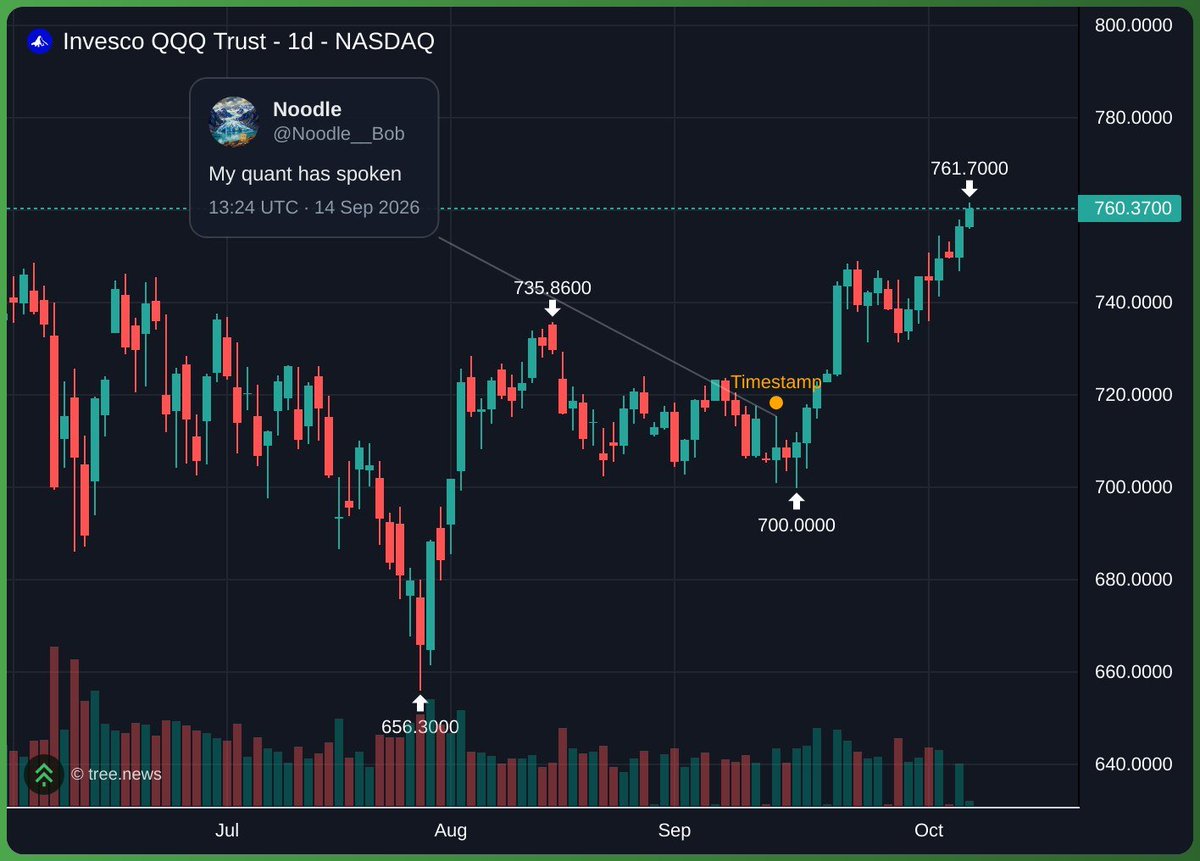
Pretty crazy we got QQQ ATH despite the quintuple hibernating bear div on the 3D, POC resistance from 1929, yields higher, breadth psychosis, seasonality and, most importantly, the chart looking bad.
As Kevin Garnett said:
Bond yield FUD, oil FUD, AI buildout FUD, global war FUD...
...Equities at ATH.
Some fellas really forgot what it feels like to climb a wall of worry.
I’d probably be a lot more cautious once all of these things are actually resolved.
Have you considered that higher yields and tighter financial conditions have already crushed plenty of old-economy names and shitcos (many of which are at 52W lows [breadth phychosis]), while a subset of higher-quality companies may be more resilient? Not every stock has the same exposure to rates, and yields don't explain every move.
In DCF terms, higher WACC lowers the present value of future cash flows, but higher expected FCF growth means those future cash flows are larger. So while higher rates hurt valuations, stronger growth can partially offset that impact. The duration effect matters, but so does the growth rate.
And have you also considered that investors may be willing to tolerate higher yields (for now) to have right tail exposure in case AI / Biotech / Robotics / etc. prove to be genuinely transformative?
And have you also considered that these higher-growth, higher-quality companies now make up a drastically larger portion of the index than they did in the past.
Eventually, if yields go high enough, these companies will also take a beating. I know this time isn't different, but I don't think we're at the breaking point yet.
Bond yield FUD, oil FUD, AI buildout FUD, global war FUD...
...Equities at ATH.
Some fellas really forgot what it feels like to climb a wall of worry.
I’d probably be a lot more cautious once all of these things are actually resolved.
Guy who draws every bear case parallel to the 2000 dot-com bubble but conveniently omits the fact that the Nasdaq nearly doubled after the Fed’s first rate hike
Glad I decided to buy semis over the last little bit. Would just encourage people to stay away from shitcos outside of a scalp and remember that the winners of this run are unlikely to be the same as the winners of prior runups.
Will be slowly buying stocks and metals on every meaningful red day heading into the midterms. Who am I to fade seasonality, religious holidays and calendar effects?
Trying to get down to 15-20% cash by midterms (I never really go below this).
General thoughts on select sectors:
Semis: I think the setup for another semis rolling bubble is becoming increasingly interesting. A lot of the speculative excess has already been washed out, a number of new exciting discoveries have been announced (probably larp but narrative matters), and there’s a ton of macro larping given the uncertainty around the removal of forward guidance. Feels worth taking a stab and slowly scaling into quality semis (not shitcos trading at 50x FY+10 revenue).
Metals: Still long PMs despite doing some shorter-term scalping. Hard to ignore the setup when you look at where gold traded the last time oil was at these levels versus where it trades today.
Healthcare: Another area I like here. Less dependent on the macro narrative and plenty of idiosyncratic opportunities. Also like that it's not really correlated to the rest of my portfolio.
Software: Remains more of a minefield imo. This past earnings season was a good reminder of that. Some names are fun to scalp from range lows to highs, but I’m hesitant to make them core positions.
From a risk management perspective, if you're skittish but still want to stay invested, IV has come down a lot across a number of names. Makes defined-risk expressions via calls more interesting than a few months ago.
Overall, feel pretty good about this approach. Slowly adding on weakness, staying selective on sectors and names, and partly hedged with index shorts from higher.
Somehow ended the day up 0.3%.
My semi names got killed (happy I wasn’t complacent and put some shorts on over the weekend to reduce the brunt of the nuke), metals were a wash given tungsten, healthcare was up, software was up and boomer stonks were up.
The diversifyoooor.
Anyways, bought a bit of semis today in line with my plan to buy stonks every red day into midterms.
I dunno if semi stocks die on Monday, but I’d kick myself if I was complacent and we proceeded to nuke. Between AGI Derangement Syndrome and FOMC this week, there’s plenty here to spark some panic.
I’ve hedged some positions with a few shorts on Hyperliquid and also longed some hyperscalers. Also curious to see how my names in healthcare, software and FIG trade through this.
My current framework is still that the Dario/Sam/Elon AI pacing stuff is ultimately gamesmanship around regulatory capture, national security carve-outs, or some other angle we’re not seeing yet.
As my old boss used to say: "You don’t need to know what happens next. You just need to make sure you’re still around when you find out."
Half my timeline is calling for a 10% nuke tomorrow and salivating at the chance to buy it.
The other half is calling this a nothing burger and expecting green close tomorrow.
Futs open and tomorrow’s PA should be an absolute circus.
I dunno if semi stocks die on Monday, but I’d kick myself if I was complacent and we proceeded to nuke. Between AGI Derangement Syndrome and FOMC this week, there’s plenty here to spark some panic.
I’ve hedged some positions with a few shorts on Hyperliquid and also longed some hyperscalers. Also curious to see how my names in healthcare, software and FIG trade through this.
My current framework is still that the Dario/Sam/Elon AI pacing stuff is ultimately gamesmanship around regulatory capture, national security carve-outs, or some other angle we’re not seeing yet.
As my old boss used to say: "You don’t need to know what happens next. You just need to make sure you’re still around when you find out."