Over 100 of our brands are founder-led growth stage brands - nearly all of them want to exit their businesses, but they all fall into the same trap:
They grow too fast
And It takes me about 1 second to be able to tell which ones are falling for it
You can figure out the ones who are growing too fast by looking at 2 columns on the P&L; revenue and operating income; if ebitda isnt ~5% or higher, and growth is over 60/70%, you're doing it wrong.
These founders see brands like Hero Cosmetics, rhode skin, or Coterie growing like weekds, but they tend to not realize that these are very unicorny businesses that are having their cake and eating it too on profitability and growth
There are 2 exceptions to what I am about to explain:
1) you are early on in your J curve, fine, but you're not ready to sell now - there's an entire class of capital providers we aptly refer to as 'growth equity' who will invest unprofitable businesses that with steep growth trajectory. The playbook is to find one of these investors, grow some more, find positive ebitda then exiting to a strategic or financial buyer
2) a strategic NEEDS you and is not so much concerned with financial valuations.
However if you are planning for a fairway PE exit, you are doing yourself a disservice by pursuing that level of growth, as buyers will generally not give you any credit or value after a certain level of growth.
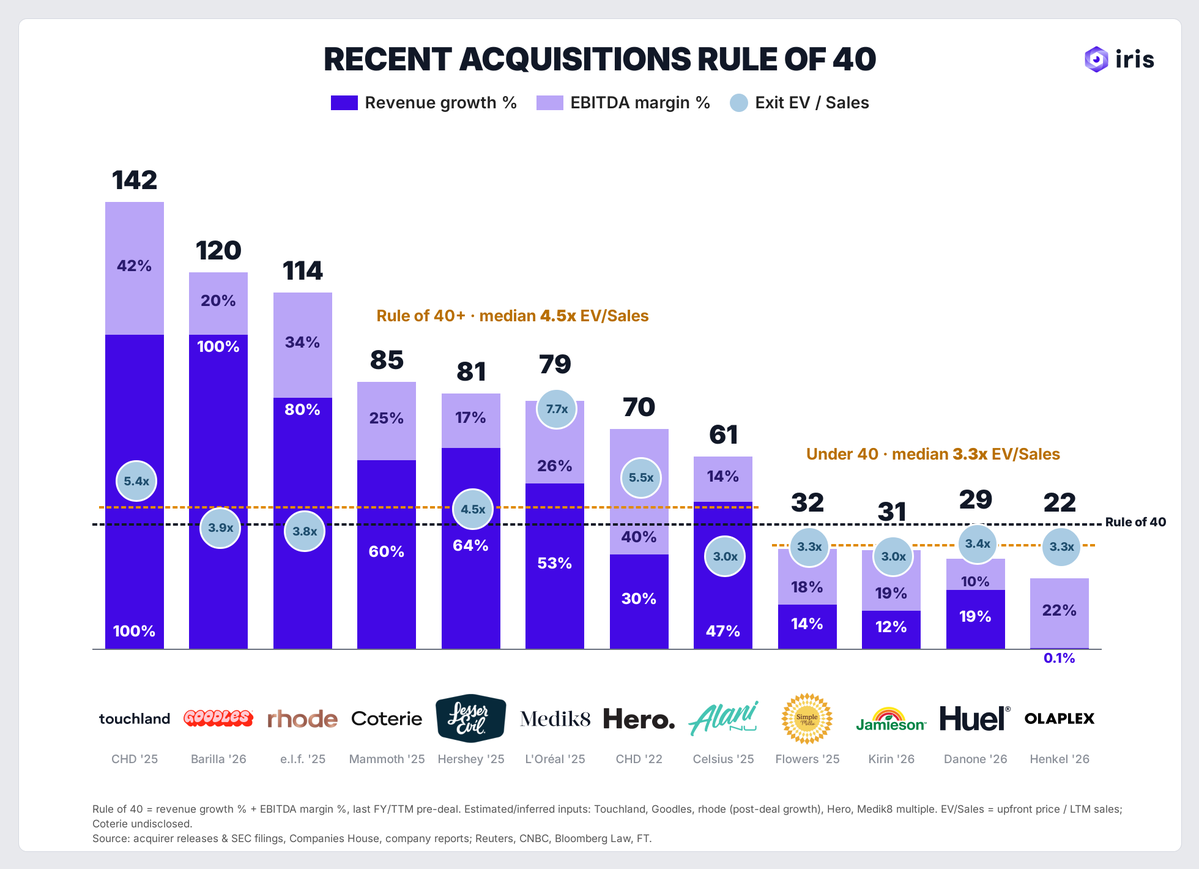
This comes down to a concept conventionally known as 'the rule of 40' - the balance of revenue growth rate + ebitda margin equaling 40, when ebitda is positive.
40, really not THAT high of a number. These days maybe its more like the rule of 50, but the concept prevails: you really only need so much growth; and anything beyond 40 or 50% - most PE buyers are going to look at it and just throw their hands up in the air and say we dont know how to underwrite this
said differently:
You are SO much better off growing 50%, then 40%, then 35% versus 150%, 50%, 10%
It makes the business much more predictable and therefore more underwritable for PE buyers
The chart below shows that many recent strategic acquisitions were well in excess of the rule of 40, with strong ebitda all around. If this is you, you'd generally earn a higher exit multiple - brands over the rule of 40 had median 4.5x EV/Sales exit vs sub rule of 40 had 3.3x EV/Sales exits
And remember, the brands highlighted below are the best of the best. If you want to maximize optionality and be able to attract the most buyers possible, most founders would be better off focused building real, solid businesses that balance growth with profitability vs. swinging for the fences to become the next brand on this chart.
though we do like to see that too :)
Almave, the non-alc agave spirits brand created by Lewis Hamilton and Casa Lumbre, just launched an RTD line exclusively at Target.
Two varieties are available:
Almave Classic Margarita
Almave Paloma
Almave is made using real blue agave harvested from the highlands of Jalisco under the direction of Dr. Iván Saldaña, Casa Lumbre's Master Distiller and PhD biochemist.
Casa Lumbre is a Mexican craft spirits company best known for Montelobos, Ancho Reyes, Abasolo, and several other brands.
cream cheese’s competition isn't just another spread. it's a tub of cottage cheese.
us cottage cheese dollar sales rose 17.7% while cream cheese fell 4.4% over the same 52 weeks through october 4, per circana.
l catterton’s majority investment reportedly valued good culture above $500m. its ceo says it was meeting less than half of demand. with this tailwind brands in this category are going to rip.
The longer I work in finance, the more I appreciate simple financial models.
If your model takes 2 hours to show what happens when your biggest customer leaves, there's probably a better way to build it.
Rogue Protein Snacks just surpassed $1M in scanned sales at Walmart.
Even more impressive, Rogue only landed on shelves at Walmart 13 weeks ago.
In May, Rogue secured $2.5M in pre-seed funding from Science, Inc., Simple Food Ventures, Uncommon VC, and several others.