Updated statistics on Integration & Migration in the #NordicStatisticsDatabase!
Data: https://t.co/vgNQ7af2UN
Visualisations: https://t.co/zCGeqOJXqG
Article: https://t.co/0LaJ69eXnt
Nordic countries see high employment but rising unemployment levels. 📈 Read more about this and a projected demographic shift in the Nordic labour market 👉 https://t.co/lgXSNHyrHk
2024 life expectancy in #theNordics was 83.2 years, +0.6 years from 2023 and exceeding pre-pandemic levels. It ranged from 82.3 🇩🇰 to 84.1 years 🇸🇪, with the exception of 🇬🇱 with 71.3 years. The gap between men and women is steadily decreasing.
Wishing you a happy #WorldStatisticsDay 2025! Why not celebrate by browsing the Nordic Statistics web page and database, a great way to learn more about #theNordics? 🇩🇰🇫🇴🇬🇱🇫🇮🇦🇽🇮🇸🇳🇴🇸🇪https://t.co/cHS7Ti6r4Z
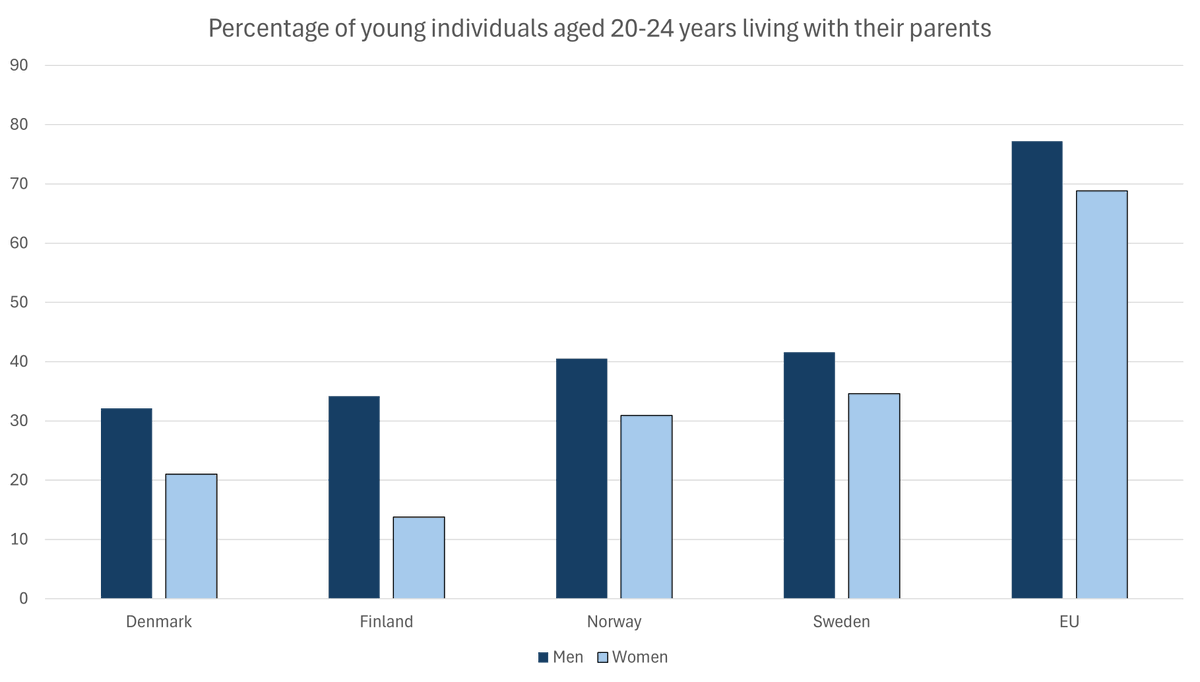
Young people in #theNordics leave their parents’ homes earlier than their European peers. There is also a gender gap, as young women leave home earlier than men🏡
Read more about family and living conditions 👇
https://t.co/NVsv7NY479
In 2024, 259,000 children were born in #theNordics, historically low. Fertility rates from 1.25 in 🇫🇮 to 1.91 in 🇫🇴, with 4 countries having record lows. No. of women of fertile age also affects no. of births negatively for some countries.
https://t.co/G7RsyZWKlH
📊How do #theNordics stack up against the EU in public finances? Norway leads with a surplus fueled by oil and gas, while Finland faces persistent deficits. Explore more: https://t.co/bKqKWcadWU
On January 1st #theNordics had 28.3 million residents, up by 150,000 residents or 0.5% in a year.
An aging population is a reality in all eight countries. Since 1990:
0-19 years -13%
Working age (20-64 years) -3%
65 years and older +31%
https://t.co/fetVrfG4FK
In 2024, #theNordics had import & export values of 464 and 540 billion euros, respectively. Intra-Nordic trade was substantial, but the largest market was Europe. How has the Russian war on Ukraine effected trade, and how big is trade with the US? https://t.co/lJkqEBZhob
In 2023, the five largest countries in the Nordic region 🇩🇰🇫🇮🇮🇸🇳🇴🇸🇪 all met the EU's 2030 renewable energy target of 42.5%
More 👉https://t.co/rxHKXWs6IL
Significant declines in emissions of greenhouse gases during 2020, in #theNordics by over 10%. In the two subsequent years, emissions increased again, but not back to pre-pandemic levels. In Finland 🇫🇮 emissions have even decreased further. https://t.co/AFzG4dUsFf
New article on #integration, #migration and #education: no large, systematic differences between immigrants, descendants and the rest of the population in #theNordics, and descendants participate more frequently than immigrants. #NordicStatisticsDatabase
https://t.co/YcmlMkzRkN
#WorldStatisticsDay2024 was yesterday - we celebrated by presenting our new site on the #Nordic Labour Market and Working Life! https://t.co/mT9xeRZbdw
Tourism in #theNordics was in steady growth before the pandemic. Between 2019 and 2020, the number of guest nights dropped by 60%. In 2023, the Nordic countries can be said to have recovered, having all reported more guest nights than ever before. More: https://t.co/vgia0GP4nd
On January 1st, 2024 #theNordics had 28.2 million residents, an increase by 0.6% compared with 2023. All eight Nordic countries grew, with between 0.2 and 2.3 percent, mainly due to net migrations.
More: https://t.co/dMgBsQfQoM
In the four #Nordic EU member states and regions, between 40 and 58 percent voted in the #euelections in June. For all four countries, the turnout was lower than in the previous election.
More: https://t.co/eNotrtiCeY
Education abroad – back on track after the pandemic. 43,000 #Nordic students enrolled in a Full education abroad 2022/2023, the majority from Sweden/Norway and more women than men. More on this and the effects of the pandemic: https://t.co/JM0URXhcll
#NordicStatisticsDatabase
In 2022, just over 1.6 million #enterprises were registered in #theNordics. Largest sector, with 22%: Professional, scientific and technical activities. Nordic enterprises constitute 6 % of those of the EU.
https://t.co/YjAGrjdjXf
Data in #NordicStatisticsDatabase