#AlexCoughlan Has Been Laid To Rest On His Birthday
In a cruel twist of fate, Alex Coughlan has been laid to rest on his 38th birthday (May 30th, 2026). This specific date was incidental, as his loved ones did not have Alex returned to them until Friday May 29th.
RTE were in attendance this morning. No other media appeared to be present. RTE's attendance felt like a box-ticking exercise: standing, arms folded, across the carpark of Stafford's funeral home in Ballyfermot, gazing at the mourners gathered, as a faded Irish flag flew on a pole nearby, tethered by a single cable tie.
They reported little on the touching aspects of what was to be a celebration of Alex's life. The omissions feel calculated and in keeping with the lack of overall coverage of Alex's death. They published a short, dispassionate article about what was an incredibly moving service. I have, at the time of writing this piece, found no other articles online about the funeral itself—not even a mere mention today that it was taking place.
The service for Alex was open to all, and this fact further indicates that what RTE and other media have not reported illustrates a lack of respect and a desire to conceal, as opposed to a desire to honour privacy.
In the wake of his passing, RTE (purposely?) reported inaccurate details, leading to incorrect speculation and victim-blaming (which caused further unnecessary pain for his loved ones) around the circumstances of the day Alex left his home (and did not return until yesterday, where he lay in repose).
Now, that is quite enough about the government's mouthpiece.
Today is about Alex. Mourners were asked to make May 30th Alex's day. Everyone who gathered was asked to sing "Happy Birthday." As tears are not usually seen when singing "Happy Birthday," it was a well-wish like no other, for a human being who, for many there, was like no other. The words were sung in a heartfelt manner, with the sad realisation that he should be here celebrating.
The backdrop behind the casket (with a single red rose upon it) was the Irish tricolour with lighting that subdued the green, white, and orange as it stood, standing in silent guard, as Alex made his final departure.
Pictures and clips of a smiling Alex and his family, friends, and significant life events played throughout the service. He was spoken of as the glue that held his family together. It was clear Alex was a shining and guiding light in the lives of many. The celebrant spoke of the necessity to ensure that the circumstances leading to Alex's untimely departure be prevented, so that no family ever has to suffer such a loss again.
In the final minutes, all who gathered were asked to sing "Ireland's Call" as family members carried Alex's coffin upon their shoulders past the crowd. He had been a proud Ireland rugby supporter in life.
It goes without saying, an abundance of tears fell throughout the service, but particularly during singing. Upon leaving, people were asked to have a shot of his favourite tipple in Alex's honour (Jameson and Coke) as they made their way out.
Alex was brought to Glasnevin Cemetery for a private cremation.
If you are reading this, raise a toast for Alex today, who will be forever young at 38.
#SpeakHisName
#RememberHim
PLEASE KEEP COMMENTS CONSIDERATE, AS ALEX'S LOVED ONES MAY COME ACROSS THEM.
By Susanne Delaney
"Ireland’s Call
Come the day and come the hour Come the power and the glory We have come to answer Our Country's call
From the four proud provinces of Ireland Ireland, Ireland Together standing tall Shoulder to shoulder We'll answer Ireland's call
From the four proud provinces of Ireland Ireland, Ireland Together standing tall Shoulder to shoulder We'll answer Ireland's call
Hearts of steel And heads unbowing Vowing never to be broken We will fight, until We can fight no more
From the four proud provinces of Ireland Ireland, Ireland Together standing tall Shoulder to shoulder We'll answer Ireland's call."
A Norwegian neuroscientist spent 20 years proving that the act of writing by hand changes the human brain in ways typing physically cannot, and almost nobody outside her field has read the paper.
Her name is Audrey van der Meer.
She runs a brain research lab in Trondheim, and the paper that closed the argument was published in 2024 in a journal called Frontiers in Psychology. The finding is brutal enough that it should have changed every classroom on Earth.
Sometimes the students wrote the word by hand on a touchscreen using a digital pen, and sometimes they typed the same word on a keyboard. Every neural response was recorded for the full five seconds the word stayed on screen.
When the students wrote by hand, the brain lit up everywhere at once.
The regions responsible for memory, sensory integration, and the encoding of new information were all firing together in a coordinated pattern that spread across the entire cortex. The whole network was awake and connected.
When the same students typed the same word, that pattern collapsed almost completely.
The reason turned out to be something nobody had really paid attention to before her work. Writing by hand is not one motion but a sequence of thousands of tiny micro-movements coordinated with your eyes in real time, where each letter is a different shape that requires the brain to solve a slightly different spatial problem.
Your fingers, wrist, vision, and the parts of your brain that track position in space are all working together to produce one letter, then the next, then the next.
Typing throws all of that away. Every key on a keyboard requires the exact same finger motion regardless of which letter you are pressing, which means the brain has almost nothing to integrate and almost no problem to solve.
Van der Meer said it plainly in her interviews.
Pressing the same key with the same finger over and over does not stimulate the brain in any meaningful way, and she pointed out something that should scare every parent who handed their kid an iPad.
Children who learn to read and write on tablets often cannot tell letters like b and d apart, because they have never physically felt with their bodies what it takes to actually produce those letters on a page.
A decade before her, two researchers at Princeton ran the same fight using a completely different method and ended up at the same answer. Pam Mueller and Daniel Oppenheimer tested 327 students across three experiments, where half took notes on laptops with the internet disabled and half took notes by hand, before testing everyone on what they actually understood from the lectures they had watched.
The handwriting group won by a wide margin on every question that required real understanding rather than surface recall.
The reason was hiding in the transcripts of what the two groups had actually written down.
The laptop students typed almost word for word, capturing more total content but processing almost none of it as they went, while the handwriting students physically could not write fast enough to transcribe a lecture in real time, which forced them to listen carefully, decide what actually mattered, and put it in their own words on the page.
That single act of choosing what to keep was the learning itself, and the keyboard had quietly skipped the choosing and skipped the learning along with it.
Two studies. Two countries. Same answer.
Handwriting makes the brain work. Typing lets it coast.
Every note you have ever typed instead of written went into your brain through a thinner pipe. Every meeting, every book highlight, every idea you captured on your phone instead of on paper was processed at half depth.
You did not forget those things because your memory is bad. You forgot them because typing never woke the part of the brain that would have made them stick.
The fix is the thing your grandmother already knew.
Pick up a pen. Write the thing down. The slower road is the faster one.
Pauline Robinson - Physiotherapist informed everyone at today’s HSCP conference in @stjamesdublin about testing the National Osteoporosis Hip & Knee Pathway. Some fantastic patient feedback.
@RCSI_Irl@HealthyIreland#HSCP
My book "Coercive control and vulnerable adults: Law and Practice in the Court of Protection and under the Inherent Jurisdiction of the High Court" comes out next week, but I've already received some copies. Order the book here https://t.co/YHyflBLsaQ DM me for a discount code 😉
Nursing, dietetics, Speech and Language Therapists, and Aramark staff at UHG highlighted the importance of the Red Tray initiative. Patients who need help with meals are given a red tray instead of a standard one, easily alerting staff to patient safety control.
Discover more about Trinity College Dublin's online postgraduate courses in Social Work and Social Policy with a free information webinar on Tuesday 21st April at 5.30pm GMT+1.
https://t.co/9gj7Glg7LC
Today, Sligo University Hospital’s Frailty Intervention Team officially launched Supporting your Health, a patient information booklet designed to support older adults living well in their community.
Produced as a result of a multidisciplinary collaboration.
A former Circuit Court judge who was convicted of attempted rape and the sexual abuse of six young men when he was a teacher 30 years ago has appealed his conviction, arguing that trial judge’s instructions to the jury were “confusing” and “weighted against the defence”.
https://t.co/Dd9JuTewXO
@rtenews both government parties were elected on the back of promises of annual tax band & credit increases. Will media ask @SimonHarrisTD & @MichealMartinTD if they intend to apologise for lying to the Irish people?
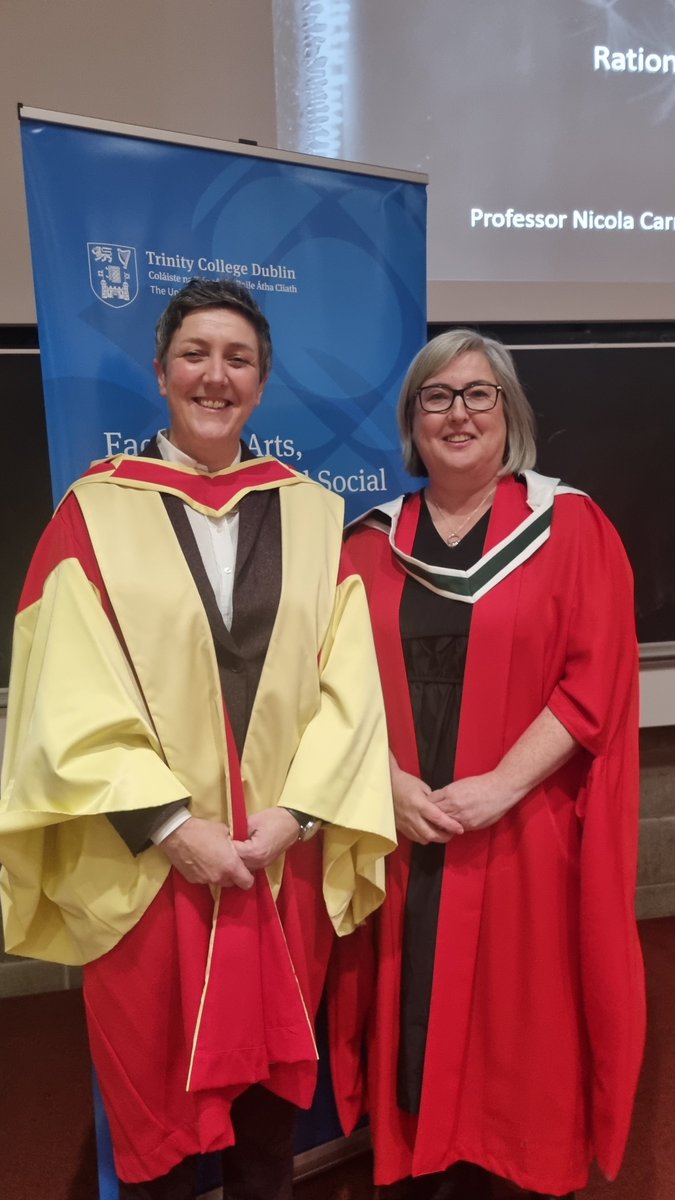
Professor Nicola Carr delivers her Inaugural Lecture titled ‘Doing Time: Rationalities, Practices, and Experiences of Punishment’
https://t.co/Ddy0gkIfO1