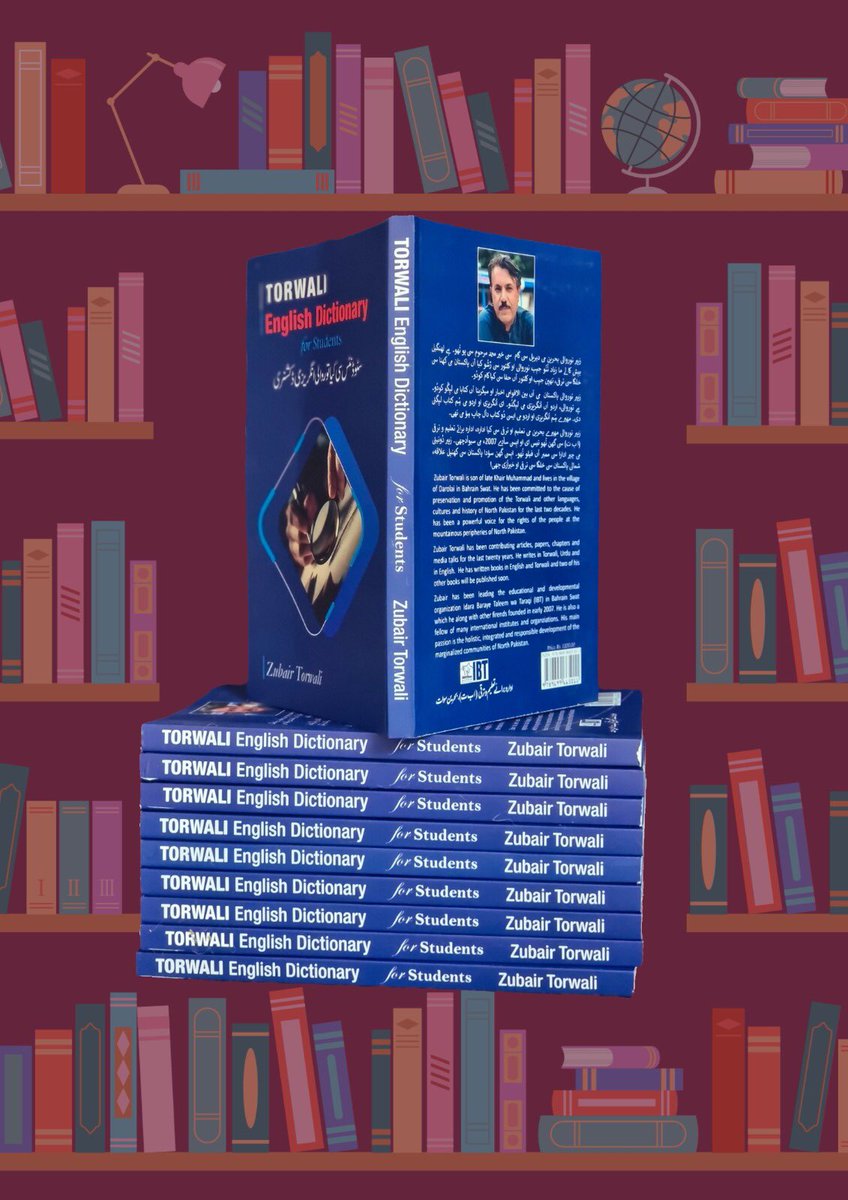
I am a social media forum for the promotion and advocacy of the lesser known languages of North Pakistan which is upper Khyber Pakhtunkhwa and Gilgit-Baltistan.
توروالی ڙو خاتون کی طرف سے خاتون کی آواز میں۔
پورے ڙو سننے کے لیے لنک کلک کریں۔
Famous Torwali Zjo songs|| vocals woman|| Mhi Chin Aengi Thi Iran Si Qalama Si Zjanga||
https://t.co/spw0FgQxh2
New book!
"Multilingual Family Language Policy and Wellbeing: Language Ideologies, Strategies and Experiences" by Kaisa Pankakoski is out now!
Order your copy below ⬇️
I wrote this paper for one of the most prestigious international magazines, Aeon, a few years back. It is on the languages of Dardistan with a short history and background of the region. For one year, this paper was among the most-read essays in the magazine. Aeon is very powerful and very academic. It usually publishes articles on every complex issue. I think it would be of some help for my friends living in the region as well as in the rest of Pakistan. It was an honour to write this piece in the magazine as the first Pakistani. At the end of the essay, you can also read some poems in different languages such as #Shina, #Brushaski #Torwali
#Dardistan #Dardesha #LinguisticDiversity #Pakistan #DardicLanguages
How Dardistan became one of the most multilingual places on Earth – https://t.co/2nK3WYSWYh via @aeonmag
Something very personal. My story
A Love Letter to a Homeland that Never Loved Back
Zubair Torwali on the trials and tribulations of an activist
Jun 29, 2026
For over twenty years, I have dedicated myself to a dream much bigger than me. I never chased wealth, fame, power or comfort. My dream was for my people, a small Indigenous community in the mountains of Upper Swat, whose identity, language, poetry and history had long been invisible to the world. I wanted the Torwali people to know who they truly were. I hoped they would feel proud of their language, songs, mountains and stories. I wanted the world to see that we exist. What started as a youthful passion slowly became the main purpose of my life.
I threw myself into learning about language, history, folklore, culture and identity. I wrote books in Torwali, Urdu and English. I collected folk songs and oral histories from being lost. I recorded traditions that were disappearing and started community schools and early literacy programs. I helped create books and learning materials where none had existed before. I travelled to international conferences and academic forums, often as the only voice for a people history had forgotten and modern society seemed eager to erase.
But my struggle was never just about the Torwali people. As I learned more about my own community’s deep wounds, I saw the same struggles among other Indigenous and marginalised groups in the mountains of North Pakistan such as the Gawri, Ushojo, Palula, Dameli, Kalasha, Shina, Burushaski, Wakhi, Balti and others. Our stories were heartbreakingly similar. Their languages were not safe, their histories ignored and their voices left out of policy decisions. I dreamed of bringing these mountain communities together so we could face our shared challenges and shape our future. I hoped that one day, we would speak as one, aware of our rights, cultures and destinies.
Then came the darkest time in Swat’s recent history. When Taliban militancy took over the Swat Valley and other areas in 2007-2009, fear became a part of daily life and most people stayed silent to survive. But I couldn’t stay silent. I wrote against fascism, spoke out from the edges, and resisted. I openly challenged sectarian violence, extremism and intolerance. I tried to give a voice to the suffering of ordinary people, even when the world looked away and others were too afraid to speak. During those violent days, I renamed Mingora’s central grain square “Khooni Chowk,” or Bloody Square, a name that soon became known beyond our borders. After that, militants hunted me. I left my homeland and hid in cities, moving between Peshawar and Islamabad, never staying in one place for more than two days. Even while hiding for six months, I kept writing about my valley and my province.
Standing up came at a huge cost. Over the years, my own society turned against me. I was called an infidel, a liberal agent, anti-religion, a foreign proxy and even a la-deen (non-believer). People attacked my writing, questioned my motives and tried to ruin my reputation through smear campaigns and social media attacks. Sometimes, it felt like powerful groups in my community wanted to destroy everything I had worked for. First, I was judged for being a farmer’s son. Then, for questioning injustice. Then, for defending minorities. Then, for supporting Indigenous land and language rights. In the end, I simply refused to follow the crowd or accept blind conformity.
Still, through all of this, I never gave up. I stood firm as the ancient rocks in the middle of the Daral River in my hometown, Bahrain. The rushing water hit from every side but the rock stayed, and so more powerfully I wrote. Reading and writing became both my refuge and my rebellion. Sometimes I think of Goethe’s Faust, caught in an unending surge of striving, searching and perpetual dissatisfaction. Like him, I found myself pursuing knowledge not because it promised comfort or societal embrace, but because it was the only thing that promised meaning. And perhaps a transcendent meaning was what I was truly seeking all along.
Bahrain: Photograph by Aftab Ahmad📷
In recent years, I have faced a new challenge. The planned Madyan Hydropower Project threatened the River Swat’s ecology and the Indigenous communities along its banks. For almost two years, I worked tirelessly advocating, speaking, documenting, meeting and organising at the grassroots level. Against all odds, we put enough pressure on the project’s international backers that the World Bank eventually withdrew. It was one of the hardest and most important victories of my life.
Bahrain: Photograph by Aftab Ahmad📷
Yet, oddly, victory did not bring me peace. In the past six months, I have felt exposed more facing a deeper question: What was all this for?
For twenty-five years, I have worked hard for a community that often seems directionless. I gave it my youth, energy, mind, emotions and peace. In return, I rarely got gratitude. Most of the time, I faced indifference, sometimes even hostility but usually just silence. The people I tried to help are still divided. The community I wanted to strengthen is still broken. The society I hoped to awaken seems to prefer staying asleep. Worst of all, some of those I cared for most turned away from me.
Maybe every activist, writer or dreamer reaches this lonely crossroads. The applause fades, victories feel incomplete, and you stop looking for outside success and start searching for inner meaning. In this heavy mood, I wrote the following poem in my mother tongue, Torwali. It is an honest conversation with my homeland and with myself.
My Torwali Zjo (classical verse in rhymed couplets) with English translation
Waṭaniyā se kyā tūnū čonjo goṭ zed thōu ni ki parwāh
Waṭani būṛ qaṣāb aga mhēre čhīnadī mhī ʂā
For my people, I laid my head on the altar, with no care of cost;
Yet my people are butchers all, eager to claim the head I lost.
Mhae o čhi ūmo e šānā khedā
Theye nām se gaṭā mheye ūmū hī āngā
Your life and mine were never cast the same;
You live for honour’s name; mine was forged in flame!
Tū zuwānā se sardār āman ge mhae namūnā na sawā
Mae baečai ki yī mhēre dīyi nū thū ki saudā
You are the lord of youth; do not trace my footsteps’ line;
I lived like a king in my season, and no longing now is mine.
Mhī khayāl tū, nīnd tū, tū mhī ʐād se čharā
Tū saedā mā šomēl mudām bayadū pīṭhā
You are my dream, my thought, the blood within my vein;
Yet fearful of the world, you never come to see me again.
Mheye oḍīn se ašī banūdud, kala šimāl se tā
Mae āman thalū lār, mhēre čhi nazar me ā hū koṭā
I was Odin’s Eye to you, sometimes the Northern Star;
I fell from that summit of skies, and from your eyes afar.
Ā ūmo se ṭhamēl, thū jedūn mā čer khwā
Aga čhi mēnā me āman ge nīm sawādū maʿānā
I am worn by the years, and weary of life’s refrain;
In your love, I try to give new meaning to my pain.
Mhaeo čhi sakhtī khānā e šānā khedā
Tū ūmo se basān, ā lhangū šīdā phā
Our griefs are not the same, nor do they share one sky;
You are of spring age, while I have seen its autumn die.
Mae khām se kyā zuwānī jhīgī, hay se zorā gā
Tūnū āman piyān, me khām se kyā āman na kaṛā
For my people, I burned my youth, spent my heart’s last flame;
Beware! Live only for yourself and do nothing for their name.
Āmā bare me khām jannēn, konēn tūnū šā bhā
He lā thāmūṛ mothal bail tūho, kūdū sajdā
I thought my people would awaken and hold their heads high;
Yet they are still face down, as though in endless prayer they lie.
Now, as I look back on this long journey, I don’t claim victory or admit defeat. I am still what I have always been: a seeker, a reader and a learner. A son of these mountains. A guardian of endangered words. A witness to a world that is fading. Most of all, I am still searching for meaning in my life, and in the community, I have spent my life fighting for. I don’t know if I will ever find it. But the struggle, like the old river, goes on.
https://t.co/3o0NRgYe2d
In case it is missed!
Sharing my latest paper on the internal colonisation of the ethnic communities in North Pakistan, Gilgit Baltistan and upper reaches of Khyber Pakhtunkhwa, tracing the impacts on cultures, identities, language and social marginalisation.
It is a study done for the Human Rights Commission of Pakistan under its IA Rehman Research Award!
It is open accessed and the link is given here.
https://t.co/GqbcO7qapD
Look at these children. They love their river which was destroyed by diverting for hydroelectric plant. Now the same organization tries to divert River Swat for another project Madyan Hydropower Project. @WBG_Climate@World_Wildlife@WorldBankSAsia
“My resignation from the Culture Committee of ANP”
I regard the amendment to the name “Khyber Pakhtunkhwa” to just “Pakhtunkhwa” as an attempt to deny the right of identification, to land and to their distinct cultures, histories and languages to the other ethnic communities like Hindko, Saraiki, Gujjar and the Dardic and other ethnic communities of Chitral, Dir, Swat and Kohistan.
I regard this move as subsuming the other communities. Such moves will definitely create more tensions. These are means to further internally colonize these communities.
The postcolonial state Pakistan has been suffering from an Internal Colonialism which refers to, ‘a structure of social relations and exploitation between heterogeneous cultural groups.’ Being culturally and ethnically heterogenous with four widely known major ethnic groups this structure of the social relations and exploitation is seen mostly within these four ethnic groups while the lesser populations, or the ethnic minorities, are never given any mention while considering geographical delimitation, distribution of resources, ethnicization, and political representation within the state boundaries.
In the present territorial domination of these four major ethnicities live many minor indigenous groups with their distinct languages, cultures, history, indigeneity and ethnic boundaries. These minorities get the least attention in the power struggle within the power corridors in Islamabad, Rawalpindi, Peshawar, Karachi or Lahore.
Political parties claiming to represent the major ethnic groups have always been complaining of this internal colonialism but ironically, they fail to see the same where they themselves become the internal colonizers.
The so-called federalist parties also do the same without expressing it. They suppress the indigenous and rights movements which rise for protecting their rights to land, resources and cultures.
In Sindh the indigenous movements are crushed by these federal parties. In Khyber Pakhtunkhwa the major mantra is but of one majority ethic group and the entire land of North Pakistan is ascribed as their land denying the existence to all other diverse ethic and indigenous communities in North Pakistan.
I would reject any label for any region of Pakistan which represents only one ethnic group further pushing the ‘others’ to the margins socially, politically and culturally!
Given these reasons I would like to resign from the Culture Committee of Awami National Party which I had joined that I would be able to voice the concerns of the diverse languages, cultures and communities of Khyber Pakhtunkhwa.
I would also like to bring it to light that despite being member of the Culture Committee I was not aware of such a proposal by Awami National Party neither has the suggestion been discussed in the committee.
It seems to me that one man decided to vote for the 26th Amendment while having this suggestion in his hands.
I also strongly condemn the so-called federalist parties like Pakistan People’s Party and Pakistan Muslim League (Nawaz) agreeing to such a proposal just because they need the one vote in the Senate of Pakistan.
I stand resigned!
Zubair Torwali, Bahrain Swat, Khyber-Pakhtunkhwa Pakistan.
پاکستان کی اندرونی نوآبادیاتی جہتیں
نوآبادیاتی دور کے بعد قائم ہونے والی ریاست پاکستان ایک اندرونی نوآبادیاتی نظام سے دوچار ہے، جس کا مطلب ”متنوع ثقافتی گروہوں کے درمیان سماجی تعلقات اور استحصال کا ایک ڈھانچہ“ ہوتا ہے۔ پاکستان میں مختلف ثقافتوں اور ایتھنِک گروہ کے لحاظ سے چار بڑے گروہ موجود ہیں، اور یہی استحصال اور سماجی تعلقات کا یہ ڈھانچہ زیادہ تر انہی چار بڑے گروہوں کے درمیان طاقت کی متحریکات کو دیکھتا ہے، جبکہ کم تعداد میں موجود اقلیتی گروہوں کو جغرافیائی حد بندی، وسائل کی تقسیم، شناخت اور ریاستی حدود کے اندر سیاسی نمائندگی کے وقت مکمل نظر انداز کیا جاتا ہے۔
ان چار بڑی قومیتوں کے زیر تسلط علاقوں میں بہت سی چھوٹی دیسی قومیں بھی بستی ہیں جو اپنی منفرد زبانوں، ثقافتوں، تاریخ اور شناخت رکھتی ہیں۔ ان اقلیتوں کو اسلام آباد ، راولپنڈی ، پشاور، کراچی یا لاہور میں اقتدار کی راہداریوں میں جاری اقتدار کی رسہ کشی میں بہت کم توجہ ملتی ہے۔
سیاسی جماعتیں جو ان بڑے گروہوں کی نمائندگی کا دعویٰ کرتی ہیں وہ اکثر اس اندرونی نوآبادیاتی نظام کی شکایت کرتی رہتی ہیں لیکن ستم ظریفی دیکھیں کہ وہ خود اس نظام کا حصہ بن کر اندرونی نوآبادکار بن جاتی ہیں اور اس حقیقت کو تسلیم کرنے سے قاصر رہتی ہیں۔
نام نہاد وفاقی جماعتیں بھی اسی طرز پر عمل کرتی ہیں اور اس کا اعتراف کیے بغیر دیسی اور حقوق کی تحریکوں کو دباتی ہیں، جو اپنے زمین، وسائل اور ثقافتوں کے تحفظ کے لیے آواز اٹھاتی ہیں۔
سندھ میں دیسی تحریکوں کو ان وفاقی جماعتوں کے ذریعے کچل دیا جاتا ہے۔ خیبر پختونخواہ میں بڑا نعرہ ایک بڑے ایتھنِک اکثریت کا ہوتا ہے اور شمالی پاکستان کی پوری سرزمین کو اسی اکثریتی گروہ کی زمین قرار دے دیا جاتا ہے جس سے شمالی پاکستان میں موجود دیگر متنوع نسلی اور دیسی برادریوں کے وجود کو یکسر نظرانداز کیا جاتا ہے۔
میں پاکستان کے کسی بھی خطے کو کسی ایک ایتھنِک گروہ تک محدود کرنے والے کسی بھی لیبل یا نام کو مسترد کرتا ہوں کیونکہ یہ دیگر برادریوں کو سماجی، سیاسی اور ثقافتی طور پر مزید حاشیے پر دھکیلنے کا سبب بنتا ہے۔
Look at these children of Bahrain Swat Pakistan. Their river, Daral, was destroyed by the gov organization PEDO (Pakhtunkhwa Energy Development Organization) for a hydropower project. Now, as the children find some water in this water race built by the community themselves. The children felt jubilant.
The same organization PEDO is now hell bent to destroy the River Swat for such project which is rejected by the indigenous Torwali community. Shamer on PEDO. Wrath on PEDO.
#WorldRiversDay #WorldBank #SaveRiverSwat @WorldBank@WBG_Climate @WorldRivers