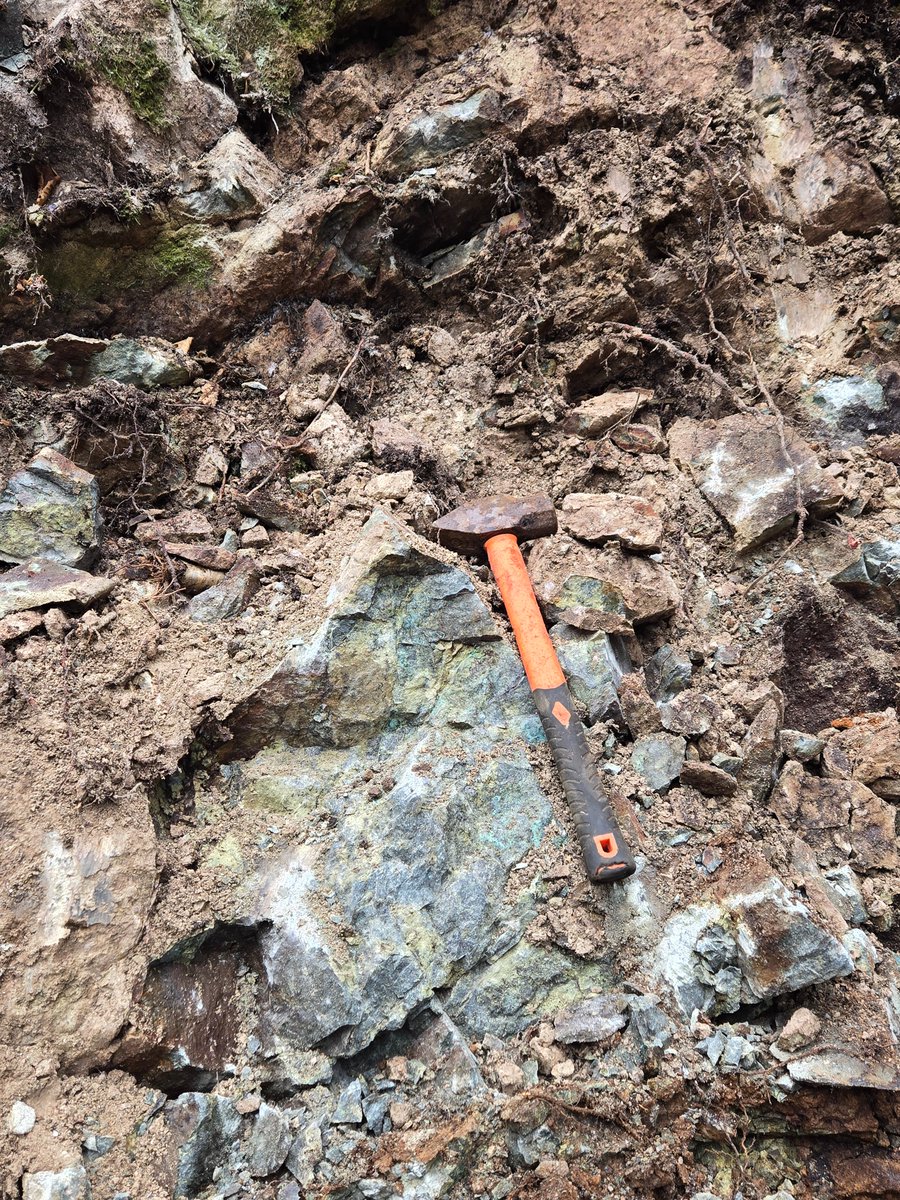
2/2 We followed it with a second outcropping porphyry 700 m away — even more visible copper, incl. hypogene (primary) chalcocite + native copper. A few km from a deep-water port, overlooked for its age.
It sucks to be old. $NRN
(interpreted; assays pending)
It sucks to be old!
Not me — porphyry copper. The Burin was written off for its age: how could surface copper survive 500M+ yrs of erosion?
Creston did — upright, intact, at surface. An interpreted alkalic porphyry copper system hiding in plain sight. $NRN 1/2
Each step - the first discovery, a second copper-bearing dike 700 m away, and now this trench - points the same way. Is the Burin Peninsula a new, overlooked porphyry copper district? We think it’s worth finding out.
We’re getting our eyes tuned to it, and combined with our soil geochemistry, we think there’s more of it to find at surface. So, without a single drill hole, we now have multiple porphyry-copper occurrences at surface, over an IP target that strengthens with depth.
This marks the first identification of porphyry-hosted copper mineralization on the property and, to the Company’s knowledge, on the Burin Peninsula.
Read Full Press Release: https://t.co/abkkIPlkik
Northern Shield reports additional copper mineralization uncovered during trenching at the Creston Target on its flagship Root & Cellar property in Newfoundland.
Together, these relationships indicate a long-lived and active magmatic-hydrothermal system, with mineralizing fluids active before, during and after the formation of the diatreme breccias.
What can multiple generations of copper mineralization tell us about a deposit?
At the Creston Copper Zone, copper mineralization has been observed in three distinct phases:
1. Primary porphyry-style mineralization within fragments enclosed by diatreme breccia;
2. Chalcopyrite forming veins and void fillings during the development of the diatreme breccia; and
3. Later veinlets containing chalcopyrite, bornite and disseminated chalcocite that are hosted in both the breccia fragments and the breccia matrix.
Northern Shield Resources Inc. reports assay results from a copper-bearing feldspar porphyry dike (the “Creston Discovery”), discovered while ground truthing induced polarization geophysical targets at the Company's flagship Root & Cellar Property-
The Company believes the two occurrences may form part of a broader porphyry system. Planned next steps include mechanical trenching, additional prospecting and sampling, followed by a proposed maiden drilling program targeting the Creston IP anomaly, the interpreted system-
- in a district that has never been systematically explored for porphyry copper.
New copper has to come from somewhere. We think the Burin Peninsula is one of those “somewheres”.
Are the hallmarks of a new alkalic copper-gold district beginning to unfold on the Burin?
A new S&P Global analysis (Sept 2026) finds although copper demand is accelerating across multiple fronts, the pipeline of new copper deposits continues to thin.
That's the backdrop for our porphyry copper discovery at Creston (Root & Cellar), announced earlier this month: intact, porphyry-hosted copper mineralization in an altered feldspar porphyry, with both IP and magnetics pointing to a much larger body at depth -