Pierre Poilievre says that a Conservative government led by him will pass a castle law that allows Canadians to DEFEND their homes with whatever force they deem necessary against violent home intruders.
Common sense.
@Dljokl Read Empty Planet: by Bricker and Ibbitson
A very thoughtful and well laid out exploration of TFRs across the globe and factors affecting up/down.
Gold and silver are not acting well in a period of rapidly rising geopolitical risks. We have an Iran War, Strait of Hormuz blockade, rising volatility. In the old framework, that setup should be close to ideal for gold. But once you understand what is now driving gold, this move makes perfect sense.
Something fundamental changed after the US and Europe froze Russian reserves in 2022. For decades, surplus countries parked their excess savings in US dollar assets, mostly Treasuries. The freezing of Russian reserves combined with the current administration's explicit push to discourage foreign countries from parking excess savings in US financial assets, forced surplus countries to rethink where they store reserves.
And those countries haven't changed their domestic policies that generate the excess savings, so those savings have to be placed somewhere. The result is that gold and silver have increasingly become the obvious “neutral” reserve assets.
That’s why gold decoupled from the three factors that used to explain it…real interest rates, volatility, and liquidity. Now reserve accumulation flows have become the primary driver.
That shift has a consequence I don’t think most investors have thought through. If gold is now primarily driven by reserve flows from surplus countries, then gold has become pro-cyclical.
Reserve growth is driven by export revenues, trade surpluses, economic growth in surplus economies. When the global economy is strong and surplus countries are generating large export revenues, their excess savings grow, their reserve accumulation accelerates, and gold catches a bid. When that surplus generation is disrupted, the bid weakens or reverses.
This is exactly what is happening with the blockade of the Strait of Hormuz.
The GCC countries are major reserve/gold buyers and now their export revenues are collapsing. They likely need to liquidate some reserves to cover fiscal obligations, and gold is one of their most liquid assets. Even if the reserve sales aren’t excessive yet, the market can see their reserve accumulation has stalled and probably reversed. That flow, which was a meaningful source of gold demand, has gone to zero at best.
There are also secondary effects on other surplus economies. China is the world's largest oil importer. An energy shock of this magnitude slows Chinese growth, and compresses Chinese surpluses, which slows Chinese reserve accumulation. That same growth shock ripples through Korea, Taiwan, Japan, and the rest of Asia.
The whole chain that has been driving gold higher, surplus countries generating excess savings that need a home outside the dollar system, is being disrupted by an event that in the old model would have been unambiguously bullish for gold.
This doesn't mean the structural case for gold is broken. The dollar standard is still ending. Surplus countries still need an alternative to Treasuries and gold is still the most obvious destination. But it does mean gold is going to be more volatile along that structural trend than most people expect, and the volatility will correlate with global growth and surplus generation rather than with the old drivers. Gold rallies when surpluses expand. Gold sells off when surpluses contract. Even if the reason for the contraction is rising geopolitical risk that, under the old model, should have sent gold to the moon.
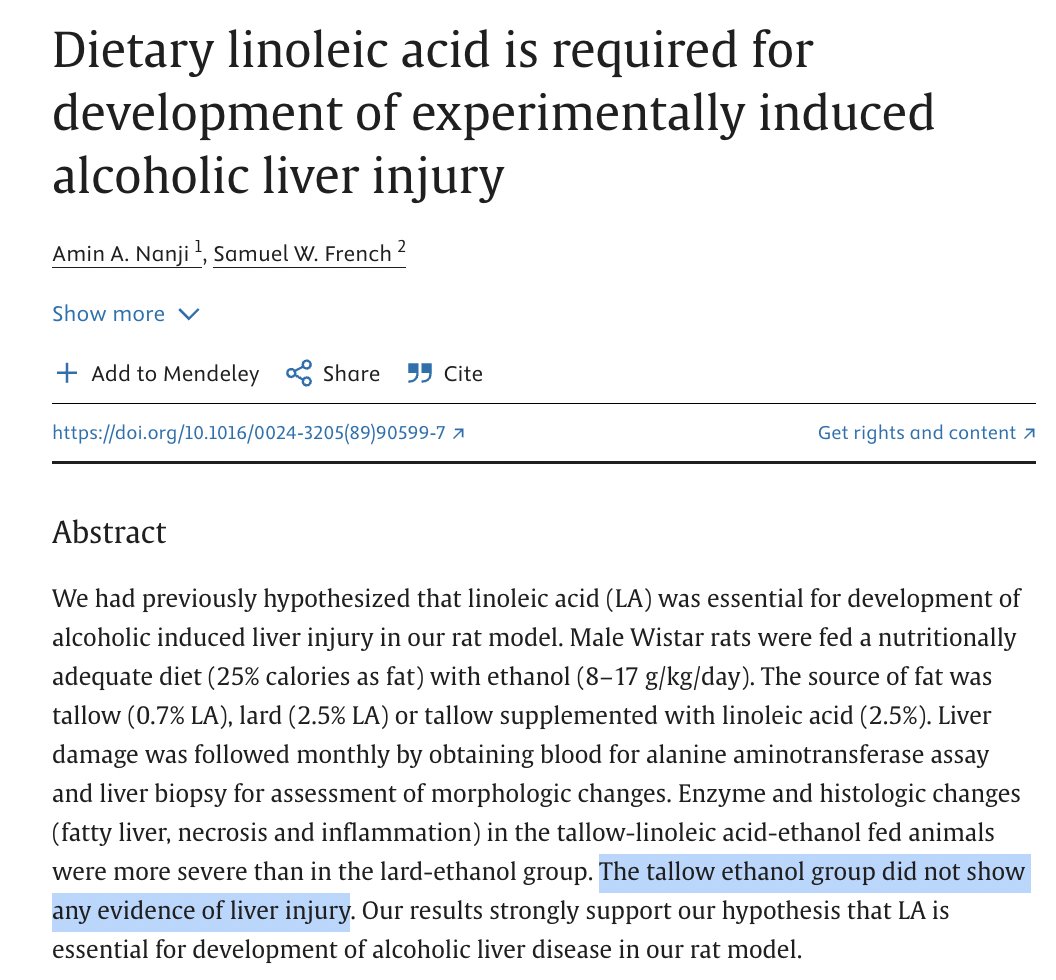
lol...turns out that researchers couldnt give rats liver disease from alcohol unless they ate seed oils
researchers gave rats the human equivalent of 20 drinks a day, and the rats were completely protected from liver injury when they ate tallow
maybe we need to stop blaming alcohol for what seed oils did.
Your home is your castle.
I call on the government to pass the Stand on Guard law to preserve Canadians' right to defend themselves without fear of punishment.
Sign here to Stand On Guard for your home: https://t.co/UKZBzOYevM
BREAKING: When asked if Canada needs castle laws, Pierre Poilievre says that Canadians should be able to do 'whatever is necessary' to defend themselves from criminals breaking into homes.
ABSOLUTELY BASED PIERRE.
McDonald's lawyer, Steven Norton, was interviewed on Toronto CFRB 1010 this am. CTV played the following segment
"I can tell you a little bit in the sense that my client maintains their innocence and that their conduct was lawful, and we are looking forward to vindicating that through the courts."
"Self defense is enshrined in the criminal code in Canada in sections 34 and 35 that allows the defense of person and property." @NortonLawPC
Premier Smith comments on the case of the Ontario man charged after defending his property during a home invasion:
"If you don't wanna get shot or beaten up, don't break into people's houses. It's pretty straightforward."