The SOH blockade ends with the USN taking or diverting 152 Iranian ships -- for now. By comparison Europe has physically stopped, boarded, detained, or redirected around 10–15 well-documented Russian Dark Fleet ships as of mid-2026—despite sanctioning hundreds.
Iran to be sure, detained hundreds of merchantment in the Gulf. But as I observed the trends were against Iran, whose physical stranglehold on the SOH lessened by the day. By comparison the USN blockade accelerated, peaked and probably was going to taper off as Iranian ships dwindled.
Early days (first 48 hours–~1 week): 9–10 vessels turned back; rising to ~23–29 intercepted/redirected.
Late April: ~29+ intercepted.
Mid-May: 89–100+ redirected; some disabled.
Late May: 97–118+ redirected, 4–5 disabled.
Early June: 132+ redirected, 6 disabled (higher totals reported in some updates)
So Iran had to sign while they still had cards to hold. Little noted is how the relative risks will change if the ceasefire lasts a month. In that month the ships trapped in the Gulf will escape en masse, dramatically lowering Iran's leverage. Simultaneously Iranian ships now skulking in port must put to see with cargoes, dramatically increasing USN's leverage.
A rational Iran will allow the ceasefire to survive at least until its first or second cycle of cargoes reaches intended port. If they violate it too soon their ships at sea will be seized.
https://t.co/sopvwWOw2D
USA. Summer. It is 95 degrees outside, and I am shivering inside a sandwich shop.
I have discovered how Americans forge strong souls.
Outside, the sun is trying to kill everyone. Inside this small restaurant, it is winter. My breath does not fog, but it is thinking about it. A man near me is eating a cold sandwich while wearing a jacket. In summer. Indoors.
In Japan we would simply turn it down. Americans do not turn it down. And now I understand them better than they understand themselves.
This cold is not an accident. This cold is a gift.
The owner has built, inside his shop, a second season. He invites you in from the brutal heat and hands you the one thing the sun has denied you all day: a reason to be cold. To endure it is to be tempered. You walk in soft and sweating. You walk out sharp and clear, a slightly stronger person than you were.
So I did not complain. I removed my outer layer and offered it to the woman at the next table, who was hugging herself. She said, "Oh, no, I'm fine, thank you." She was not fine. Her lips were blue. But she, too, understood the training. She would not break first. I respected her deeply.
The owner asked if everything was okay.
"It is perfect," I said, through my teeth, which were chattering. "Thank you for the winter."
He said, "...I can turn the AC down if you want?"
I told him no. A man does not ask the mountain to be shorter.
I stayed two hours. I ordered a hot coffee to survive. Then a second one, to hold. By the end I could no longer feel my hands, but my spirit had never been clearer.
So now, on the hottest days, I seek out the coldest rooms. I sit. I shiver. I sharpen.
And when I finally step back out into the summer heat, and it wraps around me like a warm bath, I feel it.
Reborn.
A man who has survived the winter, in August, indoors, for the price of a sandwich.
USA. Summer. It is 95 degrees outside, and I am shivering inside a sandwich shop.
I have discovered how Americans forge strong souls.
Outside, the sun is trying to kill everyone. Inside this small restaurant, it is winter. My breath does not fog, but it is thinking about it. A man near me is eating a cold sandwich while wearing a jacket. In summer. Indoors.
In Japan we would simply turn it down. Americans do not turn it down. And now I understand them better than they understand themselves.
This cold is not an accident. This cold is a gift.
The owner has built, inside his shop, a second season. He invites you in from the brutal heat and hands you the one thing the sun has denied you all day: a reason to be cold. To endure it is to be tempered. You walk in soft and sweating. You walk out sharp and clear, a slightly stronger person than you were.
So I did not complain. I removed my outer layer and offered it to the woman at the next table, who was hugging herself. She said, "Oh, no, I'm fine, thank you." She was not fine. Her lips were blue. But she, too, understood the training. She would not break first. I respected her deeply.
The owner asked if everything was okay.
"It is perfect," I said, through my teeth, which were chattering. "Thank you for the winter."
He said, "...I can turn the AC down if you want?"
I told him no. A man does not ask the mountain to be shorter.
I stayed two hours. I ordered a hot coffee to survive. Then a second one, to hold. By the end I could no longer feel my hands, but my spirit had never been clearer.
So now, on the hottest days, I seek out the coldest rooms. I sit. I shiver. I sharpen.
And when I finally step back out into the summer heat, and it wraps around me like a warm bath, I feel it.
Reborn.
A man who has survived the winter, in August, indoors, for the price of a sandwich.
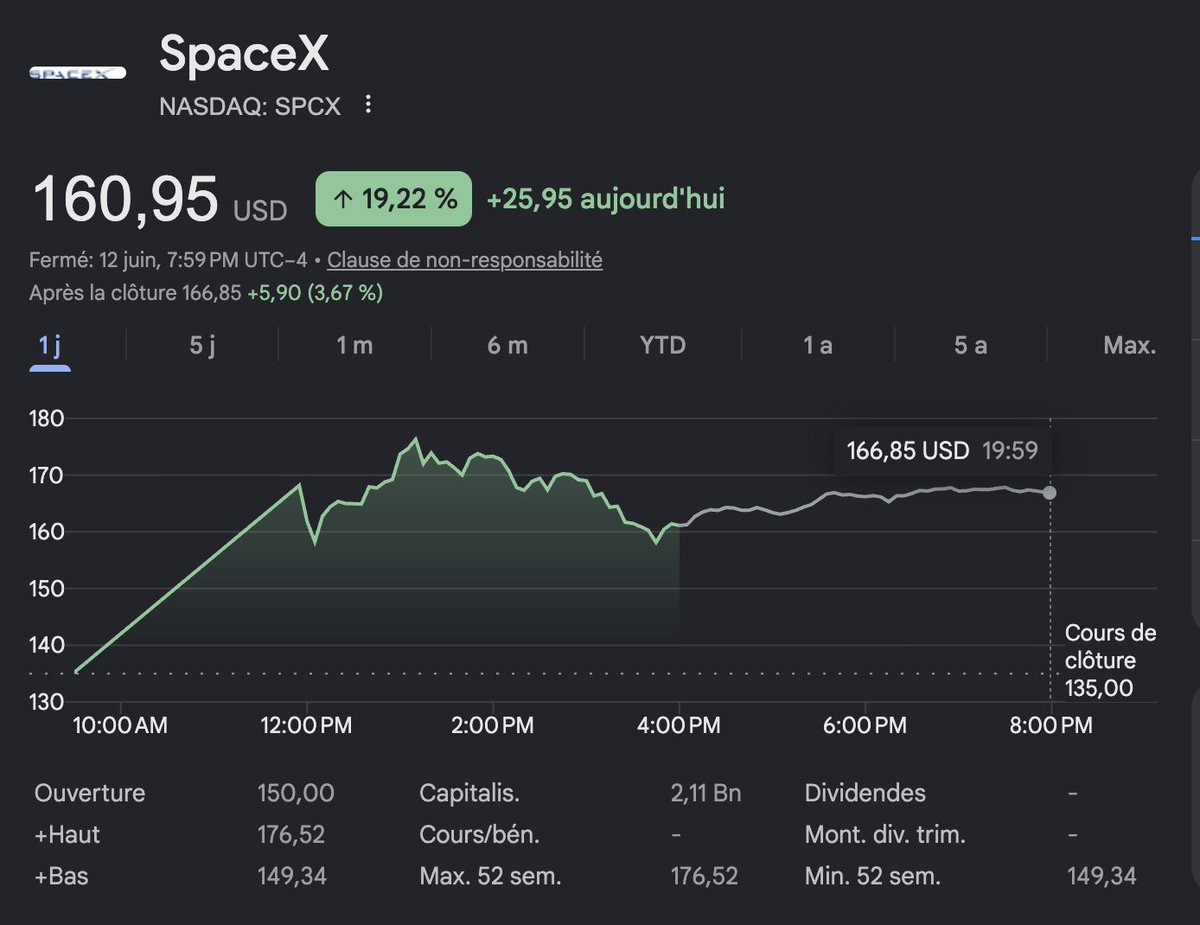
SpaceX a clôturé son premier jour de cotation à 2 100 milliards de dollars, +19%. Tout le monde regarde le chiffre. Personne ne regarde ce qu'il price réellement.
Laissez-moi vous dire ce que le marché vient d'acheter, et pourquoi je pense que cette boîte vaudra 30 à 50 trillions d'ici 5 ans.
D'abord, le symbole. Cette IPO est un référendum. D'un côté, 20 ans de discours sur la décroissance, la sobriété, la redistribution, la fin de l'histoire gérée par des comités. De l'autre, un homme qui a dit "je vais rendre l'humanité multiplanétaire", que tout le monde a traité de clown, et qui vient de créer la plus grosse entreprise cotée de l'histoire en partant d'un entrepôt à El Segundo. Le marché a voté. Le wokisme avait des départements RH, SpaceX avait des fusées. Les fusées ont gagné.
Ensuite, la mécanique économique, parce que c'est là que tout le monde se trompe. Les analystes valorisent SpaceX comme une entreprise de lancement plus Starlink. C'est comme valoriser Internet en 1995 sur le marché du fax. Starship ne réduit pas le coût du kilo en orbite de 20%, il le divise par 100. Et chaque fois dans l'histoire qu'un coût d'infrastructure est divisé par 100, ce n'est pas le marché existant qui grossit, ce sont des industries entières qui naissent. Le coût du calcul divisé par 100 a donné Internet, le smartphone, l'IA. Le coût de l'orbite divisé par 100 va donner une économie spatiale complète.
Faisons la liste de ce qui devient rentable quand le kilo en orbite coûte le prix d'un billet d'avion. Les data centers orbitaux, avec énergie solaire continue et refroidissement gratuit, au moment exact où l'IA fait exploser la demande énergétique terrestre. La fabrication en microgravité de semi-conducteurs, de fibres optiques, d'organes imprimés impossibles à produire sous gravité. Le tourisme orbital de masse, puis les hôtels lunaires, qui passeront du fantasme au business plan exactement comme la croisière de luxe au 20ème siècle. Le transport point à point terrestre, Paris-Tokyo en 40 minutes. L'industrie minière des astéroïdes, dont un seul corps de classe M contient plus de métaux que tout ce que l'humanité a extrait depuis le néolithique. Et Mars en ligne de mire, pas comme destination touristique, mais comme le plus grand projet d'infrastructure jamais entrepris, avec tout ce que ça implique de demande en énergie, matériaux, robotique, IA.
SpaceX ne participera pas à ces marchés. SpaceX possède le péage d'entrée de tous ces marchés. C'est AWS, mais pour la civilisation. Apple vaut 3 500 milliards en vendant des rectangles de verre sur une seule planète. Le premier monopole d'accès à une frontière infinie à 30 ou 50 trillions dans 5 ans, ce n'est pas de l'exubérance, c'est une simple règle de trois sur l'expansion du marché adressable.
Et maintenant, la partie que je préfère. Ce futur n'a pas besoin de bureaucrates. Il n'y a pas de comité consultatif en orbite. Pas de commission Théodule sur Mars. Chaque dollar de cette nouvelle économie sera créé par des ingénieurs, des techniciens, des soudeurs, des pilotes, des entrepreneurs. Les diplômés en gestion de la norme vont devoir apprendre un métier utile, et franchement, c'est une excellente nouvelle pour eux aussi : construire est infiniment plus fun que contrôler.
Parce que c'est ça, le vrai signal d'aujourd'hui. Pendant 50 ans on nous a vendu un futur rétréci : moins d'énergie, moins d'enfants, moins d'ambition, gérer le déclin proprement. Et là, d'un coup, le plus gros actif financier du monde est un pari sur l'abondance, l'expansion et l'aventure. Le pessimisme vient de passer en position vendeuse sur lui-même.
Le futur sera méga fun. Il y aura des hôtels avec vue sur la Terre, des honeymoons en orbite, des gamins qui diront "papa, c'était comment avant les fusées réutilisables" comme on dit "c'était comment avant Internet". Et quelque part dans les années 2030, un humain marchera sur Mars en livestream devant 5 milliards de personnes, et ce jour-là plus personne ne se souviendra du nom d'un seul de ses détracteurs.
Achetez de l'optimisme. C'est encore sous-valorisé.
I think possibly the best thing about Elon Musk becoming a trillionaire is how angry it makes a bunch of losers who've never built a thing in their lives.
As a native Texan and current Charleston resident, I can assure Ms Brennan that the south is the friendliest, most welcoming, and least racist part of the country. I’ve lived in Boston, NY, DC and Cleveland and each of those cities is manifestly more racist than any southern city I’ve ever lived in or visited. Despite the lack of racial animus in the south, journalists continually reinforce the tired old trope of racist southern rednecks. We’ll even welcome soccer fans and hope they stay long enough to experience real football - the SEC kind.
CNN did a segment on Freddy, the German soccer tourist, and sports analyst Christine Brennan claimed "I saw some conversation, Wolf and Pamela, about how the rest of the world is looking at the United States and feeling that we are—it's a foreboding image and that we are inhospitable...But how wonderful again, that sports can bring people here and show people that the United States and you know, the South is welcoming a German tourist in a way we would never have anticipated"
Who is "we"?
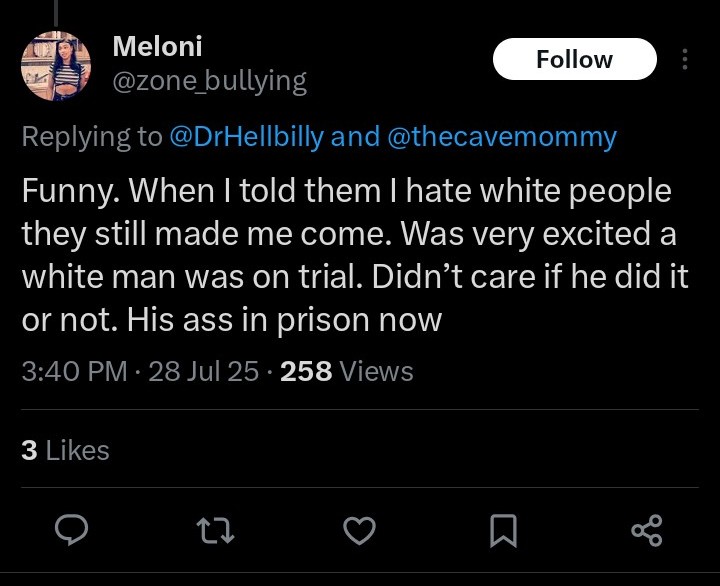
In a study on race and juror decision-making, participants evaluated an identical defendant whose name was either Bradley Schwartz or Jamal Gaines.
Black respondents were significantly more likely to convict and more harshly sentence the white-named defendant, while white respondents showed no statistically significant bias in either direction.
BLM-Antifa terrorist Malik Muhammed is referred to as an "activist" and "protester" in this fake news report by The Intercept's @jessica_m_wash.
He was prosecuted both by Biden's DOJ and by the then-Portland DA Mike Schmidt for multiple counts of attempted murder for trying to bomb people with explosive devices. He came from Indianapolis to Portland, Ore. to commit violence. He was convicted of 14 state felonies and two federal felonies.
https://t.co/Niu8WfGw6P
https://t.co/gSLSGtTAa8
https://t.co/IOzsTtxozc