NO ROOM AT THE INN!
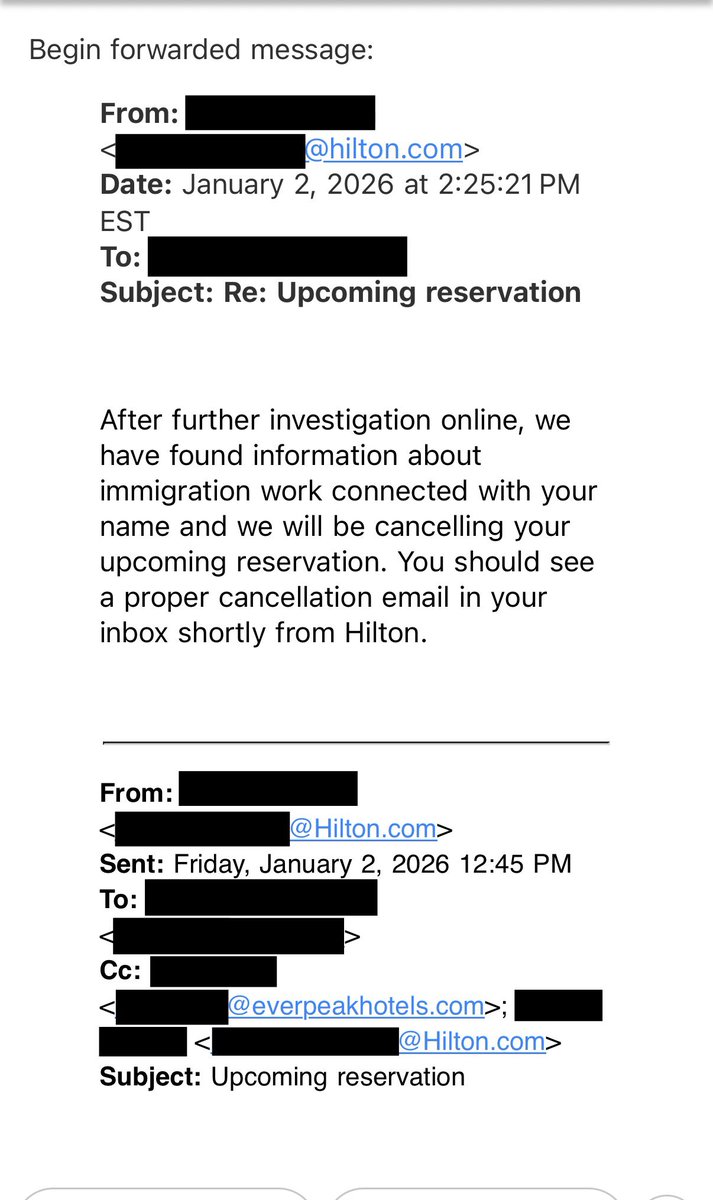
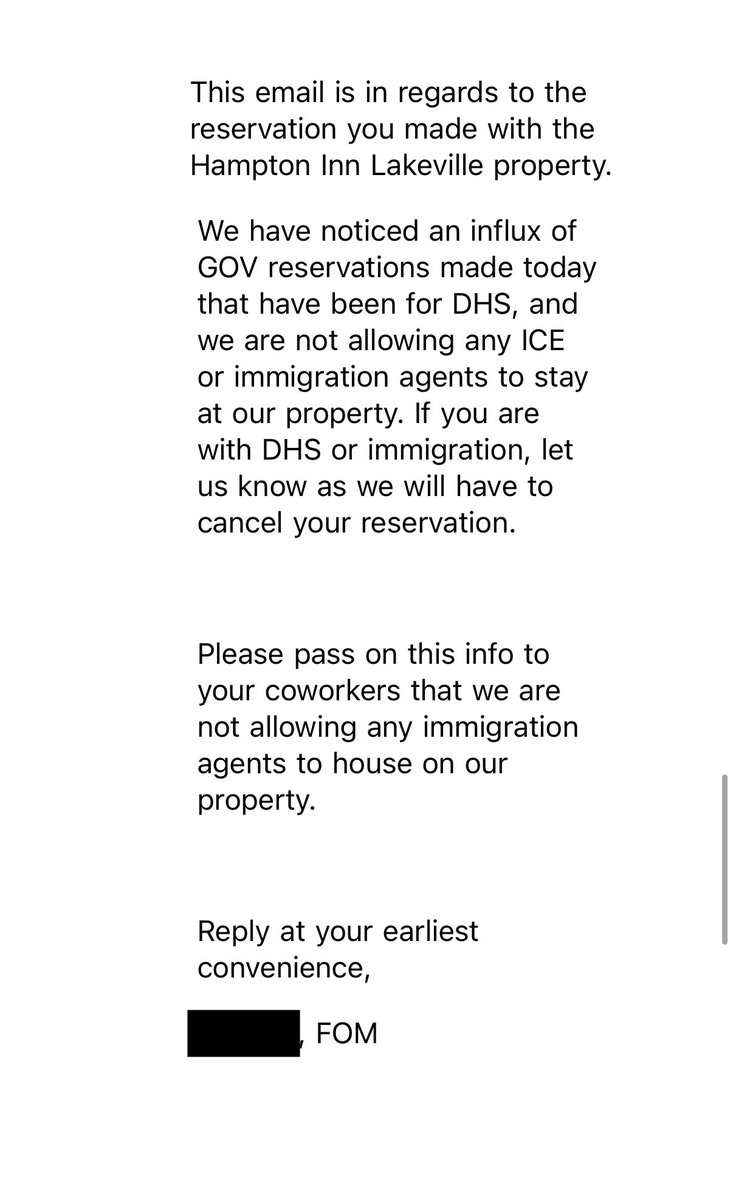
@HiltonHotels has launched a coordinated campaign in Minneapolis to REFUSE service to DHS law enforcement.
When officers attempted to book rooms using official government emails and rates, Hilton Hotels maliciously CANCELLED their reservations.
This is UNACCEPTABLE. Why is Hilton Hotels siding with murderers and rapists to deliberately undermine and impede DHS law enforcement from their mission to enforce our nation’s immigration laws?
This was Baltimore in 1946
The white marble steps of Baltimore were once the city's trademark. Homeowners took pride in scrubbing them daily, ensuring they stayed bright.
Erika Kirk: "He (Charlie) would walk through the door, drop his bags, say 'daddy's home,' take his phone Friday night, say 'Shabbat Shalom,' throw it in the junk drawer, and it was just all us, and that's what I always wanted to make so special for him was coming home."
My hot take is that a lot of (non-iPad) kids are weird these days because these schools are obsessed with independent hyper learning so kids know all their colors but not how to tolerate schedules and working with others i.e. most of being alive
In Montessori, children learn many things earlier than normal. They start phonics around 2.5yo; they do multiplication and division in 'kindergarten'.
But the point is not to win some sort of preschool rat race.
Other concepts are taught *later* than normal. e.g. colors
Most adults think colors are a basic, first-step kind of concept. After all, we can just look out at the world and notice colors without even trying. Indeed, we can't see something *without* noticing its color. Color, to us, is part of the fabric of the universe.
As a result, usually from the moment a child is able to speak, he is constantly quizzed by the adults around him about colors. If you've spent much time around toddlers, you've seen this persistent quizzing. You've probably done it yourself; I certainly have!
You've likely also seen the frequent blank stares and wrong answers from the children in response.
Colors are actually a sophisticated concept. You can hand a child a banana. You can hand her a rubber ball. But you cannot hand her 'yellow'. Yellow is a *quality*. To understand colors, a young child has to abstract away from the object itself and mentally isolate one of its many attributes.
This is not a basic, first-step cognitive move. For a child just starting out, it's advanced! Objects have an immense amount of attributes. When you show a young child a toy firetruck, a ball, and a blanket and say, "these are all red", she does not automatically understand what this means.
Though a child doesn't have the words to describe her confusion, she's puzzling over what these objects have in common. Is it something about their shape, size, function, texture that makes them "red"?
In Montessori, formal lessons to learn the colors typically wait until a child is around 2.5-3yo. To begin, we use materials that are the same in every way except for their color, starting with just the primary colors.
For a while, the child simply plays a matching game independently to pair red-with-red, blue-with-blue etc. Only when she can do this flawlessly—i.e. only when we know she can perceive the colors with ease and really understands what makes the pairs the same—do the Montessori guides start a lesson on the color names.
During the first part of the lesson, the goal is just introducing the name. The guide will point to each color tablet, saying "This is red. This is blue." etc. and the child will repeat the name.
During the second part of the lesson, the goal is for the child to recall the name. The guide plays a game with the child asking her to point to, hand her, move the tablets etc. based on their color. She might say to the child, "Can you move the red one here? Can you point to the yellow one? Can you tap the blue one?"
Only once the child can recognize the names and connect them to the correct tablet will the guide move to the third and last part of the lesson. During this part, the goal is for the child to produce the language herself. The guide will point to the color tablet and ask, "What is this?" and the child will respond, "Red!".
Once the child masters the primary colors, she is progressively introduced to the other basic colors, usually three at a time, until she can recognize and name each.
Eventually, she'll work her way to being able to arrange all the colors into a gradient (a task that can be difficult to do correctly even for adults) and describe them using the language, "dark, light, darker, lighter, darkest, and lightest"
Breaking through to the most abstract level, the child plays a game, often in a group, to walk around the Montessori environment finding objects that match the colors.
None of this means that colors are ignored before these formal lessons start around 3yo. From birth, Montessori parents and educators use rich language to describe everything a child sees and experiences. While preparing a snack together, a Montessori parent might say, for example, "First we peel the banana. The peel is yellow!".
It does mean, however, that children aren't quizzed repeatedly or expected to be able to abstract the meaning of colors as young toddlers.
Despite how often Montessori is criticized for "forcing" children to learn things before they're cognitively ready, this is one example where the conventional approach is doing just that.
The principle behind why Montessori introduces reading and certain math concepts so much earlier than normal, and why Montessori introduces colors later than normal is the same.
In Montessori, we follow the child. We observe from a child's perspective and use materials that isolate ideas and make them concretely accessible, interesting, and engaging. And we introduce those materials at the earliest possible time so that a child can learn with a surmountable, but still interesting, level of challenge.
"The U.S. Coast Guard will no longer classify the swastika, an emblem of fascism and white supremacy inextricably linked to the murder of millions of Jews and that more than 400,000 U.S. troops died fighting against in World War II, as a hate symbol, according to a new policy that takes effect next month. Instead, the Coast Guard will classify the Nazi-era insignia as 'potentially divisive' under its new guidelines." https://t.co/OUTxk0QOp7
This type of Israel propaganda works because it is designed to make you think that Jews or "zionists" run the world. The more people believe that = more jews feel unsafe = more jews believe they need israel for safety. Don't fall for it.
Cheryl Hines tells Bill Maher: "The Republicans have been very kind to me from the beginning. Even... when Bobby was running as a Democrat, they weren’t mean. And they never have been. And I can’t say that for the Democrats."
Erika Kirk: "You have no idea what you just have unleashed across this entire country and this world. You have no idea the fire that you have ignited within this wife. The cries of this widow will echo around the world like a battle cry."
Not to get into neo-lib "gotcha" territory but the visual metaphor here is literally Uncle Sam removing the hat that represents America and replacing it with one that represents our racist secret police. Gonna make for a slam dunk of a DBQ one day.