@jamesmurray_ldn@zubirahmed@SharonHodgsonMP
Please prioritise issues of patient safety for pw VSevere ME.
It is distressing to have another patient treated without understanding of this illness and put at risk.
Yet Delivery Plan for ME/CFS action delayed till April 2027!
really???? The ME Association funded a study to test water, pacing, salt, and calf muscle activation for management of OI.
how can it be possible that this is still where research funding for trials is going????
in 2026.
1/4 of the participants dropped out.
"The authors caution: "the magnitude of change was limited, and statistical significance might not necessarily relate to a clinically significant improvement in symptoms."
Part 2/3: Families of ME/CFS.
“You’re only doing as well as your least well child.”
ME/CFS is a disease that takes over a home. The noise has to stop. The light has to go. The world has to get very, very small for everyone in it. And families do all of it. Because what else do you do?
This is #NotJustFatigue.
#mecfs #pwme #longcovid #millionsmissing
I’ve been contacted by @BBCR4Feedback
They are covering this in next episode on Wed 15Apr
May I suggest if you drop them a voice note via WhatsApp
(+44) 03 333 444 544 to highlight points or email
[email protected]
Or send again - I’m not sure they have seen all sent in 🤔
Perhaps some of us could contact @BBCRadio4 Feedback “forum for comments, queries, criticisms & congratulations”
(Email, WhatsApp msg or voice note).
Next episode 9 April I think.
https://t.co/2V6N3CHIjX
@Prof_J_Lawton@lyricalowl £150 for a consultation with Dicksons' PoTS/MCAS clinic or £50 for LDN consultation. I don't think they would be permitted to prescribe without consultation so I can't see a way around this. Good that Dicksons have stepped in to prioritise continuity for Jura patients.
Ella Copley’s mum is continuing her daughter’s dream. Lovely handmade jewellery in memory of one lost to ME/CFS far too young.
Please share:
(Photos to follow)
https://t.co/7fIf9EXgKP
@NickyProctor Explain PEM & pacing at first sign of ME to avoid worsening. Support with evidence for school, employer, disability support, social care etc. Refer to OT for aids/equipment. Learn about ME & comorbidities. Be open to prescribing off-label. Offer annual check-in.
🚨MCAS: EXCITING NEWS & SURVEY OPPORTUNITY🚨
Dr Larry Afrin & MANY others have been working behind the scenes for years trying to improve the mast cell activation syndrome situation. It has paid off & we now have an International Society for MCAS: https://t.co/N2sBuBbyL3 🧵
@bencooper@LucyHunterB Doctor: "It's not very clear what the problem is."
Me: "It's clear to me that my daughter has ME/CFS."
Doctor: "I am a trained doctor, you know. I have a medical degree."
Letter: "mum... anxious... "
(Five years on: ME/CFS since diagnosed by three specialists.)
@NeurologistMom Yes, daughter (ME/CFS) went into sleep reversal first and then on to a 25hr cycle. It was grim. I had to map it on a chart so as to know when she might be awake for appointments. Fortunately she found that 2.5mg melatonin is enough to induce sleep now & anchor to a 24hr cycle.
The Long Covid Strategy Guide for Talking to Doctors
Your appointment was at 2:30. You’ve been sitting in this waiting room since 2:15, which means you’ve already burned through half your energy reserves for the day.
You’re clutching a carefully written list of symptoms that have plagued you since your Covid infection eight months ago. Brain fog that makes you feel like you’re thinking through molasses. Heart palpitations that wake you up at 3 AM. Fatigue so crushing that taking a shower feels like running a marathon.
You sit there counting ceiling tiles, trying not to cry.
You were early. You always are now. That’s the only way you can make it through the door, early, braced, list in hand, pretending you’re okay when you’re absolutely not.
You’ve rehearsed this visit like a courtroom deposition. Because that’s essentially what it’s become.
The Predictable Disappointment
The doctor finally calls you back. You explain how you can’t remember your coworker’s name anymore, how you lose track of conversations mid-sentence, how your heart races when you stand up. How you used to run half-marathons and now you’re winded walking to the mailbox.
“Covid is over,” they say, barely looking up from their laptop. “Maybe you should try being more active. Have you considered therapy?”
You leave with nothing but a growing certainty that your own doctor thinks you’re either lying, lazy, or losing your mind.
Sound familiar? Here’s what actually just happened and what you’re going to do about it.
Why Smart Doctors Act Catastrophically Stupid
Your doctor didn’t dismiss you because long Covid isn’t real. They dismissed you because humans, even highly educated ones, are wired to reject information that threatens their understanding. And you just threatened theirs in a big way.
When doctors encounter diagnostic uncertainty, their brains undergo what researchers call stress-induced cognitive narrowing. They literally become less capable of processing new information. Your complex, multi-system symptoms trigger this stress response because they don’t fit into the neat diagnostic boxes doctors learned in medical school.
It gets worse. Thanks to the backfire effect, when confronted with evidence that contradicts their existing beliefs about post-viral COVID , many doctors don’t update their knowledge, they dig deeper into denial. Your symptoms become “proof” that patients are catastrophizing, not evidence that long Covid is devastating lives.
There’s also hierarchy protection behavior at play. Doctors exist at the top of medical authority structures. Admitting uncertainty about your condition threatens their position in that hierarchy. It’s psychologically easier to blame you than to acknowledge the gaping holes in their knowledge.
Time pressure amplifies all of these cognitive failures. Most primary care appointments are 15-20 minutes, barely enough time to take your vitals, let alone unpack the complexity of long COVID. This creates cognitive overload. Instead of saying “I don’t know,” many doctors resolve this psychological stress by making the problem disappear entirely.
This isn’t an excuse for poor care. It’s a roadmap for getting better care.
Your Strategic Arsenal - The Mirror and Label Approach
When your doctor starts dismissing you, try what FBI negotiator, Chris Voss calls mirroring, reflecting back what you’re hearing to slow down their defensive response.
“It sounds like you’re saying my symptoms might be related to anxiety rather than my Covid infection. Is that right?”
This forces them to actually articulate their position instead of rushing to judgment. Most doctors will soften their stance when they have to explain their reasoning out loud to your face.
Follow with labeling their perspective: “It seems like you’re concerned about making sure we don’t miss a psychological component to this.”
You’re acknowledging their viewpoint while keeping the conversation open to other possibilities. It’s psychological jujitsu, using their own momentum against them.
The Calibrated Question Strategy
Instead of arguing about whether long Covid exists (you’ll lose), ask questions that gather information while forcing your doctor to actually think.
- “What would explain why these symptoms appeared specifically after my infection?”
- “If this were anxiety, what would you expect to see differently in my presentation?”
- “What tests would help us rule out neurological causes for these cognitive problems?”
These questions force your doctor to engage with your actual clinical picture instead of retreating into dismissive generalizations. They also reveal the gaps in their knowledge without putting them on the defensive.
The Documentation Ultimatum
When gentle approaches fail, introduce accountability through medical records.
“I need you to document in my chart that I’ve reported ongoing symptoms following Covid infection, including [specific symptoms], and that I’m requesting evaluation for post-Covid sequelae.”
Watch how quickly their attitude changes. Most doctors will suddenly become more cooperative when they realize they have to write down that they refused to investigate debilitating symptoms with clear temporal correlation to an infection.
If they continue to resist: “If you’re not comfortable evaluating post-Covid conditions, please document that you’re declining to investigate and provide a referral to someone who specializes in complex post-infectious syndromes.”
Very few doctors will actually document this level of dismissal. The liability implications are too significant, and they know it.
Scripts for Predictable Pushback
Your doctor’s responses are more predictable than a Netflix algorithm. Here’s how to handle the most common dismissive tactics:
“You just need to reduce stress”:
“I understand stress affects cognitive function. However, these memory and concentration problems have a clear onset after my infection and occur even during relaxed periods. What tests would help rule out neurological causes?”
“This sounds like anxiety”:
“I understand anxiety can affect memory and concentration. However, these symptoms have a clear temporal relationship to my infection and occur even when I’m not feeling anxious. What tests would help differentiate between psychological and neurological causes?”
“Long Covid isn’t a real diagnosis”:
“I understand the terminology is still evolving. The CDC refers to this as post-Covid conditions, and the WHO calls it post-Covid syndrome. Regardless of the name, I’m experiencing measurable functional decline since my infection. How do we investigate that?”
When they start edging toward the door:
“Before we finish, I want to make sure I understand your position. Are you saying these symptoms aren’t related to my Covid infection, or that you don’t feel comfortable evaluating post-viral conditions?”
This final question forces them to clarify whether they’re denying your lived experience or acknowledging the limits of their expertise. Most will choose the latter when cornered.
When to Cut Your Losses
Some doctors are beyond strategic persuasion. Recognizing these red flags saves your limited energy for more productive relationships:
- Visible irritation when you mention post-Covid symptoms
- Refusal to document your reported symptoms
- Statements like “long Covid is media hype” or “it’s all in your head”
- Attribution of all symptoms to anxiety without any investigation
- Eye-rolling, interrupted speech, or other dismissive body language
Don’t waste precious energy trying to educate the willfully ignorant. Your job is getting care, not changing minds.
Finding Someone Who Actually Gets It
When seeking new medical care, front-load your screening process. During scheduling, ask: “Has Dr. [Name] treated patients with post-Covid symptoms?” This simple question saves emotional energy and prevents repeated dismissals.
Target specialists who regularly deal with diagnostic uncertainty: infectious disease doctors, rheumatologists, neurologists, or cardiologists. These physicians are more comfortable with complex, multi-system conditions that don’t fit into neat boxes.
Consider bypassing primary care entirely for your initial evaluation. While this seems backwards, specialists often have longer appointment slots and greater familiarity with post-Covid syndromes.
Lastly, if you can afford it, find independent doctors, or concierge practices. They can be significantly more flexible. Some of these independent doctors have deep networks of other providers, some at the top of their fields.
Research patient communities and online forums for doctor recommendations. Other long Covid patients are your best resource for finding physicians who take this condition seriously.
Protecting Your Psychological Sanity
Medical dismissal triggers what neuroscientists call social rejection stress, the same neurological response as physical pain. Your emotional reaction to dismissive doctors isn’t oversensitivity. It’s your brain recognizing a genuine threat to your survival.
Build your evidence base outside the medical system. Keep detailed symptom records, connect with patient communities, and research your condition independently. This creates psychological anchoring that prevents dismissive interactions from completely destabilizing your self-knowledge.
Prepare your support network before difficult appointments. Let trusted people know when you’re seeing doctors and schedule debriefing time afterward. Having someone to process the interaction with helps prevent internalization of dismissive messages.
Consider bringing an advocate to important appointments. Another person in the room changes the entire dynamic. Doctors are less likely to dismiss patients when there’s a witness to their behavior.
The Uncomfortable Truth
You shouldn’t have to become an expert in negotiation psychology just to get basic medical care. The fact that you do reveals everything about our broken healthcare system and nothing about the validity of your symptoms.
The medical establishment’s gaslighting strategy won’t work much longer. Reality has a way of forcing itself into the conversation, whether institutions are ready or not. Long Covid patients are becoming impossible to ignore, impossible to dismiss, and increasingly impossible to gaslight.
Every time you strategically advocate for yourself, document your symptoms professionally, and escalate dismissive responses through proper channels, you’re making it slightly easier for the next long Covid patient who walks into that office.
But here’s what matters most right now: Your symptoms are real. Your suffering is valid. And you’re going to keep fighting until someone provides the care you deserve.
Your job isn’t to fix the broken system. Your job is to get the help you need while navigating around its failures.
The doctors who dismiss you today will be embarrassed by their ignorance tomorrow. Don’t let their temporary blindness become your permanent defeat.
@wakethesheepnow @notestomyboy My ND child (not P/P) does this too. When she says stop it's because she's feeling stressed and dysregulated and needs space. I'm learning that it's not personal but can feel that way. She thanks me afterwards for respecting it. Maybe similar with P/P?
Quite disheartening to return from 10 days working with some of the most important and relevant #MECFS and #LongCOVID researchers in the world and to read this drivel being allowed through from @bmj_latest. Let's be unambiguous about this: BMJ has 1/
https://t.co/1TUtC2wFSE
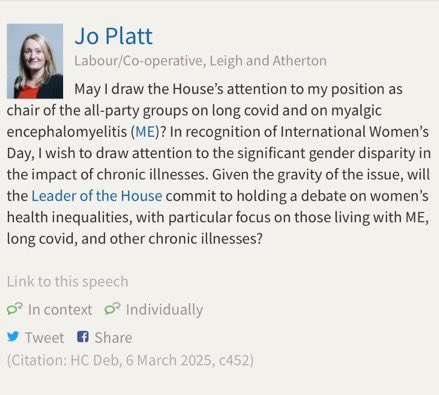
Great question from @JoPlatt, Chair of APPG ME, on which I serve, highlighting how #ME disproportionately affects women. As we celebrate #InternationalWomensDay we’re looking to Dept Health SocialCare for an ambitious and well funded Delivery Plan for ME. #ThereForME@actionforme
If you feel like you have 'stalled out'....and are now just surviving (stable) but are failing to increase your baseline - its time to look at "whole body pathogen load".
For most of us its pathogens that got us in this mess (and reducing pathogen load) is going to be essential to getting us out of it.
They key to remember is that the triggering pathogen is rarely what needs to be controlled down the line ....what starts as an acute viral issue....quickly becomes bacterial, fungal, and about viral reactivations.
search my feed: "whole body pathogen load"
https://t.co/W5UtJjIXcm
https://t.co/mPndiBvS4C
Lets talk about "mitochondrial extrusion" - its a super key concept in how chronic illness is maintained and plays into why drugs often fail to permanently move the needle in MECFS.
Mitochondrial extrusion is the process by which cells release damaged/dysfunctional mitochondria into the surrounding environment. The mitochondria that are released act as part of 'signaling cascades' - they are essentially MESSAGES and they are ALARM SIGNALS.
Cells do this (extrusion) to maintain mitochondrial quality control when internal degradation systems (like mitophagy) are overwhelmed or impaired. In ME we think that mitophagy is itself dysfunctional so extrusion is the default 'clean-up' pathway.
So instead of a healthy processes being triggered followed mitochondrial damage (mitophagy) instead a danger signal is generated -- called DAMPS (damage associated molecular processes) - these DAMPS then trigger inflammatory processes in the surrounding tissue.
In conditions like post-exertional malaise (PEM), intense physical exertion might damage mitochondria in susceptible individuals.
If mitochondrial extrusion occurs, the release of mitochondrial DAMPs could help drive systemic inflammation and neuroinflammation, potentially contributing to the delayed and prolonged symptom flare seen in PEM.
Cellular leakiness is obviously going to be a factor here but how do cells become leaky in the first place? We hear a lot about leaky gut and leaky BBB but permeability affects cells as well as tissues.
So what drives leakiness? Well - all the stuff that drives chronic illness. Cells can become leaky when their membranes lose integrity—this happens when various stressors compromise the structure and function of the plasma membrane and associated cytoskeletal elements.
Cell leakiness or cell membrane dysfunction can be caused by:
• Oxidative Stress:
High levels of reactive oxygen species (ROS) can lead to lipid peroxidation, where the fatty acid components of the membrane are damaged. This damage disrupts the ordered structure of the lipid bilayer, making the membrane more permeable (lipids and fatty acids are abnormal in MECFS. ROS/oxidative stress is an issue in MECFS).
• Inflammatory Signals:
Cytokines and other inflammatory mediators released during a stress response can alter the expression or function of tight junction proteins and other components that help maintain membrane integrity. (inflammatory cytokines are a thing in MECFS).
• Metabolic or Mitochondrial Dysfunction:
When mitochondria are damaged, they may generate excess ROS or fail to produce sufficient ATP. Energy depletion can impair the cell’s ability to maintain ion gradients and repair membrane damage, contributing to increased permeability (occurs in MECFS).
• Toxins or Viral Infections:
Certain toxins or pathogens (including some viruses) can directly damage cell membranes or induce processes (such as the formation of pores) that compromise membrane integrity.
OK. So leakiness is probably a big thing in MECFS.
What to do about it?
We need to work on 'CELL MEMBRANE' function - this means using things like "lipid replacement therapy" and plasmalogens.
We need to work on leaky tissues (like gut) and heal those gap junctions with things like BPC-157 and zinc-carnosine and other treatments for leaky gut.
We need to heal the BBB barrier. It actually IS possible to heal TBI and a leaky BBB. What helps heal cells and gut lining will also likely help with BBB dysfunction.
When thinking about treatment - we often think about symptoms. Symptom control and management is important but the best bang for your buck and energy is to focus on basic foundational optimization. If cells are 'leaky' it is going to be difficult for advanced interventions to really shift the needle permanently.
One of the patterns we often see in trials is interventions that look promising initially. While this would not apply across the board, this actually makes a lot of sense to me. If there is pre-existing leakiness at the cell, gut, BBB levels the pathogenic processes are going to re-kick in (even if they were halted for a while).
Foundational healing (electrolytes, nutrients, microbiome, minerals, cell membranes and leaky gut) may not cure you - but without healing and stopping the leaky processes, long-term healing is going to be rare.


![Dave_it_up's tweet photo. The Long Covid Strategy Guide for Talking to Doctors
Your appointment was at 2:30. You’ve been sitting in this waiting room since 2:15, which means you’ve already burned through half your energy reserves for the day.
You’re clutching a carefully written list of symptoms that have plagued you since your Covid infection eight months ago. Brain fog that makes you feel like you’re thinking through molasses. Heart palpitations that wake you up at 3 AM. Fatigue so crushing that taking a shower feels like running a marathon.
You sit there counting ceiling tiles, trying not to cry.
You were early. You always are now. That’s the only way you can make it through the door, early, braced, list in hand, pretending you’re okay when you’re absolutely not.
You’ve rehearsed this visit like a courtroom deposition. Because that’s essentially what it’s become.
The Predictable Disappointment
The doctor finally calls you back. You explain how you can’t remember your coworker’s name anymore, how you lose track of conversations mid-sentence, how your heart races when you stand up. How you used to run half-marathons and now you’re winded walking to the mailbox.
“Covid is over,” they say, barely looking up from their laptop. “Maybe you should try being more active. Have you considered therapy?”
You leave with nothing but a growing certainty that your own doctor thinks you’re either lying, lazy, or losing your mind.
Sound familiar? Here’s what actually just happened and what you’re going to do about it.
Why Smart Doctors Act Catastrophically Stupid
Your doctor didn’t dismiss you because long Covid isn’t real. They dismissed you because humans, even highly educated ones, are wired to reject information that threatens their understanding. And you just threatened theirs in a big way.
When doctors encounter diagnostic uncertainty, their brains undergo what researchers call stress-induced cognitive narrowing. They literally become less capable of processing new information. Your complex, multi-system symptoms trigger this stress response because they don’t fit into the neat diagnostic boxes doctors learned in medical school.
It gets worse. Thanks to the backfire effect, when confronted with evidence that contradicts their existing beliefs about post-viral COVID , many doctors don’t update their knowledge, they dig deeper into denial. Your symptoms become “proof” that patients are catastrophizing, not evidence that long Covid is devastating lives.
There’s also hierarchy protection behavior at play. Doctors exist at the top of medical authority structures. Admitting uncertainty about your condition threatens their position in that hierarchy. It’s psychologically easier to blame you than to acknowledge the gaping holes in their knowledge.
Time pressure amplifies all of these cognitive failures. Most primary care appointments are 15-20 minutes, barely enough time to take your vitals, let alone unpack the complexity of long COVID. This creates cognitive overload. Instead of saying “I don’t know,” many doctors resolve this psychological stress by making the problem disappear entirely.
This isn’t an excuse for poor care. It’s a roadmap for getting better care.
Your Strategic Arsenal - The Mirror and Label Approach
When your doctor starts dismissing you, try what FBI negotiator, Chris Voss calls mirroring, reflecting back what you’re hearing to slow down their defensive response.
“It sounds like you’re saying my symptoms might be related to anxiety rather than my Covid infection. Is that right?”
This forces them to actually articulate their position instead of rushing to judgment. Most doctors will soften their stance when they have to explain their reasoning out loud to your face.
Follow with labeling their perspective: “It seems like you’re concerned about making sure we don’t miss a psychological component to this.”
You’re acknowledging their viewpoint while keeping the conversation open to other possibilities. It’s psychological jujitsu, using their own momentum against them.
The Calibrated Question Strategy
Instead of arguing about whether long Covid exists (you’ll lose), ask questions that gather information while forcing your doctor to actually think.
- “What would explain why these symptoms appeared specifically after my infection?”
- “If this were anxiety, what would you expect to see differently in my presentation?”
- “What tests would help us rule out neurological causes for these cognitive problems?”
These questions force your doctor to engage with your actual clinical picture instead of retreating into dismissive generalizations. They also reveal the gaps in their knowledge without putting them on the defensive.
The Documentation Ultimatum
When gentle approaches fail, introduce accountability through medical records.
“I need you to document in my chart that I’ve reported ongoing symptoms following Covid infection, including [specific symptoms], and that I’m requesting evaluation for post-Covid sequelae.”
Watch how quickly their attitude changes. Most doctors will suddenly become more cooperative when they realize they have to write down that they refused to investigate debilitating symptoms with clear temporal correlation to an infection.
If they continue to resist: “If you’re not comfortable evaluating post-Covid conditions, please document that you’re declining to investigate and provide a referral to someone who specializes in complex post-infectious syndromes.”
Very few doctors will actually document this level of dismissal. The liability implications are too significant, and they know it.
Scripts for Predictable Pushback
Your doctor’s responses are more predictable than a Netflix algorithm. Here’s how to handle the most common dismissive tactics:
“You just need to reduce stress”:
“I understand stress affects cognitive function. However, these memory and concentration problems have a clear onset after my infection and occur even during relaxed periods. What tests would help rule out neurological causes?”
“This sounds like anxiety”:
“I understand anxiety can affect memory and concentration. However, these symptoms have a clear temporal relationship to my infection and occur even when I’m not feeling anxious. What tests would help differentiate between psychological and neurological causes?”
“Long Covid isn’t a real diagnosis”:
“I understand the terminology is still evolving. The CDC refers to this as post-Covid conditions, and the WHO calls it post-Covid syndrome. Regardless of the name, I’m experiencing measurable functional decline since my infection. How do we investigate that?”
When they start edging toward the door:
“Before we finish, I want to make sure I understand your position. Are you saying these symptoms aren’t related to my Covid infection, or that you don’t feel comfortable evaluating post-viral conditions?”
This final question forces them to clarify whether they’re denying your lived experience or acknowledging the limits of their expertise. Most will choose the latter when cornered.
When to Cut Your Losses
Some doctors are beyond strategic persuasion. Recognizing these red flags saves your limited energy for more productive relationships:
- Visible irritation when you mention post-Covid symptoms
- Refusal to document your reported symptoms
- Statements like “long Covid is media hype” or “it’s all in your head”
- Attribution of all symptoms to anxiety without any investigation
- Eye-rolling, interrupted speech, or other dismissive body language
Don’t waste precious energy trying to educate the willfully ignorant. Your job is getting care, not changing minds.
Finding Someone Who Actually Gets It
When seeking new medical care, front-load your screening process. During scheduling, ask: “Has Dr. [Name] treated patients with post-Covid symptoms?” This simple question saves emotional energy and prevents repeated dismissals.
Target specialists who regularly deal with diagnostic uncertainty: infectious disease doctors, rheumatologists, neurologists, or cardiologists. These physicians are more comfortable with complex, multi-system conditions that don’t fit into neat boxes.
Consider bypassing primary care entirely for your initial evaluation. While this seems backwards, specialists often have longer appointment slots and greater familiarity with post-Covid syndromes.
Lastly, if you can afford it, find independent doctors, or concierge practices. They can be significantly more flexible. Some of these independent doctors have deep networks of other providers, some at the top of their fields.
Research patient communities and online forums for doctor recommendations. Other long Covid patients are your best resource for finding physicians who take this condition seriously.
Protecting Your Psychological Sanity
Medical dismissal triggers what neuroscientists call social rejection stress, the same neurological response as physical pain. Your emotional reaction to dismissive doctors isn’t oversensitivity. It’s your brain recognizing a genuine threat to your survival.
Build your evidence base outside the medical system. Keep detailed symptom records, connect with patient communities, and research your condition independently. This creates psychological anchoring that prevents dismissive interactions from completely destabilizing your self-knowledge.
Prepare your support network before difficult appointments. Let trusted people know when you’re seeing doctors and schedule debriefing time afterward. Having someone to process the interaction with helps prevent internalization of dismissive messages.
Consider bringing an advocate to important appointments. Another person in the room changes the entire dynamic. Doctors are less likely to dismiss patients when there’s a witness to their behavior.
The Uncomfortable Truth
You shouldn’t have to become an expert in negotiation psychology just to get basic medical care. The fact that you do reveals everything about our broken healthcare system and nothing about the validity of your symptoms.
The medical establishment’s gaslighting strategy won’t work much longer. Reality has a way of forcing itself into the conversation, whether institutions are ready or not. Long Covid patients are becoming impossible to ignore, impossible to dismiss, and increasingly impossible to gaslight.
Every time you strategically advocate for yourself, document your symptoms professionally, and escalate dismissive responses through proper channels, you’re making it slightly easier for the next long Covid patient who walks into that office.
But here’s what matters most right now: Your symptoms are real. Your suffering is valid. And you’re going to keep fighting until someone provides the care you deserve.
Your job isn’t to fix the broken system. Your job is to get the help you need while navigating around its failures.
The doctors who dismiss you today will be embarrassed by their ignorance tomorrow. Don’t let their temporary blindness become your permanent defeat.](https://pbs.twimg.com/media/GzqOf7HXAAAkR4E.jpg)