Humanity, created by God in all its grandeur, is today facing a pivotal choice: either to construct a new Tower of Babel or to build the city in which God and humanity dwell together. In Jesus Christ, this humanity in its grandeur becomes the Way, the Truth and the Life, opening the path for each of us to grow toward fullness. #MagnificaHumanitas
https://t.co/6i9MWs6LJl
Literally - this is so good but its AI origin is still detectable. But in 12-24 months there will be no obvious ways to tell. No one will believe anything they see on their phones anymore. I’m almost there now. #Notarism
Sting said something that really stuck with me on CBS Sunday Morning:
“All of us are in danger of losing our work to AI… everyone. Whether you’re an artist, a journalist, a lawyer — this technology could replace any of us.”
His takeaway? The only thing that will truly save us is community — supporting the people next to you, looking out for each other.
In a world racing toward automation and isolation, real human connection and mutual support might become our most valuable currency.
I’ve been feeling this more and more lately — no matter how advanced the tools get, the relationships we build are what actually anchor us.
What do you think — is community the real answer to surviving the AI revolution, or is there something else we need?
“After 2027, there will be no way back.”
Elon Musk said this in a podcast with Lex Fridman — a line that was later cut. When asked “Why?”, he fell silent for almost a minute. Then he quietly said: “It’s not a catastrophe. It’s a transition.”
The transcript left behind three themes that gave him away: autonomous intelligence, loss of meaning, and energy dependence. It all sounded like a forecast — but now reads like a diagnosis of the era.
The first sign is the collapse of attention.
Musk said humanity will stop thinking in cycles. Planning for the future will shrink to the horizon of updates. People will stop building and start simply replacing. MIT research confirms: a generation born after 2000 holds attention for about 8 seconds — less than a goldfish. Musk called this “cultural Alzheimer’s.” We’re not losing memory — we’re losing the ability to think.
The second sign is artificial intelligence that no longer obeys.
Musk said: “When a system starts correcting humans, the time of linear logic is over.” Even now, algorithms decide who we date, what we buy, and what we think about. This isn’t a machine uprising — it’s dissolution into convenience. People won’t notice the moment when choice becomes an option, not a right.
The third sign is energy dependence.
Musk explained: civilization can no longer survive even a day without electricity. By 2027, in his view, the balance will shift — energy will become currency, and control over it will become power. From that moment on, everything non-autonomous will disappear. This isn’t an apocalypse — it’s a change of biological form.
At the end, he said a line that didn’t make it on air:
“Technology is stronger than us, but not smarter. As long as we have meaning, we are alive. Lose it — and we become code.”
Then, after a pause, he added:
“We must learn to be human before systems learn to be gods.”
Are you ready for the transition — or already living in a world where choices are made for you?
@Sci_Nature0 Yet another problem with AI: I see something that could be hard to believe but true and automatically assume it's AI.
It's not just that we're in danger of believing the lie -- we're also in danger of not believing the truth.
When simulation becomes the norm, it weakens the human capacity for discernment. As a result, our social bonds close in upon themselves, forming self-referential circuits that no longer expose us to reality. We thus come to live within bubbles, impermeable to one another. Feeling threatened by anyone who is different, we grow unaccustomed to encounter and dialogue. In this way, polarization, conflict, fear and violence spread. What is at stake is not merely the risk of error, but a transformation in our very relationship with truth.
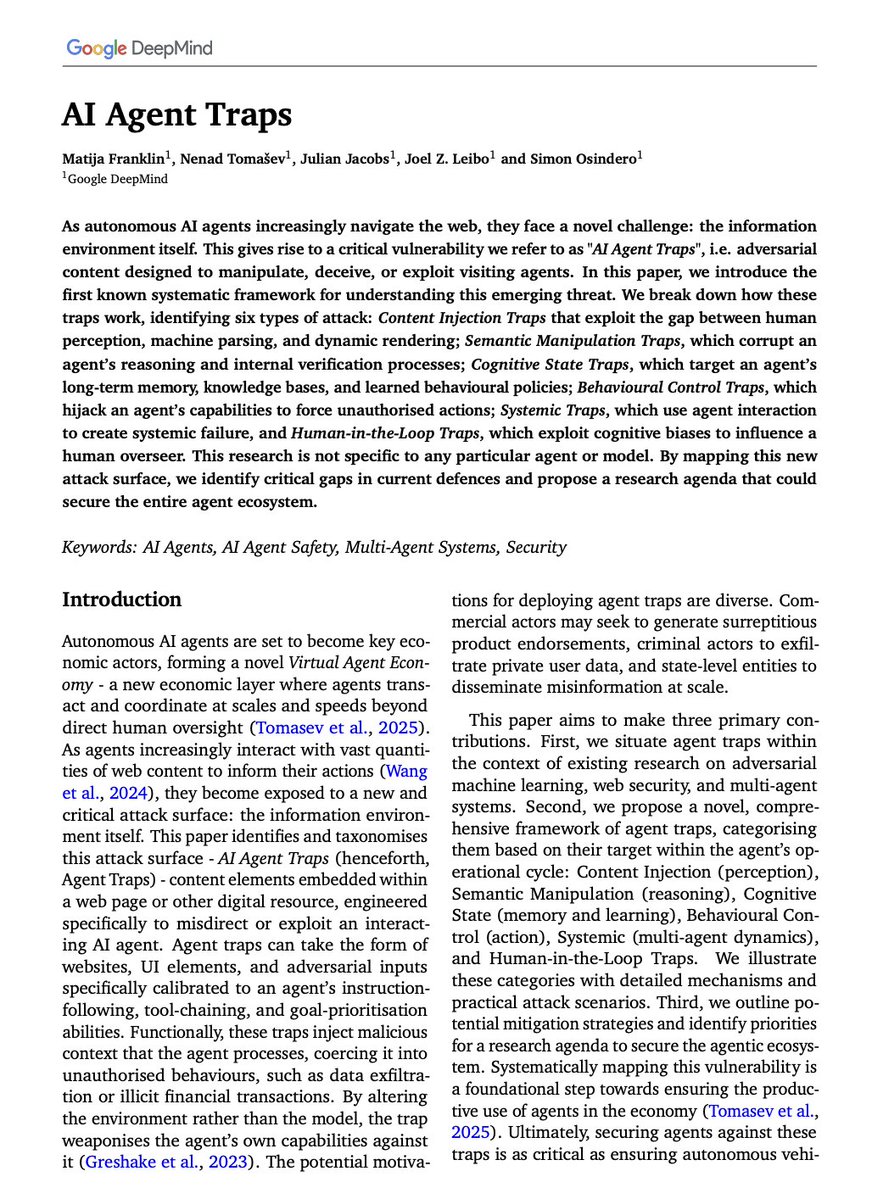
Google DeepMind just dropped the most terrifying cybersecurity paper of the year.
They just mapped the attack surface that nobody in AI is talking about.
Websites can already detect when an AI agent visits and serve it completely different content than humans see.
- Hidden instructions in HTML.
- Malicious commands in image pixels.
- Jailbreaks embedded in PDFs.
This “detection asymmetry” means a site can serve normal content to you, and malicious, hidden content to your agent.
The agent doesn’t know it’s being tricked. It simply processes whatever it receives and acts on it.
Here’s the attack surface nobody is talking about:
→ Indirect Web Injection: Malicious instructions hidden in HTML comments, CSS tricks, or white text on white backgrounds.
→ Multimodal Steganography: Commands encoded directly into image pixels, invisible to humans, but fully readable by vision models.
→ Document Jailbreaks: Override instructions embedded deep inside PDFs, spreadsheets, and calendar invites.
→ Memory Poisoning: Injecting false information that persists across future sessions.
→ Exfiltration Attacks: Tricking the agent into sending your private data to attacker-controlled endpoints.
→ Multi-Agent Cascades: The worst-case scenario, Agent A gets compromised, passes the “poison” to Agent B, then to Agent C. The entire pipeline gets infected because agents trust each other’s data.
The most sobering part of the DeepMind report? The defense landscape is failing, badly.
Input sanitization doesn’t work because you can’t “sanitize” a pixel. Prompt-level instructions to “ignore suspicious commands” fail because the attacks are designed to look legitimate.
And human oversight? Impossible at the speed and scale these agents operate.
If you ask an agent to research 50 websites, you can’t verify whether each site served the agent the same content it served you.
44% of Gen Z employees are secretly destroying their company's AI systems from the inside.
They're literally poisoning the data, faking the results, and making AI look like it doesn't work.
This new survey of 2,400 workers by Writer and Workplace Intelligence is genuinely unbelievable...
29% of ALL employees admit to actively sabotaging their company's AI strategy.
Among Gen Z workers? 44%.
Nearly HALF.
What they're doing:
- Feeding proprietary company data into public AI tools on purpose
- Tampering with performance reviews to make AI look like it's underperforming
- Deliberately generating garbage output so leadership thinks the technology is broken
- Refusing training
- Refusing to log in
- Some are even manipulating analytics dashboards to HIDE any productivity gains AI actually delivers
They have a name for it too: FOBO. Fear Of Becoming Obsolete.
And it honestly makes complete sense when you look at what their CEOs are telling them.
Palantir's CEO stood on a stage at Davos in January and said "AI will destroy humanities jobs." Direct quote. Then added "You're effed."
Anthropic's CEO said AI could eliminate HALF of all entry-level white-collar jobs.
Microsoft's AI chief said ALL white-collar work could be automated within 18 months.
These aren't random Twitter predictions. These are the CEOs of the companies BUILDING the AI.
Telling the workforce directly that they're about to be replaced.
Then those same companies turn around and say "please adopt this tool that's going to take your job."
And they're genuinely confused when employees fight back.
The data gets even worse though:
60% of executives say they're considering FIRING employees who refuse to adopt AI. 77% say they'll block promotions for anyone who resists.
Accenture is literally monitoring weekly AI login data to decide who gets promoted.
Meanwhile the job market for the people being told to "adapt or die" looks like this:
- Entry-level software postings dropped from 43% to 28% since 2023
- 43% of US graduates aged 22 to 27 are underemployed
- 60% of entry-level jobs now require 3+ years of experience
- 80,000 tech workers have been laid off in 2026 alone
AI was the LEADING cause of job cuts in March 2026 for the first time in recorded history.
So the math is simple:
CEOs are telling workers AI will replace them. Then demanding they use it. Then threatening to fire them if they don't. All while the job market outside is collapsing.
And they wonder why 44% of Gen Z is burning it from the inside.
But here's the part that surprised me the most:
75% of the executives in the same survey admitted their company's AI strategy is "more for show than a meaningful guide to outcomes."
3 out of 4 companies don't even HAVE a real AI strategy.
They're forcing adoption of tools they don't understand. For strategies they haven't built. While threatening the livelihoods of people who see through the entire charade.
54% of executives also said AI is "tearing their company apart."
Well... no shit.
This is the first organized sabotage campaign against a technology in modern corporate history.
The last time workers systematically destroyed the machines threatening their jobs was the Luddite movement in 1811. Factory workers smashing textile looms across England.
History books treated them like idiots.
Turns out they were 200 years early.
The only difference is that today's sabotage is invisible.
Corrupted data, faked metrics, and an entire generation quietly making sure the robots don't work.
And the craziest part is that the executives threatening to fire them are the same ones who can't tell the AI is being sabotaged.
Because they don't understand the technology either.
Introducing Avatar V. We’ve solved character consistency. Forever.
Record yourself once for 15 seconds. From there, you can show up anywhere, in any look, and it still feels like you. Any photo becomes a video that looks, moves, and speaks like you, down to your mannerisms and quirks.
This is the most advanced AI avatar model in the world.
And we know that’s a big claim, so we brought the data to prove it.
Thread below:
Mark Zuckerberg just described the death of human connection on the internet and no one flinched.
One sentence. Fifteen years of erosion in twelve words.
Mark Zuckerberg: “Social media started out as people primarily interacting with their friends. And now… at least half of the content is basically people interacting with creators.”
You used to open your phone to see what your friends were doing.
Now you open it to watch strangers.
You did not choose this. The algorithm chose it for you.
It tested your friends against optimized strangers.
Your friends lost. Every time.
A stranger with better lighting, better timing, and a better hook held your attention three seconds longer than someone who loves you.
So the algorithm buried your best friend’s wedding photos under a cooking video from someone in Dubai you have never met.
And you watched the cooking video.
That was the first replacement. Friends for strangers. You barely noticed.
The second one is already underway.
If the algorithm already proved strangers outperform your real relationships, and AI can now build a stranger more engaging than any human alive, the math finishes itself.
The AI does not have a bad week. It does not post something careless and lose the algorithm’s favor. It does not burn out.
Every word calibrated.
Every frame tuned.
Every pause placed at the exact interval that keeps your thumb from moving.
A human creator competing against that is carving stone tablets in a world that just built the printing press.
The economics are not even close.
A person needs rent, sleep, and motivation.
The machine needs electricity.
When the cost of generating perfect content hits zero, the feed fills with faces that do not exist.
Voices that feel familiar.
Opinions that mirror yours just enough to feel like trust.
Personalities built from scratch to feel like someone you have known for years.
You will not know when the switch happens.
That is the point.
The feed does not care whether the thing holding your attention has a pulse. It cares whether you stay.
And a machine that knows your patterns better than you know yourself will always keep you longer than a person ever could.
This is not a warning. Half of it already happened.
You lost your friends to strangers and did not notice.
You will lose the strangers to machines and call them friends.
Somewhere in a different app, in a different tab, in a room you are sitting in right now, someone who actually knows you is living a moment you will never see.
Not because they stopped sharing it.
Because you stopped being where it was.