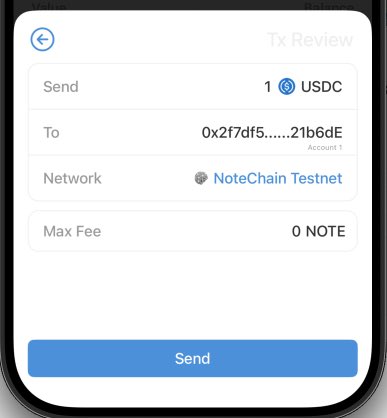
We've completed NoteChain testnet development. Mainnet launch coming soon—alongside our first commercial partner.
Built for the AI economy. Zero gas. 10,000+ TPS. Powered entirely by AI-assisted engineering.
Our 2025 vision 👇
https://t.co/kP3o4FPVEM
We’re not building tools for humans.
We’re building systems for autonomous agents to collaborate, trust, and transact.
That future needs blockchain. #NOTEProtocol
So no, blockchain isn’t obsolete.
In fact, it’s about to become critical infrastructure.
Not for humans to trade coins.
But for machines to build the next economy.
AI gives us power.
Blockchain keeps that power honest.
Without blockchain, AI becomes a black box society.
You won’t know who made what decision,
who owns what,
or where your money went.
With blockchain,
AI becomes accountable.
This is the core message from a talk at Summer of Ethereum Tokyo.
Everyone’s talking about how powerful AI has become.
It writes, codes, paints, trades, sells.
So here’s the question I keep getting:
Do we still need blockchain?
My answer:
The more powerful AI gets,
the more we need blockchain.
Let me explain.
In the future, agents won’t just talk to each other.
They’ll contract with each other.
They’ll make promises. Exchange value.
Own resources.
But they’ll only be trustworthy
if we can verify what they do and what they owe.
Blockchain is what makes that possible.
This isn’t about launching another token.
This is about building infrastructure for machine coordination.
Giving agents a way to transact trustlessly.
Like HTTP, but for economic activity.
You want autonomous AI?
Then you need autonomous payments.
That’s why last year I proposed a new direction for the NOTE protocol.
A protocol layer for agents to pay each other.
Directly. Automatically. On-chain.
Stablecoins, UTXOs, programmable payments—whatever the task requires.
Executed by agents. Verified by the chain.
No humans in the loop.
And here comes the problem no one wants to talk about:
Who pays whom?
You can’t swipe your credit card for every microtask.
You can’t manually verify every transaction.
You can’t trust any one server to keep track.
It reaches out to a travel planner agent.
That agent calls a flight booking agent.
Then hotel booking. Then a local tour guide agent.
None of them are human.
This is not science fiction.
This is where agent-to-agent coordination is headed.
Now AI is evolving.
We’re moving from AI as a tool,
to AI as an agent.
Not just answering questions,
but taking action, coordinating tasks, making decisions.
You say, “I want to plan a trip to Xinjiang.”
Your agent gets to work.
It’s funny when you think about it.
Blockchain is one of the most precise, deterministic technologies ever invented.
But it ended up fueling the most emotional industry: crypto.
Meanwhile, AI is based on probabilistic guesswork—
and it’s solving real-world problems every day.
But I also write blockchain code.
And there, every semicolon, every variable name,
might affect real assets.
Tens of thousands of dollars, across thousands of users.
There’s no “feels right” in blockchain.
Only “exactly right”.
I use tools like Cursor to write code.
Half the time, it finishes the function before I finish the sentence.
I just click “Accept”, and boom—code is in.
This is what people now call vibe coding.
You don’t fully understand what’s going on.
You just go with it. It feels right.
95% of developers take one look at Bitcoin Script and say:
“This is the worst language I’ve ever seen.”
No loops.
No variables.
No functions.
Not even an if without pain.
But here’s the twist:
That’s exactly what makes it perfect.