🚨 Nigeria tells dollar stablecoin issuers to set up locally or lose access to retail users
- Nigeria's central bank now requires dollar stablecoins offered to ordinary customers to be issued by a licensed company based in Nigeria, per CryptoSlate
- Each token also needs its own approval from the central bank, and a foreign licence or a Nigerian partner doesn't count
- The rules apply to anyone serving people in Nigeria, even companies with no office there
- Issuers must open a staffed office in Nigeria with a local chief compliance officer
- The rules took effect on 5 November, and existing operators have 180 days to apply
- They can keep operating while they apply only with the central bank's express permission, and anyone who misses the deadline must stop
- Foreign stablecoins can still be approved for large cross-border business payments, but not for ordinary users
- Approved stablecoins can't be used to pay debts owed in naira unless the law specifically allows it
A 150% collateral ratio on a protocol dashboard gives traders a false sense of security. The industry treats "fully collateralized" as proof against insolvency, but that number is often an illusion during real market stress.
The flaw lies in confusing static oracle price feeds with executable market liquidity.
When liquidation cascades hit, two structural failures occur simultaneously:
01. Oracle delay: Feeds report historical prices from previous blocks, not real-time fill rates.
02. Depth collapse: Liquidators must unload seized assets into rapidly thinning order books. If execution slippage exceeds the protocol's liquidation penalty buffer, bad debt generates automatically.
Insolvency rarely happens because smart contract logic breaks. It happens because systems treat paper valuations as guaranteed exit liquidity.
Before locking funds into any lending vault, ask this single diagnostic question:
"If liquidations start happening right now, who is actually buying the collateral and at what price?"
Which protocol in your portfolio do you think would survive an 80% liquidity drop? Drop your pick below.
Evaluating execution mechanics over dashboard figures is how you stay sharp. @RallyOnChain
stablecoin TVL has declined YoY. incremental growth will come when GENIUS takes effect, and traditional payments and finance is built on blockchain rails.
this will lead to more serious buyers of RWAs and catalyze the next wave of growth.
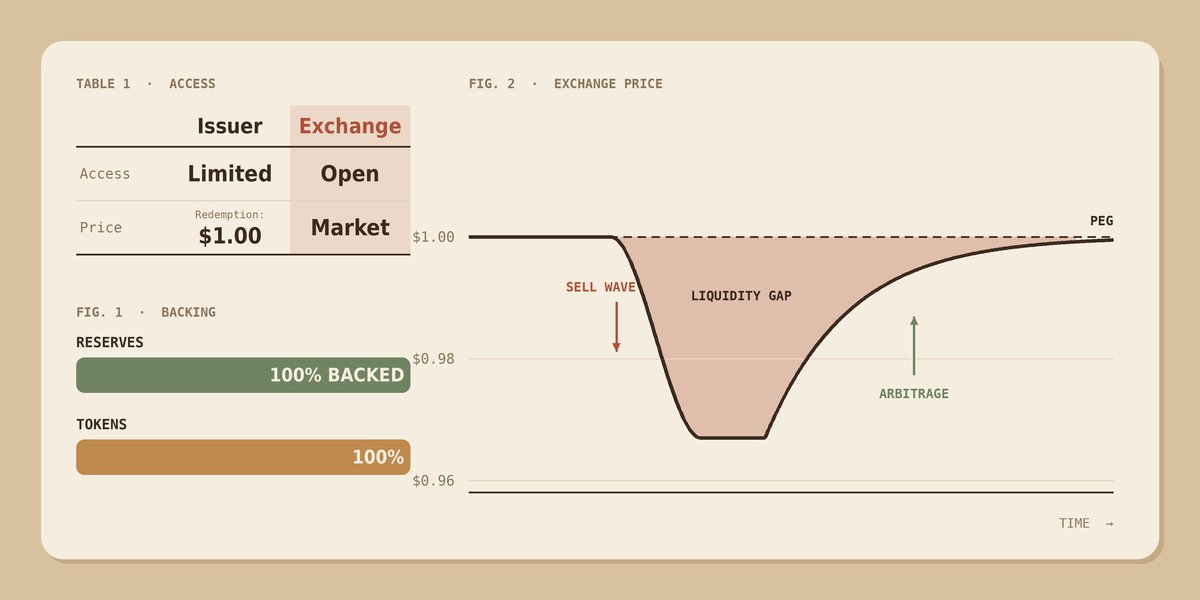
a stablecoin can have enough reserves to back every token and still lose its $1 peg
having the money in reserve doesn't mean every holder can redeem directly with the issuer.. most people buy and sell through exchanges, where the price depends on actual market demand.
if a lot of holders start selling at once and buyers aren't there to absorb the pressure, the price can slip below $1
arbitrage usually helps bring it back, but that process takes time.
so a temporary depeg doesn't always mean the reserves are missing
sometimes, it's simply a liquidity problem.
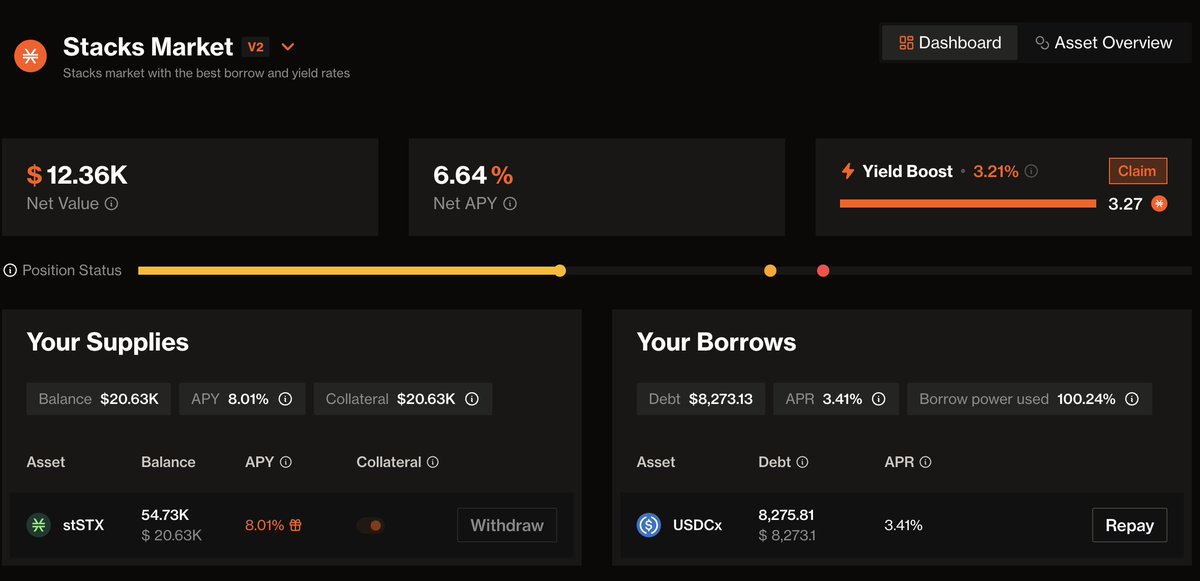
Over the weekend I was playing around with DeFi strategies and it turns out I’m actually getting paid to borrow USDCx...
Currently the yield on my collateral plus DeFi incentives is higher than the cost of borrowing
I’m running 2 looping vaults (net APY):
stSTX loop: 6.44% at 40% LTV
stBTC loop: 0.46% at 52% LTV
How each loop works:
→ Swap STX / sBTC into stSTX / stBTC on @StackingDao
→ Supply on @ZestProtocol
→ Borrow USDCx against it
→ Swap the USDCx into more stSTX / stBTC
→ Re-supply
→ Stop there, or repeat for more exposure (I repeated 3/4 times on each)
I’m long-term bullish on both assets, so I’m comfortable with the leveraged exposure
My liquidation levels:
→ stSTX: partial if STX drops ~33%, full at ~38%
→ stBTC: partial if BTC drops ~26%, full at ~31%
Other risks to know: depeg risk on stSTX/stBTC and USDCx, smart contract risk, and borrow rates can change - DYOR
There’s currently a DeFi incentives campaign on @Stacks boosting these numbers
Without it, the stBTC loop would cost me money to borrow (normal). The stSTX loop still pays me to borrow regardless
Bitcoin Capital Markets are in full flow and $STX is at the heart of it all