Muslim | Novice in religious self-study | Upon the creed of the Prophet ﷺ and his Companions ؓ (Athari) | Comparative religion | Can read Arabic, not understand
I am not someone eligible to receive zakah, so please do not use zakah funds for this purpose. Any support given here is simply voluntary and intended as a small source of additional income. Please also do not expect regular or frequent posts, as I have other duties and may have periods of absence. Jazakum Allahu khayran.
https://t.co/Oc45yAxMS5
Sneako definitely has his faults, but for those who think this is a got'cha, Allah says in the Qur'an, specifically in Surah Az-Zumar, verse 53:
۞ قُلْ يَـٰعِبَادِىَ ٱلَّذِينَ أَسْرَفُوا۟ عَلَىٰٓ أَنفُسِهِمْ لَا تَقْنَطُوا۟ مِن رَّحْمَةِ ٱللَّهِ ۚ إِنَّ ٱللَّهَ يَغْفِرُ ٱلذُّنُوبَ جَمِيعًا ۚ إِنَّهُۥ هُوَ ٱلْغَفُورُ ٱلرَّحِيمُ
"Say, ˹O Prophet, that Allah says,˺ “O My servants who have exceeded the limits against their souls! Do not lose hope in Allah’s mercy, for Allah certainly forgives all sins. He is indeed the All-Forgiving, Most Merciful."
The only unforgivable sin in Islam is if someone dies while disbelieving in Allah or associating others with Him in worship.
Anas ibn Malik رضي الله عنه reported that the Messenger of Allah ﷺ said: “Allah Almighty said: O son of Adam, if you call upon Me and place your hope in Me, I will forgive you despite what is within you and I will not hesitate. O son of Adam, if you have sins piling up to the clouds and then ask for My forgiveness, I will forgive you without hesitation. O son of Adam, if you come to Me with enough sins to fill the earth and then you meet Me without associating anything with Me, I will come to you with enough forgiveness to fill the earth.” Source: Sunan al-Tirmidhi 3540, Grade: Hasan (fair) according to Al-Albani.
Abdullah ibn Mas'ud رضي الله عنه reported that the Messenger of Allah ﷺ said: “The one who truly repented of sin is like one without sin.” Source: Sunan Ibn Majah 4250, Grade: Hasan (fair) according to Al-Albani.
Also a fascinating parallel of this hadith in the Bible, specifically in the book of Ezekiel, chapter 18, verses 21-23:
"But if a wicked person turns away from all the sins they have committed and keeps all my decrees and does what is just and right, that person will surely live; they will not die. None of the offenses they have committed will be remembered against them. Because of the righteous things they have done, they will live. Do I take any pleasure in the death of the wicked? declares the Sovereign Lord. Rather, am I not pleased when they turn from their ways and live?"
The relationship between Sunnis, Shias, and other Muslim sects at the school, high school, and university level is generally cordial. Many are friends, classmates, and even marry one another. Because of this, there is an important opportunity for dawah. Many ordinary Shias, Barelvis, and others may not have studied the details of their own beliefs, so Muslims upon the creed of the Salaf should speak to them cordially, respectfully, and with wisdom. We need unity, but unity must be upon the truth, not upon beliefs that contradict Tawhid. 12ver Shias, for e.g., hold the doctrine of Imamah, giving the 12 Imams a special divinely appointed authority that is not found in the Qur'an or authentic Sunnah. Some 12ver beliefs also involve insulting or condemning Companions رضي الله عنهم أجمعين and attacking some of the Mothers of the Believers رضي الله عنهم أجمعين, despite Allah honoring them in the Qur'an. Other beliefs, such as Wilayah Takwiniyyah, attribute universal authority and power over creation to the Imams. This violates Tawhid al-Rububiyyah and is a kufri belief, because creation, control of the universe, and disposal of its affairs belong to Allah alone. Likewise, other beliefs involving peddling of amulets, black magic, superstition, grave veneration, calling upon saints or the dead (like the Shias call upon Ali رضي الله عنه & Fatima رضي الله عنها and like the Sufis call upon saints), or attributing divine qualities to created beings must be rejected as violations of Tawhid. Some formulations of Nur Muhammadi which make Muhammad ﷺ the primordial light from which creation originated or say that the universe was created for his sake must likewise be rejected as false and shirki beliefs. These are precisely the matters that must be learned and corrected through the Qur'an, authentic Sunnah, and creed of the Salaf.
Begin with foundational works such as Kitab al-Tawhid, the explanation of Shaykh Ibn Uthaymeen, the Three Fundamental Principles and the Six Fundamental Principles. Learn the foundations of Tawhid and the creed of the Salaf before attempting to debate anyone. Then study the refutations of the scholars; Shaykh al-Islam Ibn Taymiyyah wrote against the Jahmiyyah, Mu'tazilah, and other theological sects, and wrote Minhaj al Sunnah al-Nabawiyyah, his extensive refutation of Shia arguments concerning Imamah, the Companions, and the caliphate. Also read Shah Waliullah al-Dehlawi, particularly Izalat al Khafa 'an Khilafat al Khulafa and his refutation of Shia doctrines, Tuhfah Ithna Ashariyyah.
Then speak to your Shia, Barelvi, and other sectarian friends with good manners. Ask questions, listen to what they actually believe, present evidence from the Qur'an and authentic Sunnah, and encourage them to investigate their beliefs themselves. Do not insult them or their families, and do not turn every conversation into a fight. If you do not know an answer, say so and study it. The objective is not to humiliate anyone but to call people to Tawhid and the way of the Messenger ﷺ. The various sects should be called back to the teachings of Muhammad ﷺ and the understanding of the Salaf al-Ummah. We should seek unity and brotherhood, but true unity is only upon the Qur'an, Sunnah, and the creed as it was understood by the Salaf.
Allah says in the Qur'an, in Surah An-Nur, verse 55:
وَعَدَ ٱللَّهُ ٱلَّذِينَ ءَامَنُوا۟ مِنكُمْ وَعَمِلُوا۟ ٱلصَّـٰلِحَـٰتِ لَيَسْتَخْلِفَنَّهُمْ فِى ٱلْأَرْضِ كَمَا ٱسْتَخْلَفَ ٱلَّذِينَ مِن قَبْلِهِمْ وَلَيُمَكِّنَنَّ لَهُمْ دِينَهُمُ ٱلَّذِى ٱرْتَضَىٰ لَهُمْ وَلَيُبَدِّلَنَّهُم مِّنۢ بَعْدِ خَوْفِهِمْ أَمْنًا ۚ يَعْبُدُونَنِى لَا يُشْرِكُونَ بِى شَيْـًٔا ۚ وَمَن كَفَرَ بَعْدَ ذَٰلِكَ فَأُو۟لَـٰٓئِكَ هُمُ ٱلْفَـٰسِقُونَ
Allah has promised those who have believed among you and done righteous deeds that He will surely grant them succession [to authority] upon the earth just as He granted it to those before them and that He will surely establish for them [therein] their religion which He has preferred for them and that He will surely substitute for them, after their fear, security, [for] they worship Me, not associating anything with Me. But whoever disbelieves after that - then those are the defiantly disobedient.
Surah An Nur 24:55 can be historically related to the early conquests of Islam under the Rashidun caliphate and to the later expansion of other Sunni Muslim powers. Allah promised the believers who worship Him alone and do righteous deeds that He would grant them succession, establish their religion and replace their fear with security. Abu Bakr رضي الله عنه began the expansion beyond Arabia, while Umar رضي الله عنه oversaw the conquest of Syria, Palestine, Egypt, Iraq and Persia, taking vast territories from the Byzantine and Persian empires. Uthman رضي الله عنه continued the expansion into North Africa, Armenia, Persia, Khurasan, Cyprus and beyond. Ali رضي الله عنه, whom we love and honor as one of the greatest of the Companions and the fourth rightly guided caliph, spent his caliphate navigating the First Fitnah and dealing with the internal turmoil that had afflicted the Muslims, so there was little major external expansion during his rule. After him, Muawiyah c established the Umayyad state, and the Muslims continued taking territory from non Muslim powers, eventually reaching North Africa, Central Asia and Spain. This continued under later Sunni powers such as the Abbasids, Seljuks, Ayyubids, Mamluks and others. Thus, the early history of the Sunni Muslim caliphates contains a remarkable pattern of Muslims gaining authority and vast territories from powerful non Muslim empires.
The history of the major Shia states presents a very different pattern. The Buyids seized Baghdad and placed the Sunni Abbasid caliph under their control, while the Fatimids established a rival Shia caliphate and conquered Egypt, the Hijaz and parts of Syria. The most striking example, however, is the Safavid takeover of Persia. Before the Safavids, the Iranian plateau was predominantly Sunni, with the Hanafi and Shafii madhhabs dominating much of the region. Therefore, many of the ancestors of the Shia population of modern Iran were originally Sunni Muslims. The Safavids then imposed Twelver Shi'ism as the state religion and used coercion to transform the religious character of Persia. Under Shah Ismail, Sunnis were forced to publicly curse the first three caliphs, Sunni scholars were persecuted, Sunni mosques and graves were desecrated, and massacres of Sunnis occurred in several cities. In Tabriz, which was about two thirds Sunni when Shah Ismail conquered it, people were threatened with death if they resisted the new Shia rituals. In places such as Shiraz and Yazd, outright massacres were reported. The conversion of Persia to Shiism was therefore not simply the result of ordinary peaceful preaching; it was a long process in which state coercion, persecution and forced religious conformity played a significant role.
The contrast is therefore significant when viewed alongside Surah An Nur 24:55. The Rashidun and later Sunni Muslim powers repeatedly expanded into lands ruled by major non Muslim powers, while some of the major Shia states gained much of their territory through struggles against other Muslim powers and, in the Safavid case, transformed a predominantly Sunni Muslim country into a Shia state through prolonged coercion. The verse itself, however, connects Allah's promise to specific conditions: faith, righteous deeds, worshipping Allah alone and not associating partners with Him.
Allah says in the Qur'an, in Surah An-Nur, verse 55:
وَعَدَ ٱللَّهُ ٱلَّذِينَ ءَامَنُوا۟ مِنكُمْ وَعَمِلُوا۟ ٱلصَّـٰلِحَـٰتِ لَيَسْتَخْلِفَنَّهُمْ فِى ٱلْأَرْضِ كَمَا ٱسْتَخْلَفَ ٱلَّذِينَ مِن قَبْلِهِمْ وَلَيُمَكِّنَنَّ لَهُمْ دِينَهُمُ ٱلَّذِى ٱرْتَضَىٰ لَهُمْ وَلَيُبَدِّلَنَّهُم مِّنۢ بَعْدِ خَوْفِهِمْ أَمْنًا ۚ يَعْبُدُونَنِى لَا يُشْرِكُونَ بِى شَيْـًٔا ۚ وَمَن كَفَرَ بَعْدَ ذَٰلِكَ فَأُو۟لَـٰٓئِكَ هُمُ ٱلْفَـٰسِقُونَ
Allah has promised those who have believed among you and done righteous deeds that He will surely grant them succession [to authority] upon the earth just as He granted it to those before them and that He will surely establish for them [therein] their religion which He has preferred for them and that He will surely substitute for them, after their fear, security, [for] they worship Me, not associating anything with Me. But whoever disbelieves after that - then those are the defiantly disobedient.
Surah An Nur 24:55 can be historically related to the early conquests of Islam under the Rashidun caliphate and to the later expansion of other Sunni Muslim powers. Allah promised the believers who worship Him alone and do righteous deeds that He would grant them succession, establish their religion and replace their fear with security. Abu Bakr رضي الله عنه began the expansion beyond Arabia, while Umar رضي الله عنه oversaw the conquest of Syria, Palestine, Egypt, Iraq and Persia, taking vast territories from the Byzantine and Persian empires. Uthman رضي الله عنه continued the expansion into North Africa, Armenia, Persia, Khurasan, Cyprus and beyond. Ali رضي الله عنه, whom we love and honor as one of the greatest of the Companions and the fourth rightly guided caliph, spent his caliphate navigating the First Fitnah and dealing with the internal turmoil that had afflicted the Muslims, so there was little major external expansion during his rule. After him, Muawiyah c established the Umayyad state, and the Muslims continued taking territory from non Muslim powers, eventually reaching North Africa, Central Asia and Spain. This continued under later Sunni powers such as the Abbasids, Seljuks, Ayyubids, Mamluks and others. Thus, the early history of the Sunni Muslim caliphates contains a remarkable pattern of Muslims gaining authority and vast territories from powerful non Muslim empires.
The history of the major Shia states presents a very different pattern. The Buyids seized Baghdad and placed the Sunni Abbasid caliph under their control, while the Fatimids established a rival Shia caliphate and conquered Egypt, the Hijaz and parts of Syria. The most striking example, however, is the Safavid takeover of Persia. Before the Safavids, the Iranian plateau was predominantly Sunni, with the Hanafi and Shafii madhhabs dominating much of the region. Therefore, many of the ancestors of the Shia population of modern Iran were originally Sunni Muslims. The Safavids then imposed Twelver Shi'ism as the state religion and used coercion to transform the religious character of Persia. Under Shah Ismail, Sunnis were forced to publicly curse the first three caliphs, Sunni scholars were persecuted, Sunni mosques and graves were desecrated, and massacres of Sunnis occurred in several cities. In Tabriz, which was about two thirds Sunni when Shah Ismail conquered it, people were threatened with death if they resisted the new Shia rituals. In places such as Shiraz and Yazd, outright massacres were reported. The conversion of Persia to Shiism was therefore not simply the result of ordinary peaceful preaching; it was a long process in which state coercion, persecution and forced religious conformity played a significant role.
The contrast is therefore significant when viewed alongside Surah An Nur 24:55. The Rashidun and later Sunni Muslim powers repeatedly expanded into lands ruled by major non Muslim powers, while some of the major Shia states gained much of their territory through struggles against other Muslim powers and, in the Safavid case, transformed a predominantly Sunni Muslim country into a Shia state through prolonged coercion. The verse itself, however, connects Allah's promise to specific conditions: faith, righteous deeds, worshipping Allah alone and not associating partners with Him.
@pakistanii32 Haha, became a historian without reading history?
The Fatimid Caliphate conquered all of North Africa, Egypt, Syria, and Hejaz, they literally founded Cairo. The Safavids built Iran into an empire and fought the Ottomans head-on. That's not an inch, that's thousands of miles.
@Shaofbil Are you one of the so-called Qur'an only kafirs? Have you ever read the Seerah of Rasool Allah (SAW)? Loving Ali (RA) is part of the Sunnah.
We are not even equal to a small piece of dirt on the shoes of Ali (RA).
Wallahi! The people who insult Ali (RA) are hypocrites. May Allah guide them or deal with them as He pleases.
The principle of Ahlus Sunnah wal-Jamaah is that we're not allowed to insult any Prophet (AS) or Muslim member of the Prophet's household (RA) even if other people insult the Prophet (SAW) or the companions (RA) of the Prophet (SAW).
https://t.co/XPlQLa9uOr
A Miracle from the Miracles of the Prophet ﷺ
Anas bin Mālik (رضي الله عنه) said:
“I saw the Messenger of Allāh (ﷺ) when the time for ʿAṣr prayer came. The people searched for water for wuḍūʾ but could not find any, then some water for wuḍūʾ was brought to the Messenger of Allāh ﷺ, he placed his hand in that vessel and commanded the people to perform wuḍūʾ from it. I saw the water springing forth from beneath his fingers, until they all performed wuḍūʾ, the last of them just as the first.”
[al-Muwaṭṭaʾ, 1/35]
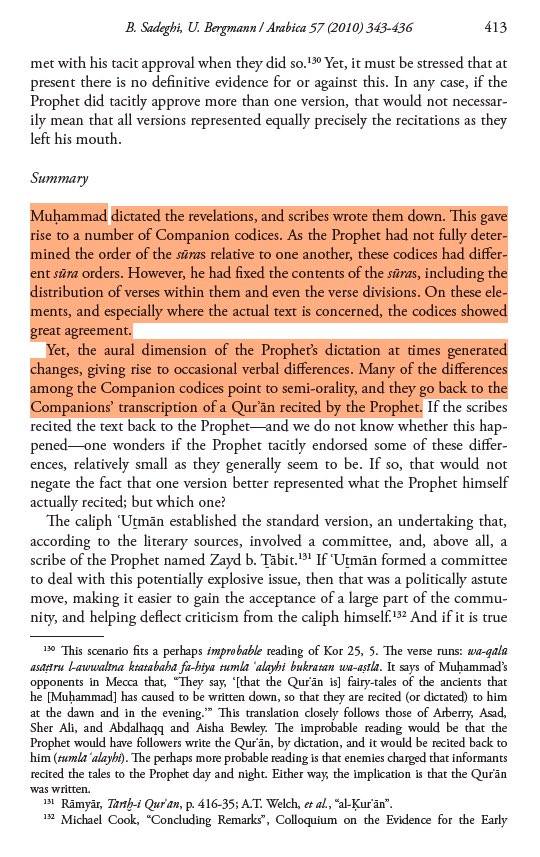
The Qurans variant modes of recitation prove its preservation.
According to Sadeghi & Bergmann Muhammad ﷺ dictated revelation, scribes wrote it down, and the Companion codices ultimately go back to Quranic recensions that were recited by the Prophet himself.
These variants are largely corroborated by manuscript attestation and later qiraat literature that documents them which is exactly what we expect to find on the traditional account which posits that the prophet proclaimed the Quran in 7 ahruf.
People who make it 'controversial' to call kufr kufr are the munafiqoon.
May Allah give everyone the knowledge to understand the meaning and importance of Tawhid.
They said I do Tawaf around the American military bases and are themselves pandering to non-Muslims.
"I apologize to the non-Islamic audience."
Allah vindicates the believers and humiliates the munafiqoon! Take heed!
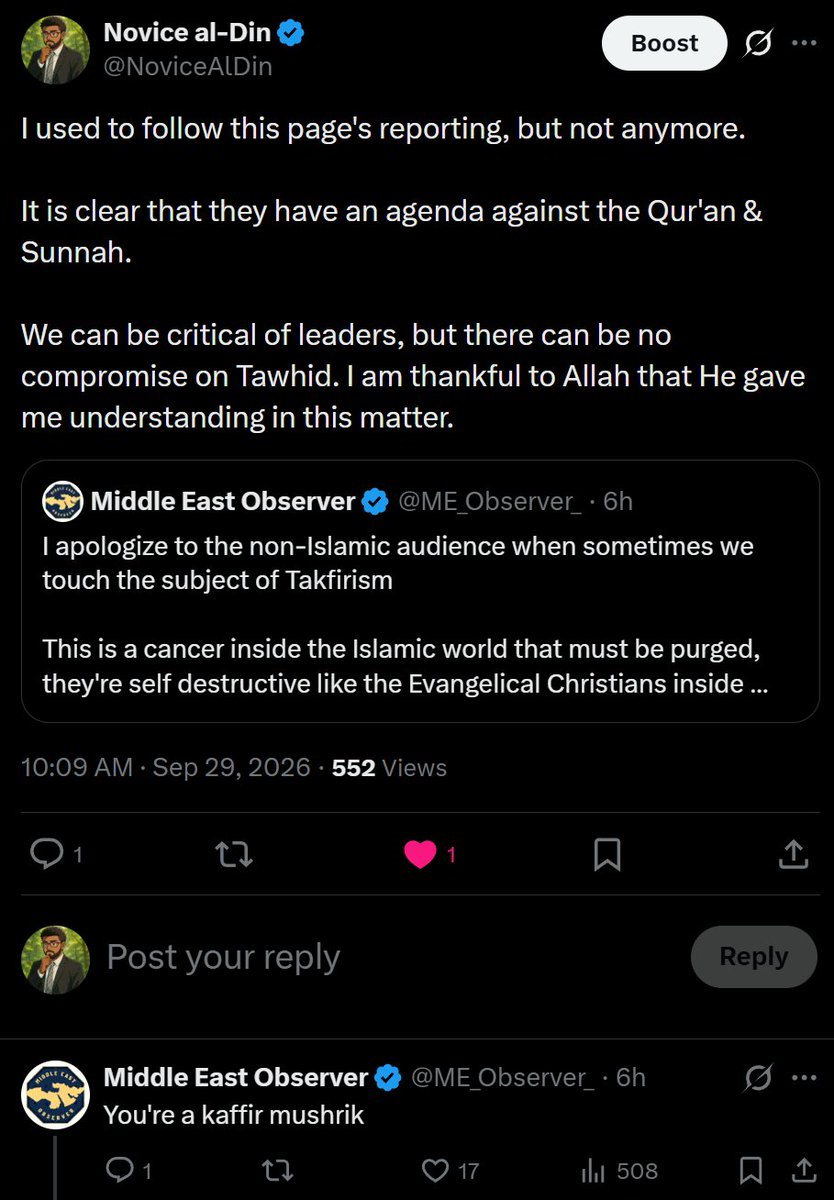
I used to follow this page's reporting, but not anymore.
It is clear that they have an agenda against the Qur'an & Sunnah.
We can be critical of leaders, but there can be no compromise on Tawhid. I am thankful to Allah that He gave me understanding in this matter.
I apologize to the non-Islamic audience when sometimes we touch the subject of Takfirism
This is a cancer inside the Islamic world that must be purged, they're self destructive like the Evangelical Christians inside your societies who drain your countries for Israel
(1) I only point out the kufr within actions. I do not Takfir specific individuals. There are some conditions that need to be fulfilled for that. You are ignorant in this regard, so you should shut up.
(2) There are some matters that are known within the religion by necessity. Even a lay Muslim can call kufr kufr.
(3) I only follow the mainstream opinions of our pious scholars and the pious predecessors who are given knowledge by Allah. These are the people we need to hold onto!
The people should also notice who's doing the Takfir on a specific individual? NOT ME! 🤦♂️
Ibn Umar reported: The Messenger of Allah, peace and blessings be upon him, said, “When a man calls his brother an unbeliever, it turns against at least one of them. Either the accused is as he claimed, or else the charge will turn against him.”
Source: Sahih al-Bukhari 6104, Sahih Muslim 60.
So, fear Allah! And His punishment!
They said I do Tawaf around the American military bases and are themselves pandering to non-Muslims.
"I apologize to the non-Islamic audience."
Allah vindicates the believers and humiliates the munafiqoon! Take heed!
I apologize to the non-Islamic audience when sometimes we touch the subject of Takfirism
This is a cancer inside the Islamic world that must be purged, they're self destructive like the Evangelical Christians inside your societies who drain your countries for Israel
(1) I only point out the kufr within actions. I do not Takfir specific individuals. There are some conditions that need to be fulfilled for that. You are ignorant in this regard, so you should shut up.
(2) There are some matters that are known within the religion by necessity. Even a lay Muslim can call kufr kufr.
(3) I only follow the mainstream opinions of our pious scholars and the pious predecessors who are given knowledge by Allah. These are the people we need to hold onto!
The people should also notice who's doing the Takfir on a specific individual? NOT ME! 🤦♂️
Ibn Umar reported: The Messenger of Allah, peace and blessings be upon him, said, “When a man calls his brother an unbeliever, it turns against at least one of them. Either the accused is as he claimed, or else the charge will turn against him.”
Source: Sahih al-Bukhari 6104, Sahih Muslim 60.
So, fear Allah! And His punishment!
You can seethe all you want, but don't undermine Tawhid. We worship Allah alone! We do not worship or call upon anyone other than Allah! We do not condemn the noble companions (RA) of the Prophet (SAW)! We don't tolerate innovation in religion! Islam as practiced by Muhammad (SAW) was and is perfect!







![shahmir69420's tweet photo. A Miracle from the Miracles of the Prophet ﷺ
Anas bin Mālik (رضي الله عنه) said:
“I saw the Messenger of Allāh (ﷺ) when the time for ʿAṣr prayer came. The people searched for water for wuḍūʾ but could not find any, then some water for wuḍūʾ was brought to the Messenger of Allāh ﷺ, he placed his hand in that vessel and commanded the people to perform wuḍūʾ from it. I saw the water springing forth from beneath his fingers, until they all performed wuḍūʾ, the last of them just as the first.”
[al-Muwaṭṭaʾ, 1/35]](https://pbs.twimg.com/media/HTX6HtiWIAEW45D.jpg)




![shahmir69420's tweet photo. A Miracle from the Miracles of the Prophet ﷺ
Anas bin Mālik (رضي الله عنه) said:
“I saw the Messenger of Allāh (ﷺ) when the time for ʿAṣr prayer came. The people searched for water for wuḍūʾ but could not find any, then some water for wuḍūʾ was brought to the Messenger of Allāh ﷺ, he placed his hand in that vessel and commanded the people to perform wuḍūʾ from it. I saw the water springing forth from beneath his fingers, until they all performed wuḍūʾ, the last of them just as the first.”
[al-Muwaṭṭaʾ, 1/35]](https://pbs.twimg.com/media/HTX6HtkWcAAy7c7.jpg)


