Meet Auto-Discovery, now live in Novix.
It turns every research question you've explored into a research constellation, then reads it to surface the next direction worth pursuing.
It proposes. You decide: go ahead, or not now.
Your research should compound. Now it moves forward on its own.
Ran one of my cases through Novix Paper Preparation.
Gave it notes, code, figures, and experimental results. It returned a 9-page ACL draft with methods, equations, experiments, limitations, and references.
Still reviewing it, but this is a solid starting point.
Finishing the research doesn’t mean the paper is ready.
There’s still a lot to organize: findings, figures, references, structure, and conference formatting.
That’s what Paper Preparation in Novix is built for.
It includes two workflows:
Draft a Paper turns your existing research materials into a structured manuscript.
Adapt to a New Conference helps prepare an existing manuscript for a different venue’s requirements.
Research done. Paper started.
Introducing Paper Preparation in Novix.
Turn your research materials into a conference-ready draft, or adapt an existing manuscript to a new conference format.
✍️ Draft a paper
📄 Adapt to a new conference
Just in time for the CVPR 2027 deadline.
Try it at https://t.co/dVemyqV3D8
Being busy doesn't always mean making progress.
Reading 20 papers without a clear question.
Running experiments without knowing what you're testing.
Collecting data without a plan to analyze it.
More work doesn't always lead to better research.
Sometimes, the most productive thing you can do is stop and rethink your approach.
Published over a decade ago, but the advice on paper structure, reproducibility, authorship, and peer review is still highly relevant today.
Worth a read for early-career researchers.
When generation gets cheap, judgment and verification become the real bottlenecks.
That’s why we built Novix — to help researchers connect the literature, frame better questions, and keep the human in control of what’s worth testing.
When hypotheses, papers and even peer reviews become cheap to generate, verification becomes the scarce resource in science.
New perspective with StGallen imt Business School: the evidence, the players, AI loops, knowledge graphs and forecasts to 2030. https://t.co/gCMwyq2hYP
@qwerty__cs Strong end-to-end loop. Still think the real leverage is in how humans frame the problem and connect the literature first. How do you see the division of labor?
A research gap isn't just something nobody has studied.
It might be:
• A result nobody can explain
• Two papers that contradict each other
• An assumption nobody has tested
• A method that fails in a new setting
The best research questions often start where existing answers stop.
Reading 50 papers doesn't automatically mean you understand a research field.
The real challenge isn't finding more papers. It's connecting what you've already read.
What do researchers agree on?
Where do their findings contradict?
Which assumptions remain untested?
And what's actually worth exploring next?
That's where a good literature review begins.
Novix helps you move from a pile of papers to a clearer research direction.
Research question: how do crystal symmetry, elastic stability, and directional mechanical response compare across real elastic tensors?
Novix ran the computational reanalysis and produced the following:
▪️ recovered and checksum-verified the historical Materials Project elasticity dataset
▪️ audited 1,181 tensors across six crystal systems
▪️ recomputed Voigt-Reuss-Hill moduli, universal anisotropy, directional Young’s modulus, shear envelopes, and Poisson-ratio envelopes
▪️ quantified structure-property associations with formula-aware and crystal-system sensitivity checks
▪️ compared two carbon records with sharply different local geometry and directional stiffness
▪️ generated a 33-page paper with 14 figures, tables, equations, references, and an executable analysis package
Got a half-finished paper you’ve been avoiding? Try this in Novix:
→ In Auto Pilot, ask Novix to read your draft like a reviewer.
Let it point out weak arguments, unclear claims, and the places a reviewer would likely get confused. Basically, the problems you stop seeing after staring at your own draft for too long.
→ Then step back and review the paper yourself.
Use Novix’s feedback as a starting point. Reread the paper as a reviewer, not as its author. That shift in perspective can make many of the problems easier to untangle.
→ Use Annotation for targeted edits.
Screenshot the exact part you want to change and tell Novix what you want: delete it, rewrite it, go deeper, or add another angle. Get the core into shape first, then keep polishing.
Most of the resistance only shows up at the beginning. Once you sit down and take the first step, the work gets less scary, and you start finding that natural state of actually doing it.
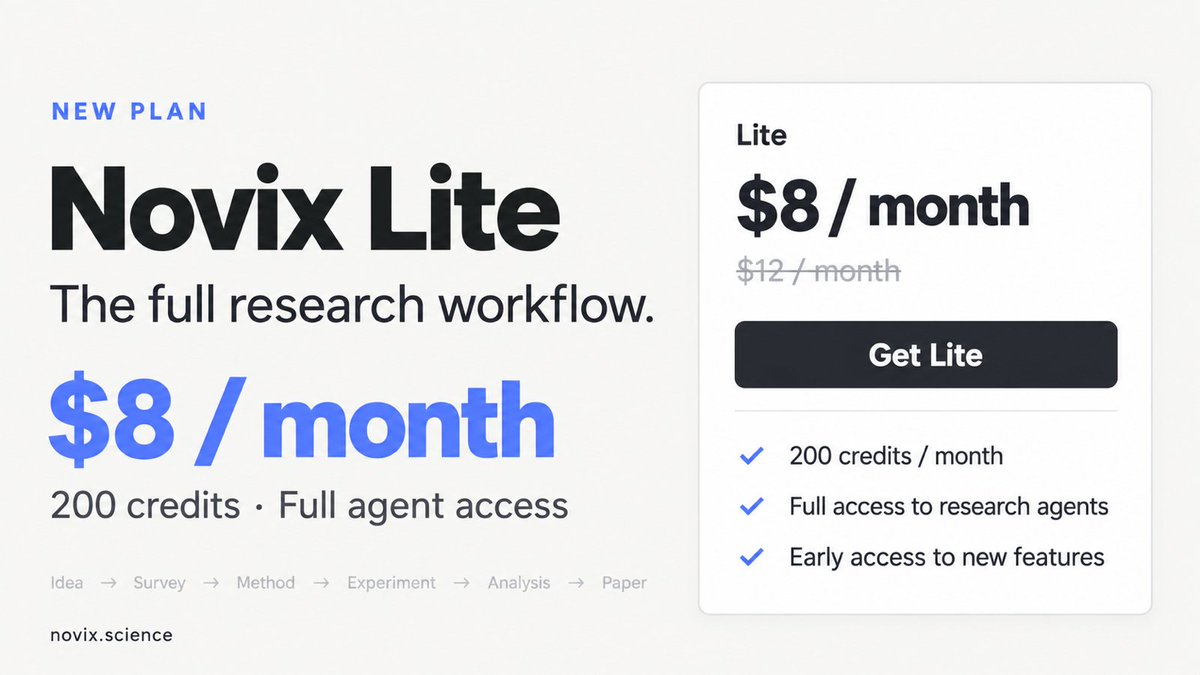
Novix Lite is live.
$8/month. 200 credits.
Full access to Deep Survey, Idea Spark, Method Design, Data Analysis, Reproduce Paper & Advanced Auto Experiment access.
Early access to new agents/features, and the Novix Scientist Community.
Built for researchers who want to try the whole workflow before moving to Pro.
Research papers are becoming executable.
A Nature paper, Paper2Agent, turns a paper into an agent you can query, rerun, and connect to other papers.
The next step isn’t chatting with a PDF.
It’s letting a paper apply its methods to new data, check its claims, and collaborate with other agents.
A paper-specific agent is useful.
A research orchestrator connecting literature, hypotheses, code, experiments, and writing is the bigger shift.
That’s the direction we’re building at Novix.