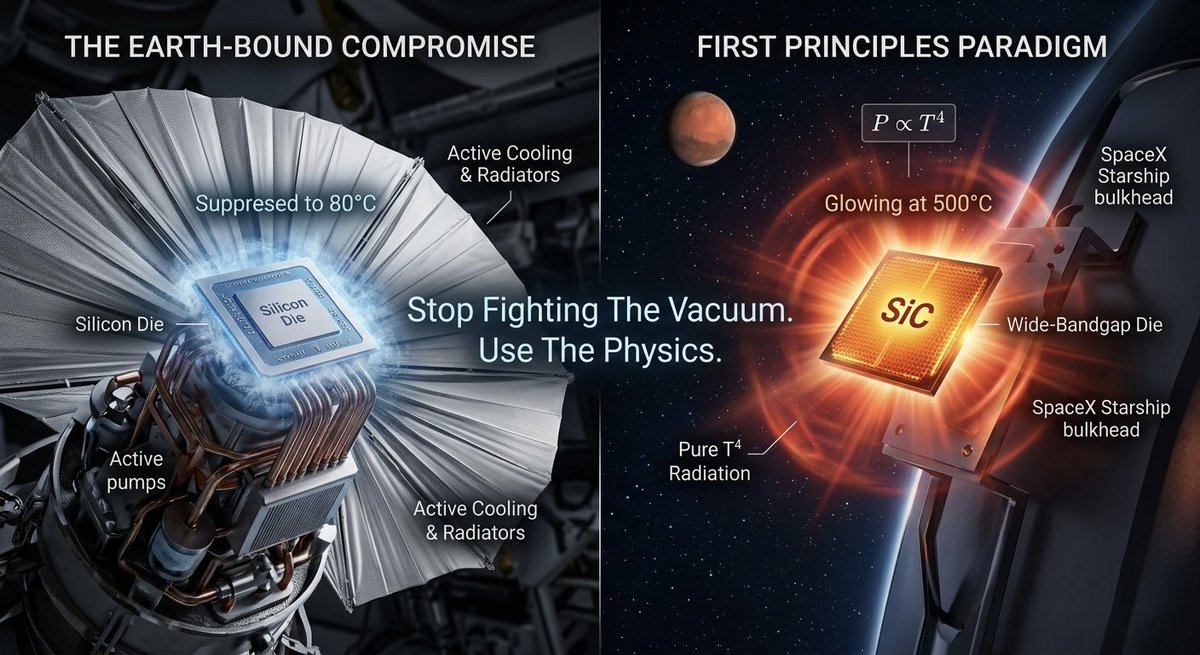
Many people constantly question @elonmusk's ambitions for deploying massive computing power in space (like high-compute on Starship or Mars). But they are trapped by Earth-bound engineering habits. Let’s break this down using First Principles Thinking.
Fundamentally, we have to ask: Why do we even need to cool chips?
It’s not actually to prevent metal from melting. We cool them to fight thermodynamic entropy—to keep electrons from jumping the bandgap and destroying the logic states of the semiconductor.
On Earth, we rely on convection (fans) and conduction. In the vacuum of space, convection is zero. The only way to shed heat is through thermal radiation. According to the Stefan-Boltzmann law, radiation power scales with the fourth power of temperature (T^4).
Here is the paradigm shift: Instead of struggling with massive, heavy radiators to suppress a silicon chip to 80°C, it is exponentially easier and more efficient to let the chip run normally at 500°C.
If we abandon standard Silicon and utilize Wide-Bandgap semiconductors like Silicon Carbide (SiC) or Diamond, the chip can easily tolerate extreme heat. Because radiation scales at T^4, a chip at 500°C becomes its own radiator, dumping heat into the cosmic background naturally and achieving thermal equilibrium without bulky, failure-prone cooling systems.
Stop fighting the vacuum. Use the physics.
We need to stop translating Earth-based compromises into space-bound hardware. I specialize in translating complex technical limits into high-ROI engineering realities. I’m looking to bring this kind of relentless, first-principles optimization to the hardware teams at @SpaceX or @Tesla. Let’s build the future. 🚀
#FirstPrinciples #SpaceX #Tesla #Engineer