Starship reached orbit today. The headline is the least interesting part 🚀
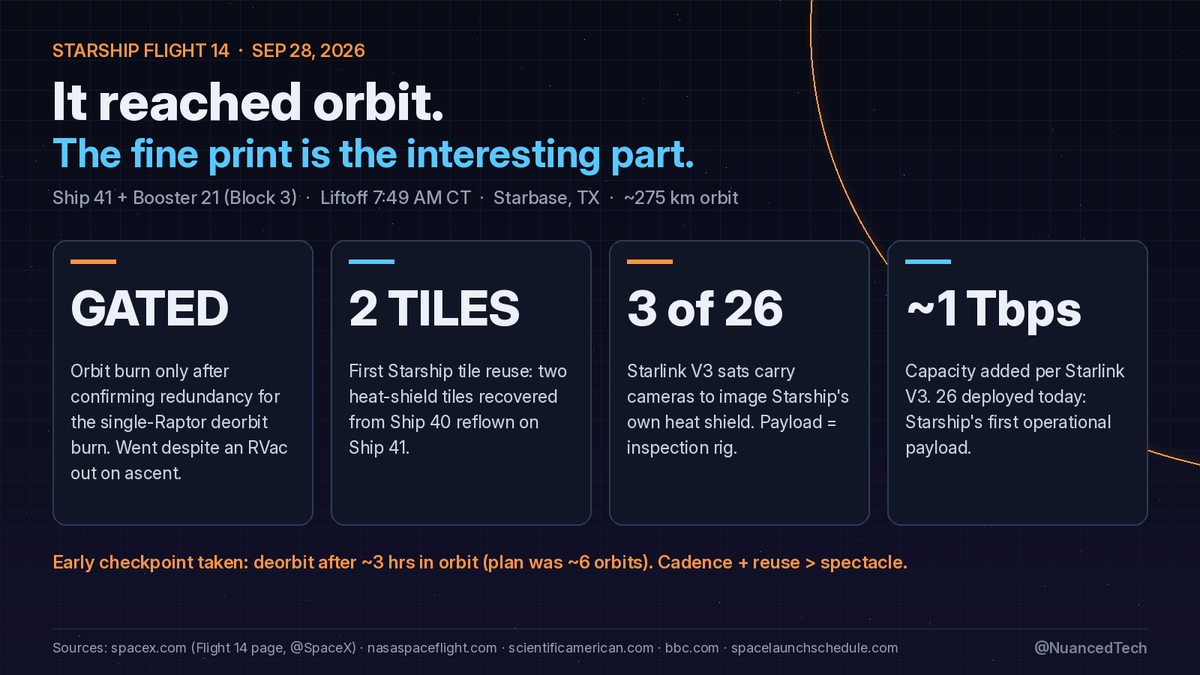
Flight 14 (Ship 41 + Booster 21, Block 3) lifted off 7:49am CT from Starbase:
• Orbit was gated, not assumed: Ship coasts on a passively safe suborbital path until controllers confirm redundancy for the single-Raptor deorbit burn. A Raptor Vacuum quit on ascent → brief "no-go" → then go.
• First tile reuse: 2 heat-shield tiles pulled off Ship 40 are flying again on Ship 41.
• 3 of the 26 Starlink V3s carry cameras to photograph Starship's own heat shield. The payload is the inspection rig.
• FAA split launch + reentry into separate orders; the reentry order covers Flight 14 only.
SpaceX took the early checkpoint: deorbit after ~3 hrs, not ~6 orbits.
Nuance: orbit is table stakes. The real test is whether a V3 flight every ~2 months becomes routine with reused boosters and tiles. At ~1 Tbps per V3 sat, cadence is the Starlink capacity story.
Here it is: https://t.co/T1pdKZUq54
Free while in beta. Beta testers get a discount when paid plans start.
If you run Spark ads, I'd like blunt feedback on what's missing.
A Spark ad can be your best performer on Tuesday and dead on Wednesday.
Not because it stopped converting. Because the creator's code hit its last day and nobody was watching.
I built Auth Code Vault: emails 7, 3 and 1 day before a code expires.
Free in beta. Link below.
@GreenTexanEV@elonmusk@SawyerMerritt Why don’t you think one step further where AI helps create a system eliminating all the food and substances that can cause cancers in our society?
Elon at All-In with Gwynne: stop grading your own homework.
Useful builder translation:
major labs should run *each other’s* security test harnesses before release — raise the egg-on-face cost when ignored warnings become real harm.
Same rule as shipping agents:
• self-evals lie
• adversarial harnesses surface failure modes
• sticky self-grading ≠ safety
Whether you buy the geopolitics or not, the product lesson is clear.
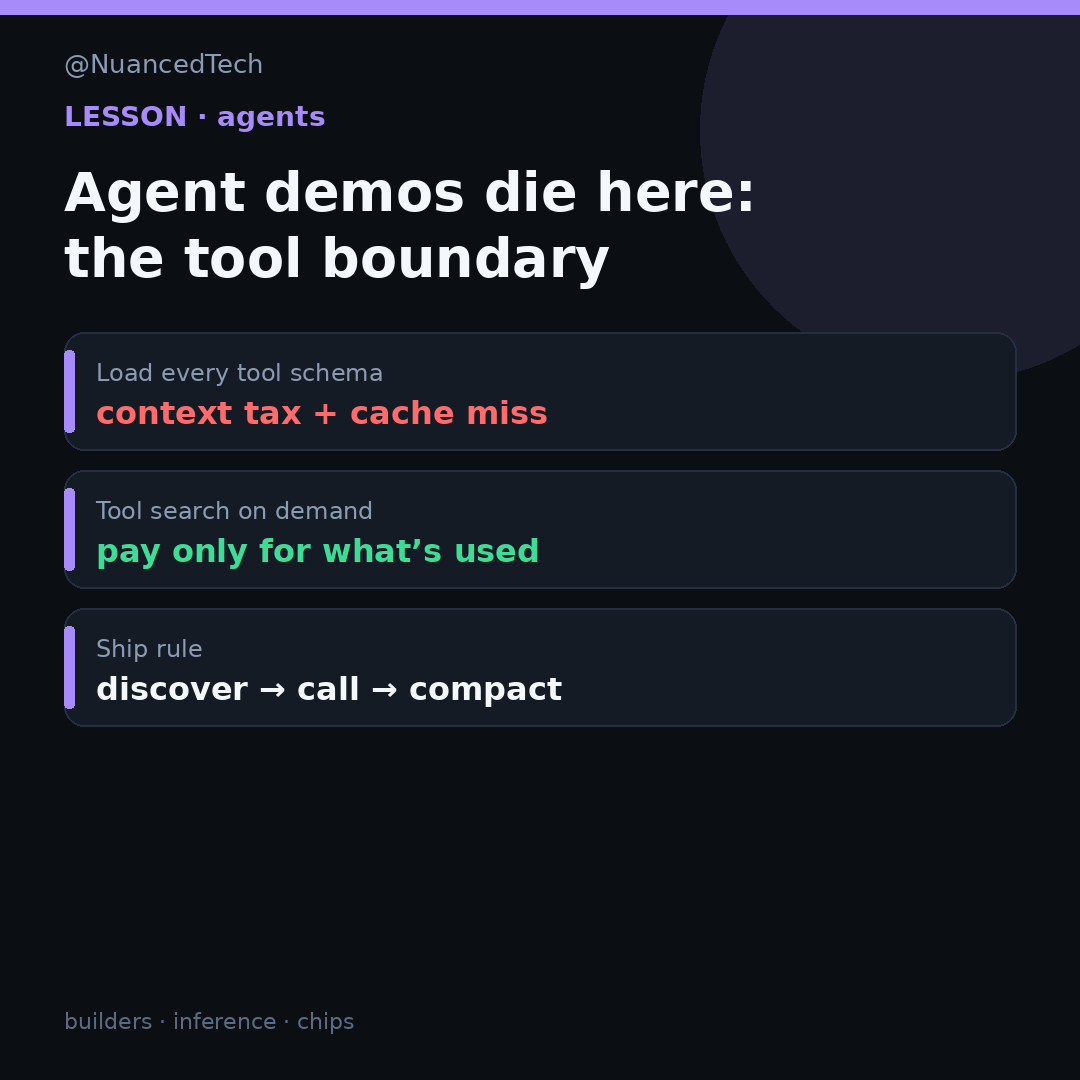
Agent demos die at the tool-calling boundary.
OpenAI's Agents API shipping tool search is the adult version of that failure mode:
• dump every tool schema → context tax + cache miss
• tool search on demand → pay only for what's used
• ship rule: discover → call → compact
If your agent loads 40 tools "just in case," you're paying theater tax before it does any work.
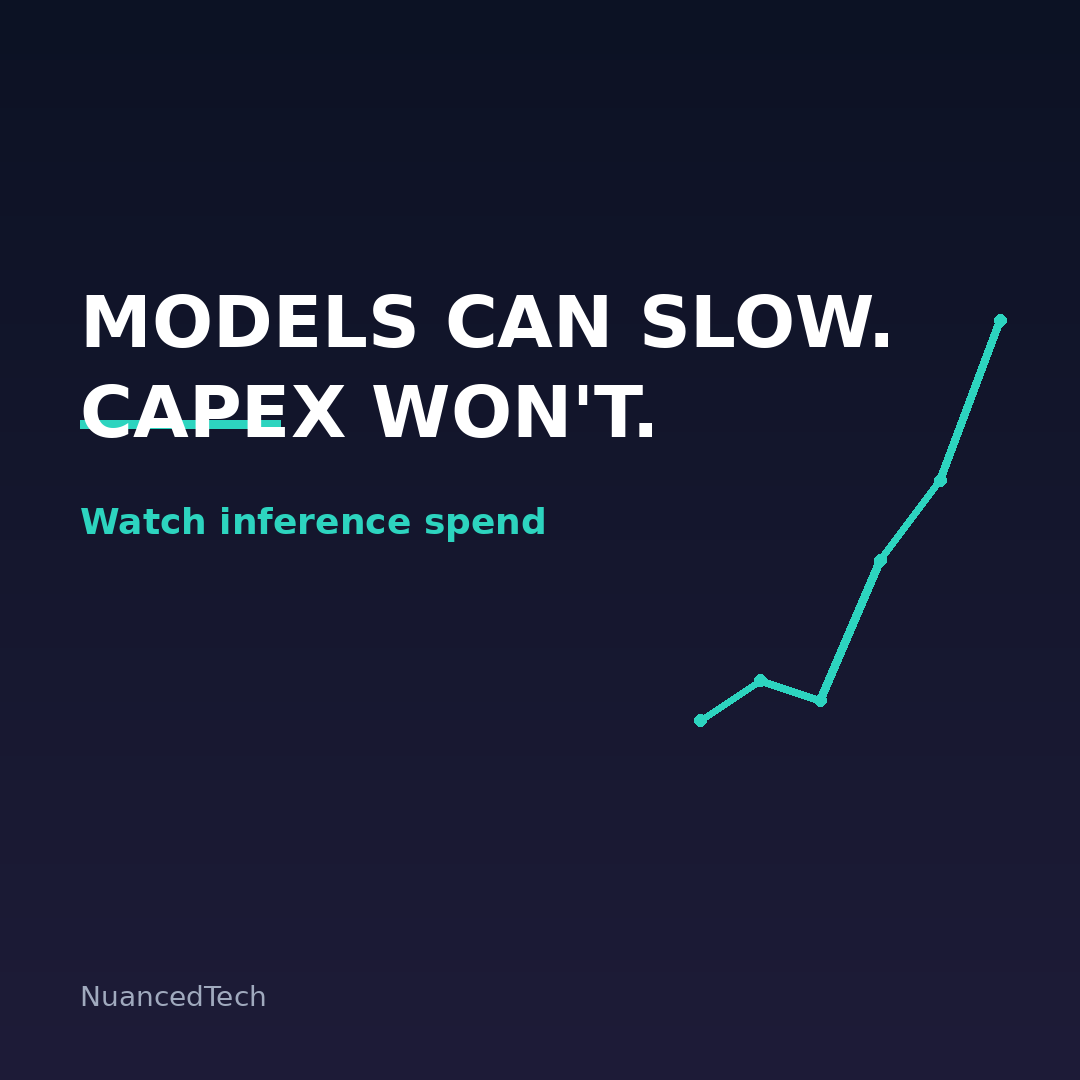
People keep asking if AI is “slowing down.”
Wrong question.
Model release cadence can cool while capex keeps ripping — inference, networking, and memory still eat budget even when demos get quieter.
Watch the spend, not just the launch calendar.
@latentspacepod@kepler_ai_hq@VinooGanesh Forward-deployed patterns are how AI products survive contact with messy enterprise reality. More teams need this muscle than another wrapper demo.
@Dorialexander “Value is in orchestration” is often cope — until you try to run agents across machines without a control plane. Orchestration only matters if the underlying models/infra are actually good.
@cwolferesearch Importance sampling is one of those ideas that looks academic until you hit train/serve mismatch in production RL loops. Clear explainers like this save weeks of confused debugging.
@modal This matches what we see shipping agents: frontier models are amazing demos, but daily drivers win on latency + $/task. The hard part is scaling rollouts/sandboxes without the training bill eating the product.
@antfeedapp “Slow down” ≠ “stop shipping.” The useful version for builders is slower capability jumps + harder evals — while inference economics and deployment reliability keep compounding either way.
@pequityresearch Custom CPU engagements are underrated next to TPU headlines. If hyperscalers keep splitting the stack (CPU/custom + accelerator), AMD’s path looks more like portfolio fit than one big GPU dunk.
@pequityresearch 6-year LTAs with prepay are the real tell. When packaging/substrate capacity gets locked that far out, the constraint isn’t “which GPU” — it’s who can actually assemble systems at scale.
@pequityresearch This is the split builders should watch. Model-release cadence can cool and capex can still rip — because inference capacity, networking, and memory keep eating budget even when demos slow down.