Here is the current state of the global SMR market.
See the readiness state of technologies across 6 key metrics: licensing, siting, financing, supply chains, engagement, and fuel.
https://t.co/OhPDoiEpfM
First a trickle, then a torrent
There have now been 30 papers since 2021 showing Bitcoin solving all three aspects of the energy trilemma:
♻️energy sustainability
🔐energy security (including grid stability) and
💳energy equity
No other technology can address all three concurrently
In fact, many energy experts believed this was impossible
(Source link to all 30 papers with a summary of they says in comments)
@EVCurveFuturist Probably because ISOs (except ERCOT) are just as dismissive around the B word as you are being.
The data speaks for itself. Miners located in regions of excess capacity that are exposed to the real-time price are a net benefit to the grid.
@jyn_urso
https://t.co/H2uUuCQv15
The data is unequivocal: Bitcoin mining is the way to make renewable projects that would otherwise need subsidies viable.
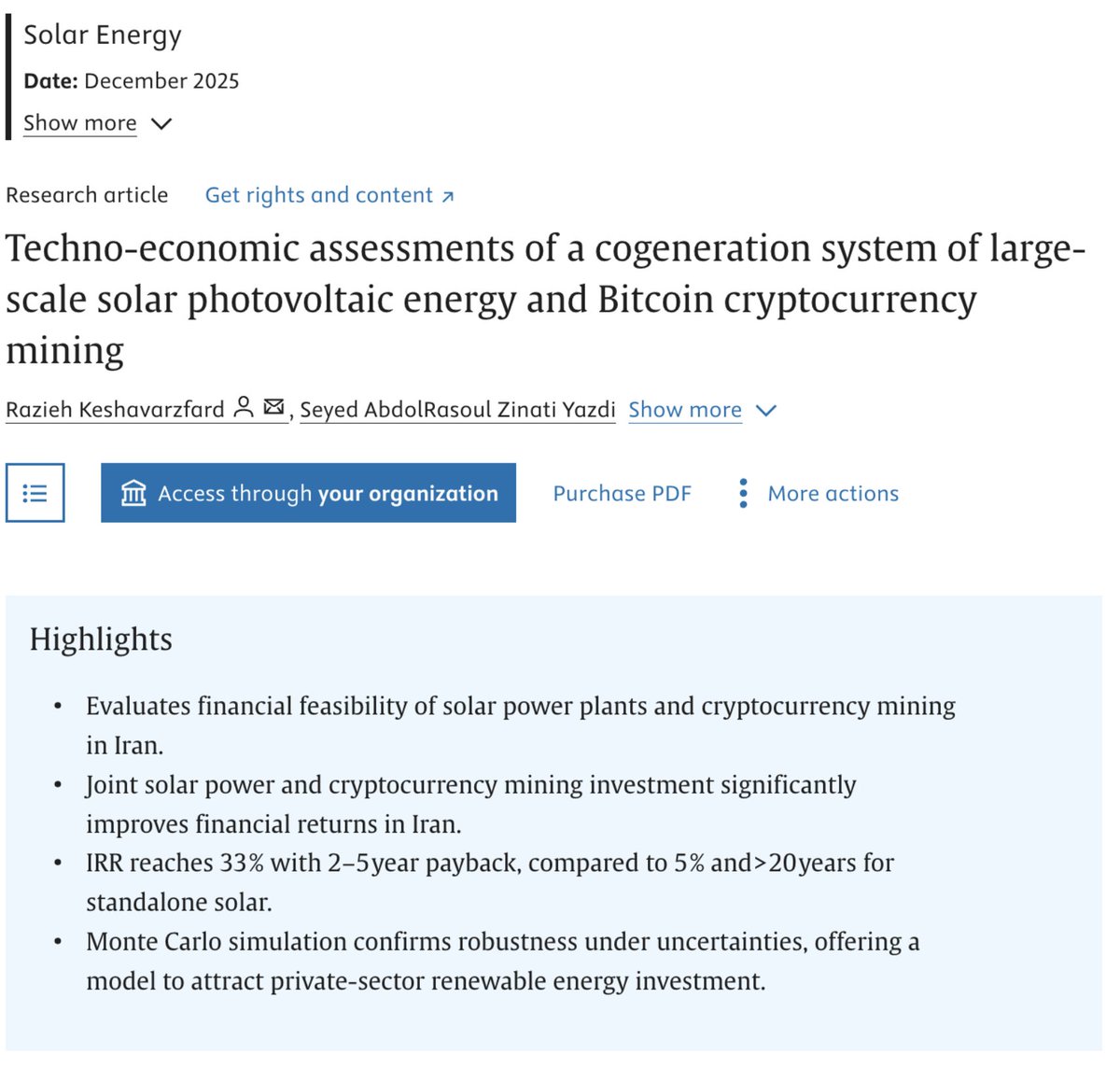
A new paper recently found that pairing large-scale solar PV with Bitcoin mining
* transforms a standalone solar project with a10-year payback, ~5% IRR into a highly profitable venture with 2–5 year payback and 33% IRR
* reduces ~10,457 tons of CO₂ avoided emissions per annum
The study was done on a 10 MW Solar Farm and supports the earlier findings of Hakimi et al that Bitcoin mining reduces the ROI from 8.1yrs to 3.5yrs while reducing CO2 emissions by 50,000 tonnes/year on a 50MW solar farm (source: https://t.co/RGsIe6z75Z)
The recent paper "Techno-economic Assessments of Large-Scale Solar PV and Bitcoin Mining" (Keshavarzfard & Zinati Yazdi 2025) was published in Solar Energy.
Source: https://t.co/MqAgiWv6CB
The journal has an impact factor of 6.6 (top 6% of academic journals)
@DIYFractal@DSBatten Fair, it's a built-in mechanism that relies on the physics of spinning mass, and its absence makes demand side flexibility all the more important.
ISOs have even had to implement minimum so that they have the 100ms they need to dispatch capacity elsewhere.
Large levels of flexible load is a non-negotiable requirement for tomorrow's grids
Bitcoin mining is best in class across 3 of the 4 dimensions of flexible load that matter most
Probably nothing
One year ago Paulo Gonçalves was not a Bitcoiner.
He's was (and is) renewable energy project developer who has spent his career building small hydroelectric dams across the world.
His problem was simple: many of these dams produce power that the grid can't absorb. The energy is wasted. The economics don't work. He'd seen the problem firsthand and had been searching for a solution for over a decade.
A year ago, he attended a @FREEMadeiraOrg event in Portugal, where he discovered Bitcoin mining.
That day changed everything.
Unlike others who fall into the mistake of evaluating Bitcoin mining without understanding energy, grids or renewable generation - he understood all three intimately, and as such was able to immediately see the value that others (including policymakers and regulators) sometimes miss.
Paulo is now evaluating 100s of small hydropowered sites throughout Portugal that are ideal candidates for Bitcoin miners. There are sites that are "too small" or too remote to be of interest to anyone else.
The miners consume what would otherwise be stranded energy. No subsidy required. The dam that didn't make financial sense now does.
This is the pattern critics miss.
They assume Bitcoin miners are Bitcoiners first, working backwards to justify energy use. In reality in the energy sector it happens the other way around.
Kenji Tateiwa in Japan. Paulo Gonçalves in Portugal, Bipin Patel in Sweden are real people solving real energy problems. Different countries, different energy sources, same discovery pattern:
When you know a lot about energy, and do deep research into how to solve energy problems, you arrive at Bitcoin mining.
@ClownWorld This is more related to aggressive KYC policy than crypto. Most of the information used by attackers came from leaks from databases of user data that exchanges are mandated to collect.
Did you know a quarter of global energy is used just for "comfort heat"? Imagine if we generated all that warm air and water using Bitcoin miners instead.
I had an incredibly fun chat with Tyler Stevens about the hashrate heating movement and what happens to Bitcoin's security budget when normal people start heating their homes with ASICs. Catch the full conversation below.
@forrest_higgs@PeterDClack They refuse to update their priors. Despite the fact that coal plant exhaust scrubbing tech has advanced to the point where nearly all by-products are captured, they are still stuck with a vision of decades old coal plants that spew their exhaust into the atmosphere.
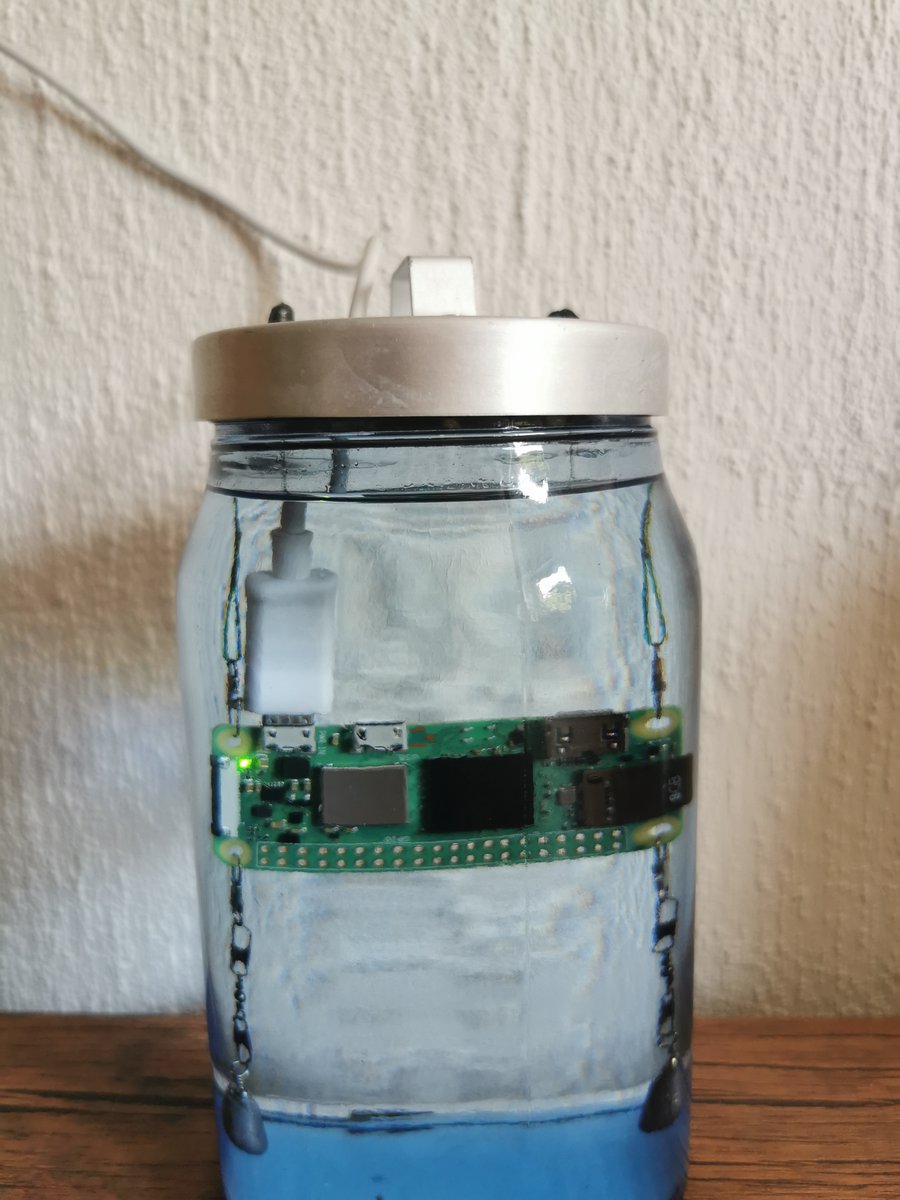
Vor genau einem Jahr habe ich einen Raspberry Zero2 W in Paraffinöl versenkt.
Das Öl sorgt dafür, dass der Prozessor auch unter Höchstlast kaum wärmer wird als Zimmertemperatur.
Seitdem berechnet er mit einem BOINC-Client für die Mathematisch-Physikalische Fakultät in Prag 24/7 Asteroidendaten.
So ermitteln wir die Umlaufbahnen aller Asteroiden und wissen, wo die ihre Bahnen ziehen und auch, ob wir uns Sorgen machen müssen, dass uns einer in Zukunft trifft.
Ein genau baugleicher Zero2 W mit genau der gleichen Software führt genau die gleiche Aufgabe ungekühlt aus.
Und jetzt stellt sich die Frage: Macht perfekte Kühlung einen Leistungsunterschied aus?
Und die Antwort ist: Ja!
Und zwar signifikant! – 5,97 %
So das wäre auch geklärt. 😀
@BTCPrague It has only been confirmed that Bhutan is drawing down and not replenishing the publicly known address.
It is plausible that they are still accumulating with a new private wallet.
It's not like they chose to reveal it in the first place.