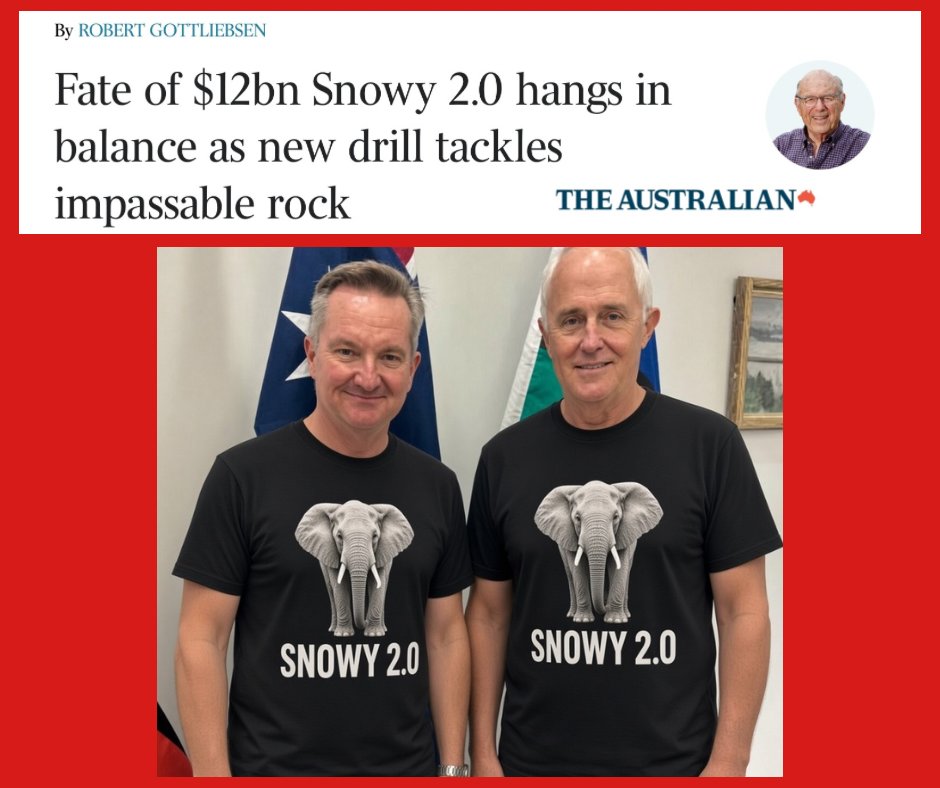
Snowy 2.0 is the greatest financial disaster in our nation’s history.
If it ever gets finished — and that’s a massive if — it will have blown more than $40 billion and locked Australians into high electricity prices for a generation.
When this farce was first proposed I was one of the few MPs in the country prepared to call it out.
The full business case was deliberately hidden from backbenchers (who were meant to support it like trained seals) yet it took about 30 seconds of back-of-a-drinks-coaster arithmetic to see it would never deliver cheap power.
It was pure politics — and a golden ticket for the grifters and spivs running the renewables racket.
It was also a failure of our Parliamentary system - controlled by the Uniparty - that failed to scrutinise the proposal, let alone even debate it.
Snowy 2.0 doesn’t create energy. It destroys it.
For every unit of electricity it might theoretically produce (if the thing is ever finished) it will consume roughly 1.3 to 1.4 units just to pump the water uphill — and that ratio will only get worse over its lifetime.
Then there’s the environmental vandalism: great swathes of forest bulldozed through the Snowy Mountains National Park to clear a path for the giant new transmission towers and lines.
Unique native fish species, protected for millennia by isolation, will be wiped out by predatory fish pumped into the high country — and not a peep from the Greens.
During the planning stages I met the then CEO of Snowy and asked him straight about the risks of drilling a 17 km tunnel, a kilometre underground, through the middle of a National Park and some of the hardest granite on the planet. He claimed it wouldn’t be a problem.
Today Robert Gottliebsen writes in The Australian:
"An essential component of Snowy 2.0 is a 17 km tunnel that links the high dam with the low dam to enable water to be pumped up to the high dam and then regenerate power on the way down.
"In the middle of that huge tunnel is about 800 metres of some of the most difficult material in the world to drill through – the so-called Long Plain Fault Zone.
"The first drill that attempted the 17 km to link the two dams was called Florence and started at the top of the mountain. It encountered very difficult material (also forecast in the feasibility study) even before it reached the Long Plain Fault Zone.
"It was clear that it simply would not have the ability to get through the fault zone. And so, a new drill called Monica was ordered to tackle the 800-metre fault zone from the bottom.
"This drill is clearly better designed for the task, but there is still no certainty that it will be able to get through the 800 metres and link with Florence.
"Right now, concerns about the ability of Monica override any question of Snowy 2.0 costs. … if the drill can’t get through, then the entire project becomes a museum piece."
We need to face reality.
Cut our losses. Abandon this project and turn the whole expensive failure into a museum of the waste and folly that flowed from the climate scare campaigns of the early 21st century — so future generations can learn the lesson and never repeat the same catastrophic mistake.
- You: "My dad missed my childhood working."
- Government: "Providing! Honorable."
- You: "He retired at 67. Died at 69."
- Government: "Tragic. Our condolences."
- You: "The pension he paid into for 45 years?"
- Government: "Reabsorbed."
- You: "Reabsorbed."
- Government: "Actuarially, he was very profitable."
- You: "He was my FATHER."
- Government: "And a model contributor. Next in line, please."
- Bank: "Your withdrawal has been flagged."
- You: "It's 20,000. My money."
- Bank: "What's it for?"
- You: "Why does that matter?"
- Bank: "We must assess the risk."
- You: "The risk of me... having my money?"
- Bank: "Exactly."
- You: "You lend it out 9 times over and I'M the risk?"
- Bank: "Correct. You might not give it back."
That first line crystallises a fundamental difference in US and European thinking when it comes to sport.
For most football fans in Europe, clubs are a family obsession passed down through generations, boiling that down to “franchise value” is missing the point spectacularly.
Pedro Porro's grandad drove him thousands of miles as a child to training and matches, helping him chase his dream of becoming a footballer.
Yesterday, Porro returned home and gave his grandad the World Cup winners' medal. Mission accomplished ❤️🏆
@SwoopLuke South Aussie here, I'm deadset gobsmacked there is a state ranked lower. I heard somewhere when ships port here they aren't allowed to fill with our water due to low quality
Labor and their billionaire mates.
Gina RInehart donates a light single-prop plane to One Nation and ABC repeat the story endlessly.
Albanese pockets a $1 million cash donation from a Chinese high roller with links to the Chinese Communist Party - in a deal brokered by dodgy Dan Andrews - and you can bet the ABC won’t mention a word of it.
https://t.co/hHOpUxkpgB
O comentarista suíço David Lemos, encerrou a transmissão resumindo com precisão os problemas desta Copa do Mundo, ele foi perfeito.
🗣️"Não há dúvidas de que esta foi a Copa do Mundo mais comercial da história e também uma das mais politizadas."
"Não esqueceremos os preços que pessoas sem grande poder aquisitivo tiveram de pagar para viver sua paixão pelo futebol."
"Em alguns casos, sequer puderam entrar no país por causa de sua nacionalidade, fossem torcedores, jornalistas ou até árbitros, como o somali Omar Artan."
"Também lembramos do tratamento inaceitável dado à seleção do Irã, que não pôde defender suas chances de forma adequada durante o torneio."
"E há ainda o caso de Folarin Balogun. Vimos um presidente se vangloriar de ter ligado para o presidente da FIFA para conseguir retirar a suspensão de um jogador."
"A política se infiltrou no coração do futebol, embora a FIFA afirme querer mantê-la acima de tudo. Fica claro que isso só vale até certo ponto."
"Foi uma Copa do Mundo em que todas as partidas foram disputadas em quatro tempos, e cuja final teve um intervalo de quase 30 minutos."
"A crise tem dois nomes: dinheiro e poder. Hoje existe uma crise de confiança entre muitos dos envolvidos no futebol e a FIFA."
"Nas próximas semanas, muito dinheiro será distribuído a diversas federações e a muitos agentes do futebol, que serão educadamente convidados a permanecer em silêncio."
"Esperamos que tudo isso seja levado em consideração e que não volte a acontecer."