Most EdTech platforms measure answers.
At NumberClub, we're more interested in measuring thinking.
We just passed 178,000 hours of mathematical thinking time. Here's why we think that might be a more meaningful number than questions answered. https://t.co/NnDuxFc6Uc
Every EdTech startup runs on an “article of faith” that what they do will help education.
AI tutors. Better data. Faster marking.
Ours is young children are far better at maths than we let them be. Once you see it, you can’t unsee it.
Blog https://t.co/QHiBCiIYWF
I admit, as an EdTech founder it can get lonely. Too often we see learning through dashboards, not children.
Fortunately we get lots of letters from teachers. So thank you, thank you, thank you to everyone who takes the time to write. It makes all the difference.
Students can spend hours in deep thought in Minecraft.
So what if math felt like that?
Build games where the mathematics is the task, and reasoning is unavoidable.
That’s how you get sustained, focused thinking.
In discussions about learning math facts through retrieval, we often underestimate one key difference between math facts and most other facts. If you don’t know that the capital of France is Paris, there’s no way to work it out. With maths facts, there's always a way.
Ideally, students would learn their basic number facts through doing lots of mathematics, not through repetitive fact drills. At NumberClub, we asked a simple question: how could we help students get through enough of the right kind of mathematics for those facts to stick?
Learn basic facts
But learn them through reasoning
Because some students may never learn all their facts
They can fall back on reasoning
Some students do learn all their facts
They'll be able to use them more flexibly.
I've been trying out the brilliant @NumberClubHQ games recently.
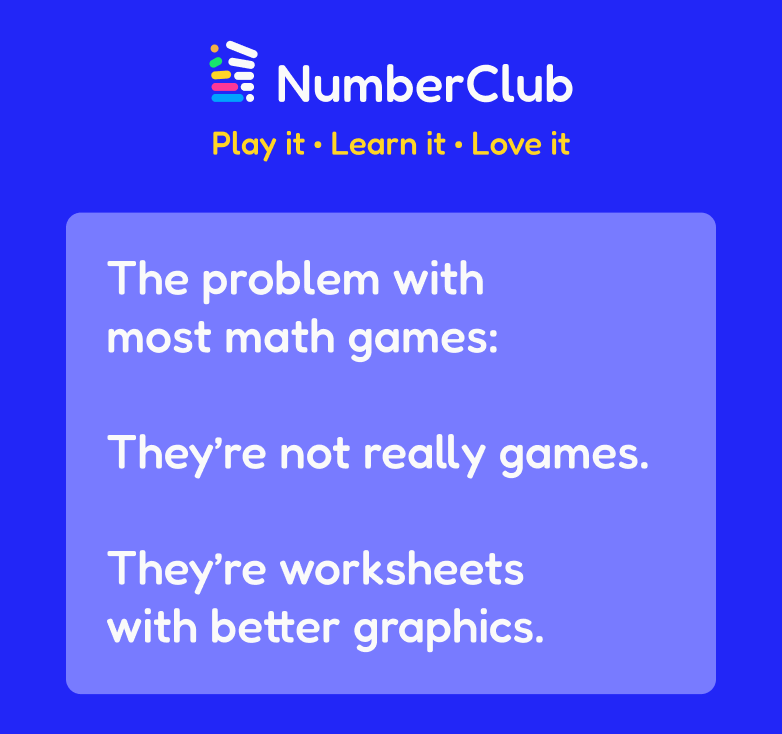
Far too many maths 'games' are just normal maths practice, gamified - correct maths gets points and prizes etc, but that's it.
Here, the maths is totally 'baked into' the structure of the games. Have a look!
Our webinar with Pam Harris and MathIsFigureOutAble is back by popular demand.
This Wednesday
📅 April 8
⏰ 2pm PT | 4pm CT | 5pm ET
Join us live to see how our games build fundamental skills and more. Free: https://t.co/hClGhEejUC #MathIsFigureOutAble#MathTeacher
Our NumberClub webinar is back by popular demand.
📅 April 8
⏰ 2pm PT | 4pm CT | 5pm ET
Join us live to see how @NumberClubHQ games build true fact fluency and morey.
Free: https://t.co/JqPNq6MFRt
#MathIsFigureOutAble#MathTeacher
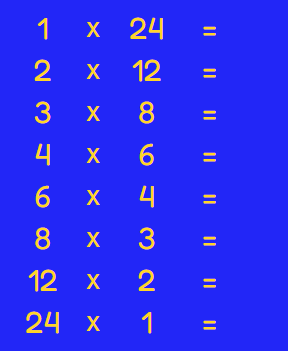
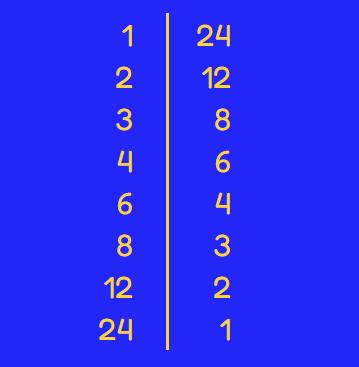
A teacher shows this to a class and asks them to look for patterns. Over a few minutes they discuss it with the class till all see the nums in one column go down by the same factor the nums in the other go up, while the product remains the same. Is this DI or Discovery Learning?
The best math questions carry no pressure, no hidden agenda. They show students instantly whether their idea works and why.
A new blog - The Anatomy of a Math Question.
https://t.co/4uBalopduH