Historic day for Sri Lankan athletics! 🇱🇰
⭕️ 23-year-old Sri Lankan javelin sensation Rumesh Tharanga Pathirage won the men’s javelin throw at the Rome Diamond League with a massive 92.62m throw.
The throw set:
✅ New Sri Lankan National Record
✅ New Rome meet record
✅ Put Rumesh at, 8th on the all-time men’s javelin throwers list
✅ 2nd in Asia
✅ World-leading throw of 2026 so far
⭕️ He is the only Sri Lankan athlete to win at a Diamond League meeting!
Way to go, Rumesh! 🎉 Heartiest congratulations! ❤️🔥
@Gihanbots It's a loan with a 4.5-year grace period, after which Sri Lanka must repay it in 12 semi-annual installments over up to 10 years, at a base interest rate of about 3.3%, with a potential 2% surcharge and an additional 0.75% time-based surcharge.
Sri Lanka Secures Another US$695 Million from IMF 🇱🇰
⭕ The IMF Executive Board has completed the combined 5th and 6th reviews of Sri Lanka’s EFF programme.
⭕ This gives Sri Lanka immediate access to SDR 508 million, equal to around US$695 million.
⭕ IMF says Sri Lanka’s reform performance remains “generally strong.”
⭕ All end-December 2025 quantitative performance targets were met.
⭕ However, IMF noted that Sri Lanka did not observe the continuous conditions on avoiding new external payment arrears and not imposing or intensifying import restrictions.
⭕ Sri Lanka 🇱🇰 now has roughly 2 tranches/review cycles left under the current IMF EFF programme.
⭕ The IMF programme is a 4-year arrangement running from March 2023 to 2027. After the combined 5th and 6th reviews, about US$2.4 billion has been disbursed out of the total ~US$3 billion facility. Around US$600 million remains.
#SriLanka #IMF
Rs.353 Customs Rate vs Rs.328 CBSL Rate: How Import Duties Are Affected by Last Week’s FX Panic 🇱🇰
⭕ Today’s CBSL USD selling rate has moved down to around Rs.328, reflecting the rupee’s recovery after last week’s FX panic.
⭕ However, for duty calculations, Sri Lanka Customs is still using Rs.353.17 as the exchange rate for CIF value this week.
⭕ This is because Customs does not update duty exchange rates daily according to the live CBSL or market rate.
⭕ Every Friday, Customs gazettes the exchange-rate schedule for the following week, based on that Friday’s CBSL rates. That rate then remains constant throughout the week. Last week’s rate was Rs.331.
⭕ As duty is calculated based on the Rs.353 rate, the rupee CIF value becomes higher, which will increase the duties payable. Therefore, some importers who can afford to wait may delay clearing their goods this week and lodge their Customs Declarations next week, expecting a lower duty amount.
⭕ The Customs rate should reset with the next Friday gazette.
#SriLanka #ExchangeRates
CBSL 🇱🇰 Hikes OPR by 100 bps in May 2026 Review
⭕ CBSL raised the Overnight Policy Rate (OPR) by 100 basis points to 8.75% at its May 2026 Monetary Policy Review.
⭕ Expected outcome: inflation pressure may ease over time as higher rates slow borrowing and reduce demand.
🔻 Inflation
🔺 Loan interest rates
🔺 Fixed deposit rates
⭕ The move signals a tighter monetary policy stance by CBSL to support price stability.
#SriLanka
CBSL Tightens Vehicle LTV Ratios AGAIN – Effective TODAY (May 25, 2026)
Announced ratios: 💵 Commercial vehicles: 60%
🚗 Cars, SUVs, vans: 40%
🛺 Three-wheelers: 40%
🚙 Other vehicles: 40%
⭕ LTV (Loan-to-Value) ratio is the maximum % of a vehicle's value that a bank will finance through a loan. The rest must be paid as a down payment from your own cash.
⭕ For example, if LTV is 40% and you want to buy a vehicle worth Rs. 10 million, you could only finance 40% of it, meaning Rs. 4 million. You should have 60% from your own money. In this case, Rs. 6 million.
⭕ This is the second tightening since July 2025 for all vehicle categories:
◽ Commercial vehicles: 80% → 70% → 60%
◽ Cars, SUVs, vans: 60% → 50% → 40%
◽ Three-wheelers: 50% → 50% → 40%
◽ Other vehicles: 50% → 50% → 40% (down 10%)
⭕ LTV is an effective macroprudential tool to moderate vehicle import demand by tightening access to credit. It prioritizes buyers with stronger upfront affordability, while encouraging others to delay purchases.
⭕ This would have been a more subtle way to curb vehicle imports earlier, instead of creating unnecessary panic through duty surcharges, which added uncertainty to the FX market.
#SriLanka
The Sri Lankan Rupee 🇱🇰 further appreciated today, with commercial banks quoting rates around Rs. 329 to 336, down from last week’s high of Rs. 354.
👉 https://t.co/VFKEA2eHj1
When a government signals that it is facing a crisis, the market reacts accordingly. That is exactly what we are seeing now.
This is a supply and demand issue.
Those holding dollars tend to wait, expecting further depreciation. Those who need dollars rush to buy early. That creates upward pressure on the exchange rate.
Even if there is no real shortage under normal market conditions, a government action like this tends to create one by triggering panic demand.
Personal vehicle imports account for only around ~5% of dollar outflows. Therefore, the raw number is not significant, but the trend is the key indicator here.
How the SL 🇱🇰 Government Manufactured a Dollar Crisis
⭕ Sri Lanka imposed a temporary 50% surcharge on vehicle Customs Import Duty from May 16, for 3 months.
⭕ The LC opening numbers revealed by Dr. Anil Jayantha:
May 07: USD 2.6 million
May 08: USD 4.6 million
May 11: USD 3.8 million
May 12: USD 4.28 million
May 13: USD 8.36 million
May 14: USD 11 million
May 15: USD 23 million
May 18: USD 17 million
⭕ The government’s intention was to delay vehicle imports by making them more expensive for three months. But the market reacted in the opposite direction.
⭕ Instead of waiting, importers rushed to open LCs. This panic response increased demand for dollars, added more pressure on foreign exchange, and further weakened the rupee.
⭕ This is the problem with shallow policy decisions. A tax or surcharge may look correct on paper, but markets do not always behave the way policymakers expect.
⭕ When secondary effects are ignored, the policy can backfire. In this case, the attempt to reduce immediate pressure may have created even more pressure in the short term.
⭕ This is becoming a repeated weakness in the NPP government’s decision-making process. Policies are announced with good intentions, but without properly considering market dynamics, behavioural responses, and long-term consequences.
⭕ Commercial banks in Sri Lanka are quoting the US dollar selling rate at Rs. 354 today.
#SriLanka
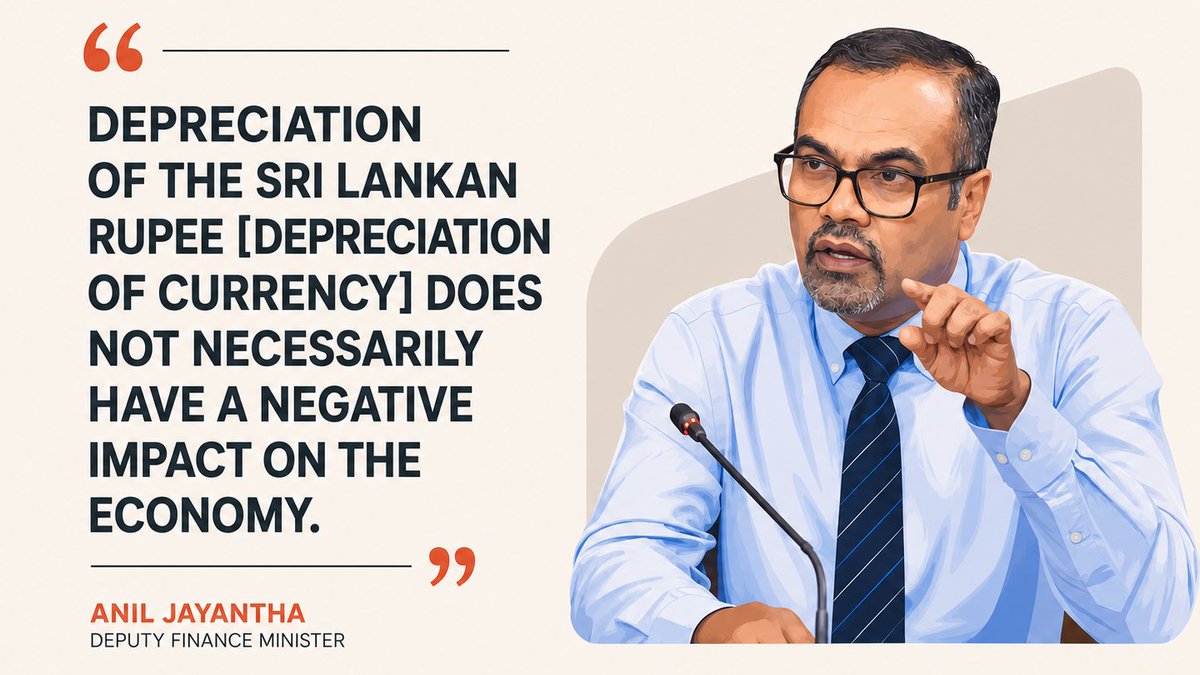
Dr. Anil Jayantha would have a point if Sri Lanka 🇱🇰 were China 🇨🇳.
⭕️ Sri Lanka has an $8 billion trade deficit and total external debt of over $50 billion.
⭕️ A weaker rupee may help sectors like exports in theory, but Sri Lanka imports far more than it exports. Depreciation will result in higher import costs, higher debt repayment costs, more inflation, and greater pressure on the economy.
⭕️ For a debt-ridden, import-dependent economy like Sri Lanka, the combined macroeconomic impact of rupee depreciation is inescapably negative. There is no way around it.
#SriLanka
It's widly reported as B2B. The following report is from daily ft.
"PayPal is set to launch in Sri Lanka on 15 May, in a move expected to expand formal digital payment channels, initially starting with business-to-business (B2B) payments to exporters.
"
https://t.co/WaXIpOb4fK
It's up to the partner banks to allow the linking. We still don't know what thier requirement will be.
PayPal in Sri Lanka 🇱🇰: Decade-Old Deadlock Nears 2026 Breakthrough 👏👏
⭕ Sri Lanka 🇱🇰 is reportedly set to officially launch PayPal services from 15 May 2026.
⭕ This means Sri Lankan 🇱🇰 users and businesses may, for the first time, be able to receive international payments directly into local bank accounts through PayPal, not just send money abroad.
⭕ Sri Lanka 🇱🇰 has pursued PayPal inward payments since at least 2014, but legal, banking and foreign exchange barriers delayed access for over a decade.
⭕ Multiple administrations, including the MR, Yahapalana and Gota administrations, spoke about building a digital economy and making Sri Lanka 🇱🇰 a digital hub, but basic inward payment access remained a major gap.
⭕ CBSL’s archaic and lagging stance was a major part of the delay, as its cautious approach to foreign exchange rules, licensed banking channels, AML safeguards and transaction monitoring remained the main bottleneck.
⭕ CBSL was also uncomfortable with PayPal’s closed-loop global platform, where foreign currency balances, reversals and transfers could operate outside Sri Lanka’s 🇱🇰 local banking system.
⭕ To this day, many freelancers and SMEs still lack a convenient formal way to receive payments for services provided to foreign clients.
⭕ The NPP Government’s Digital Ministry managed to get all parties to agree on some form of implementation, which is highly commendable.
⭕ PayPal is now expected to launch in Sri Lanka 🇱🇰 on 15 May, initially for B2B inward payments to exporters, according to reports.
⭕ This means the first phase will support business-to-business export payments, not full PayPal access for general users, especially freelancers, B2C sellers and digital product creators.
⭕ Sri Lanka 🇱🇰 already has formal export payment channels with heavy regulatory processes, so PayPal’s initial B2B rollout may not immediately transform exporter payments or create a major impact. but it is still an important starting point.
⭕ The real test is whether CBSL, local banks and PayPal expand this limited B2B rollout into wider inward payment access, similar to what users already have in many other countries.
⭕ After more than a decade of delays, the real test is whether CBSL, local banks and PayPal expand this limited B2B rollout into wider access for ordinary Sri Lankan 🇱🇰 users, freelancers, SMEs and digital businesses to receive global payments easily, legally and reliably.
#SriLanka #PayPal
🇱🇰 Sri Lanka Adds 50% Surcharge on Vehicle Import Duties Amid FX Pressure
⭕ Sri Lanka has imposed a 50% surcharge on customs duties for imported vehicles to reduce import demand and ease pressure on foreign exchange reserves.
⭕ Deputy Finance Minister Anil Jayantha Fernando said the move is aimed at delaying vehicle imports by at least three months due to the current pressure on foreign currency reserves.
⭕ The Sri Lankan rupee has depreciated by 4.5% against the US dollar so far in 2026, according to official figures.
⭕ Vehicle imports already face a 30% customs duty. With the new surcharge, the effective customs duty rate increases to 45%.
⭕ This increase will also affect VAT and SSCL, as the tax base for both includes customs duty and the surcharge.
⭕ Based on our estimates, for most commonly sold popular vehicle categories, this could translate into around a 10% increase in market prices.
⭕ Sri Lanka already imposes taxes of more than 100% on many vehicle categories, with the total tax burden averaging around 150%. This move will further increase taxes on top of already high rates.
⭕ A separate 2.5% Social Security Contribution Levy on imported vehicles took effect from April 1, 2026, and is collected directly by Sri Lanka Customs.
Analysis:
⭕ After the initial surge in vehicle imports, FX outflow from vehicle imports has started to decline, according to CBSL data. From January to May, it dropped by around 14%, from USD 224 million to USD 196 million.
⭕ The bigger recent pressure appears to be from fuel imports. Fuel import costs increased from USD 98 million in February 2026 to USD 368 million in April 2026.
⭕ Instead of repeatedly trying to control FX pressure through vehicle import restrictions, which only inflate an asset class with limited contribution to economic growth, Sri Lanka needs a long-term strategy to reduce energy-related FX pressure.
⭕ Lowering VAT on batteries and solar panels, introducing reasonable pricing for battery-backed exports to the grid during peak hours, and incentivizing EV adoption are common-sense solutions.
⭕ Short-term policy changes like increasing import duties may patch the issue temporarily. But until Sri Lanka reduces its dependence on foreign exchange for energy, the country will continue to face the same problem again and again.
The Government should think a step further and introduce policies that are genuinely beneficial for the country in the long run.
#SriLanka
Sri Lanka 🇱🇰 is expected to continue experiencing rainy weather over the coming days due to the influence of a low-pressure system.
🗺️ - Hourly Rain Forecast for the next few days, issued by the Department of Meteorology.
3 partner banks listed as PayPal moves toward 🇱🇰 Sri Lanka rollout
⭕ PayPal is set to launch in 🇱🇰 Sri Lanka on May 15, 2026.
⭕ PayPal has listed Sampath Bank, Commercial Bank of Ceylon and Bank of Ceylon as partner banks for 🇱🇰 Sri Lanka,
⭕ Users are directed to create a new PayPal account or link an existing account to a local bank account to receive and withdraw funds.
⭕ Fees may apply from both PayPal and the partner banks when users receive or withdraw funds, but PayPal and the listed partner banks are yet to issue an official statement on the fee structure, charges or rollout process.
#SriLanka #PayPal
https://t.co/9w7h1kCB3z
Diesel now costs Rs. 720 per litre, says President AKD. (Current selling price: Rs. 392)
⭕️ 1 1/2 years ago, when the Government was preparing to lift the vehicle import ban, we suggested revamping Sri Lanka’s 🇱🇰 vehicle tax structure in favour of more energy-efficient EVs and hybrids, mainly to reduce long-term foreign exchange pressure from fuel imports.
⭕️ But instead of making a policy shift in that direction, the Government continued with higher tariffs across the board and actually increased tariffs on EVs.
⭕️ Now, the same revenue gained through those higher tariffs is effectively being burned to keep fuel prices affordable, while the country continues to lose foreign exchange on fuel imports. At the same time, rupee depreciation is creating additional pressure on fuel costs.
⭕️ The reopening of vehicle imports after a five-year ban gave Sri Lanka a once-in-a-generation chance to move towards a more energy-efficient vehicle fleet and reduce long-term foreign exchange dependence on fuel imports. But nearly 600,000 vehicles and more than one and a half years later, that opportunity may already be slipping away.
Now, every Sri Lankan is paying the price for that missed policy Opportunity.
#SriLanka #EV
🚗 Sri Lanka 🇱🇰 Lifts Vehicle Import Ban – What's Next; Key Points to Consider
⭕ The primary reason for the vehicle import ban imposed on 2020 was to reduce foreign exchange (forex) outflows.
⭕ When lifting the ban, the gov must evaluate not just the immediate forex outflow at the point of importation but also the long-term forex drain caused by fuel consumption over the vehicles' lifetime.
⭕ For example, 10 years down the line, the foreign currency outflow footprint for a electric vehicle (EV) will be an order of magnitude lower than that of a combustion engine vehicle, as EVs do not rely on foreign-sourced fuel.
⭕ Ideally, the government should revamp the current vehicle tariff structure by significantly lowering taxes on EVs and hybrids, thereby incentivizing their import over combustion engine vehicles.
⭕ Fuel is by far Sri Lanka’s largest import. If the government successfully replaces a significant portion of the country’s vehicle population with electric vehicles (EVs) over the next 5-10 years, it could substantially reduce net foreign exchange outflows.
⭕ Importing older vehicles (5-7 years or older) will bring no long-term benefits. Instead, it risks turning Sri Lanka into a dumping ground for outdated vehicles, similar to trends seen in some African markets.
⭕ If the government lifts the import ban without reforming the tariff structure, it would reflect a lack of foresight and a shallow approach to policymaking, missing a critical opportunity for sustainable progress.
This decision will be a true test of whether the government is forward-thinking and genuinely committed to Sri Lanka’s long-term economic and environmental well-being.
#100Proposals -004 #SriLanka 🇱🇰
Sri Lanka's 🇱🇰 electricity tariff hike kicks in today (May 11th).
⭕ PUCSL approved an 18% increase for domestic users above 180 units/month.
⭕ Consume 180 units → Rs. 6,584.62
⭕ Consume 181 units → Rs. 8,666.67
⭕One unit over the threshold costs you an extra Rs. 2,082.
Know your meter.! Check what your bill would be: 👉https://t.co/neAx95zvzm