Spot on @Channa_Amare. As per the latest @CBSL directive, Fin Co deposit caps are applicable for tenures up to 2 years, and reviewed quarterly, i.e. next revision is due on 01 Jul 2026.
1-year cap = 364 Day T Bill + 3%, where simple average WAYR of the latest four T Bill auctions in the preceding quarter is taken.
If the current trend continues, 1-year FD cap could be above 13%!
https://t.co/bgawKUExBW
6-Month T Bills reach double-digit levels after 87 weeks
This week's T Bill auction crossed an important threshold. 182-day WAY closed at 10.01% - for the first since 03 Oct 2024. The 364-day also crossed over, finishing at 10.02%.
Pace of yield increases has slowed. However, this is because we saw a sharp adjustment last week, following @CBSL policy rate hike.
• 91 days: +48 bps → 9.84% → 85% accepted
(vs +118 bps → 110% last week)
• 182 days: +33 bps → 10.01% → 84% accepted
(vs +143 bps → 32% last week)
• 364 days: +19 bps → 10.02% → 48% accepted
(vs +134 bps → 33% last week)
Acceptance levels have recovered. 182-day fill rate jumped from 32% to 84% - proving that investors are drawn at the right yield.
However, overall auction acceptance levels still remain below 100% - a bid-to-cover of 1.52x with 79% overall fill rate.
Crossing the 10% threshold is a psychological marker more than a technical one.
But it reminds us how far rates have moved in a short period. 182-day was at 8.25% on 20th May 2026, i.e. a 176 bps spike in just two weeks.
#SriLanka #FixedIncome
Econ Impact from Middle East Conflict
@IMFNews published a valuable analysis of how ME conflict affects #SriLanka.
• 2026 GDP growth revised down from 4% to 3%
• End 2026 inflation revised up from 5% to 6.1%
• FX reserves projection revised down from USD 9.5 Bn to 8.6 Bn
Middle East accounts for around 50% of Sri Lanka’s petroleum imports, 40% of remittances, and serves as a hub for 34% of flights to Sri Lanka.
Higher energy prices erode real incomes and increase production costs, dampening demand and creating BOP pressures.
On a positive note, IMF expects remittances and the primary fiscal balance (as a % of GDP) in 2026 to remain broadly in line with 2025 levels.
Econ Impact from Middle East Conflict
@IMFNews published a valuable analysis of how ME conflict affects #SriLanka.
• 2026 GDP growth revised down from 4% to 3%
• End 2026 inflation revised up from 5% to 6.1%
• FX reserves projection revised down from USD 9.5 Bn to 8.6 Bn
Middle East accounts for around 50% of Sri Lanka’s petroleum imports, 40% of remittances, and serves as a hub for 34% of flights to Sri Lanka.
Higher energy prices erode real incomes and increase production costs, dampening demand and creating BOP pressures.
On a positive note, IMF expects remittances and the primary fiscal balance (as a % of GDP) in 2026 to remain broadly in line with 2025 levels.
Tale of a Tight T Bond Auction
Following the hike in @CBSL policy rate and the T Bill auction, the T Bond auction also saw rates spike, with elevated cut-offs.
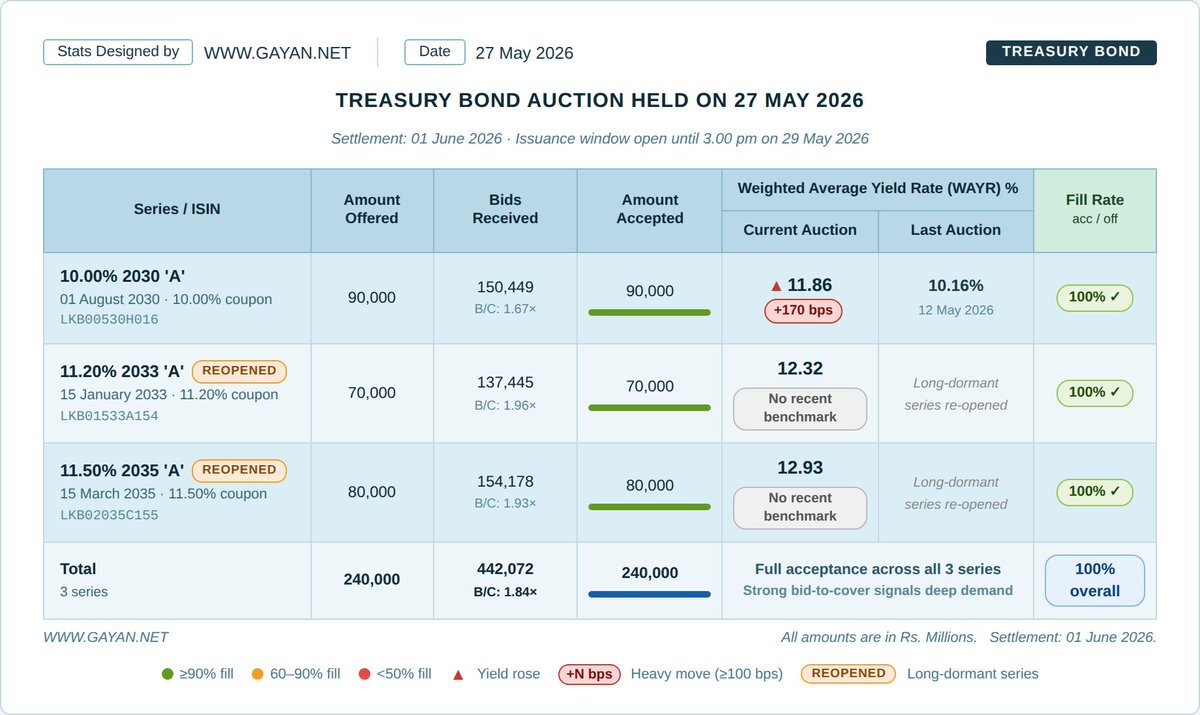
Good news: The PDMO raised the full LKR 240 Bn on offer, against 442 Bn in bids, with a bid-to-cover ratio of 1.84x.
Not-so-good news: It came at very costly yields.
Weighted Average Yields (WAYs)
• 01 Aug 2030 (4-year) → 11.86% → 100% accepted
(+170 bps from 12 May)
• 15 Jan 2033 (7-year) → 12.32% → 100% accepted
(reopened series)
• 15 Mar 2035 (9-year) → 12.93% → 100% accepted
(reopened series)
However, following Tuesday's T Bond auction and subsequent positive sentiment in global markets, the spike in yields reversed somewhat from the high cut-off levels.
• 01 Aug 2030 (4-year) → fell from 12.20% to 11.90% levels
• 15 Jan 2033 (7-year) → fell from 12.60% to 12.30% levels
• 15 Mar 2035 (9-year) → fell from 13.20% to 12.95% levels
In a further positive turn, LKR 24 Bn offered across all three series at the WAYs via the Phase II window was oversubscribed, attracting LKR 51.9 Bn in bids.
Given the bullish sentiment and the drop in yields from their elevated cut-off levels, a valid question arises:
Was the PDMO too aggressive - or too anxious - in accepting too many bids at too high a rate?
A strategy by design, or an action in haste?
Yes, there was a similar amount maturing.
But no, they can (and in the past have) repay maturing GSecs, irrespective of the amount raised.
This is where the cash buffer of the Govt. Treasury comes into play.
There have been instances where they raised more than maturing. That, plus the increased tax revenues - both which helped to build the buffer - now likely to be over LKR 2 Tn.
Also, we should be mindful of the impact of raising funds at such high rates have on future auctions.
T Bill auctions are weekly and T Bond auctions are twice per month.
Even an increase of just 10 bps can have a ripple effect on future auctions, which could run into billions.
Finally, if the market believes PDMO has to always accept the 100% of amount offered, rates will spike to levels more than you can imagine. Fortunately, they don't have to, and so does the rates.
Tale of a Tight T Bond Auction
Following the hike in @CBSL policy rate and the T Bill auction, the T Bond auction also saw rates spike, with elevated cut-offs.
Good news: The PDMO raised the full LKR 240 Bn on offer, against 442 Bn in bids, with a bid-to-cover ratio of 1.84x.
Not-so-good news: It came at very costly yields.
Weighted Average Yields (WAYs)
• 01 Aug 2030 (4-year) → 11.86% → 100% accepted
(+170 bps from 12 May)
• 15 Jan 2033 (7-year) → 12.32% → 100% accepted
(reopened series)
• 15 Mar 2035 (9-year) → 12.93% → 100% accepted
(reopened series)
However, following Tuesday's T Bond auction and subsequent positive sentiment in global markets, the spike in yields reversed somewhat from the high cut-off levels.
• 01 Aug 2030 (4-year) → fell from 12.20% to 11.90% levels
• 15 Jan 2033 (7-year) → fell from 12.60% to 12.30% levels
• 15 Mar 2035 (9-year) → fell from 13.20% to 12.95% levels
In a further positive turn, LKR 24 Bn offered across all three series at the WAYs via the Phase II window was oversubscribed, attracting LKR 51.9 Bn in bids.
Given the bullish sentiment and the drop in yields from their elevated cut-off levels, a valid question arises:
Was the PDMO too aggressive - or too anxious - in accepting too many bids at too high a rate?
A strategy by design, or an action in haste?
BREAKING: IMF approves USD 695 Mn as Sri Lanka Clears Double Review
@IMFNews Board completed the combined 5th and 6th Reviews under the EFF, releasing USD 695 Mn.
It’s the largest single disbursement so far - as it bundles two reviews (two tranches), into one.
This is because 5th review was deferred from Dec 2025 to early 2026 following the need to reassess the program after Cyclone Ditwah and opting for a separate Rapid Financing Instrument (RFI).
Sri Lanka has now caught up, clearing both reviews in one go. Performance was generally strong.
But Middle East tensions and the aftermath of Cyclone Ditwah have reshaped the outlook.
As per IMF:
• Growth is cut to 3.0% for 2026, down from 5% in 2025, due to higher oil prices and weaker tourism.
• Inflation climbs from -0.5% in 2025 to average 5.0% in 2026. End-2026 inflation climbs to 6.1%.
• Current account swings from a 1.6% of GDP surplus to a 0.5% deficit.
• Fiscal policy eases with 2026 primary surplus target drops to 1.4% of GDP, from 5.4% in 2025, funding a temporary relief package and Cyclone Ditwah reconstruction.
• From 2027, the Govt. reverts to the 2.3% of GDP primary surplus target.
• Two continuous criteria were missed - (1) no new external payment arrears, and (2) no new import restrictions.
• FX reserves projected to rise to USD 8.6 Bn by end-2026, from 6.8 Bn.
IMF emphasise that:
• Monetary policy should continue prioritising price stability - @CBSL should be prepared to act if inflation keeps ticking-up
• Greater exchange rate flexibility and gradually phasing out the BOP measures is critical to rebuild external buffers
IMF approval on 27th May?
@IMFNews has added Sri Lanka to the Executive Board agenda for 27 May 2026.
Given that all preconditions have been completed, we can look forward to approval and disbursement shortly.
Some good news (and inflow) for the FX market after a while.
The @IMFNews EFF is for budgetary support. So, the USDs ends up with the Govt.
Govt. can use them as they seem fit (for e.g. to pay foreign loans, covert to LKR by selling USDs to @CBSL, etc.).
While there are no restrictions on the usage, Govt. eventually needs to meet program targets and milestones.
@yasasrij@CBSL Good one!
On a serious note, I believe they should've smoothened the impact, specially considering this is a smaller in quantity and shorter in tenor - compared to the large and longer term T Bond auction happening next day.
An Auction to Remember (or Forget?)
T Bill yields broke out across the curve following the 100 bps @CBSL policy rate hike.
Weighted Average Yields for 91, 182, and 364-day T Bills jumped by 118, 143, and 134 bps, respectively - the sharpest single-week move in the recent past.
Things have flipped completely from last week:
• 91 days: +118 bps → 110% accepted (vs. +5 bps → 71% last week)
• 182 days: +143 bps → 32% accepted (vs. +2 bps → 41% last week)
• 364 days: +134 bps → 33% accepted (vs. 0 bps → 13% last week)
The 91-day stands out. PDMO accepted LKR 71.2 Bn against 65 Bn offered (an over-acceptance of 110%). It's likely that they wanted to accept what they could at the least possible cost, since the 182 and 364-day maturities were even more expensive.
The 364-day tells rest of the story.
Last week, PDMO held it flat at 8.49% with a low acceptance ratio of 13%. This week, they let it move 134 bps to 9.83%, but still, only 33% was accepted.
Auction bid-to-cover dropped to 1.23x. Although the overall fill rate was 68%, if you strip out the 91-day over-acceptance, only 32% (LKR 24 Bn out of 75 Bn offered) was raised across the 182 and 364-day tenors.
Given the high cut-off rates and low acceptance levels, it's worth questioning why PDMO would:
- accept bids at such high yields?
- to raise only a fraction of the amount offered?
- in the midst of a 100 bps CBSL policy rate hike?
- when a massive T Bond auction is due the next day?
- while the Govt. is supposed to be sitting on an over LKR 2 Tn cash pile?
I do want to write about PDMO's auction acceptance strategy, but I'll leave that for a separate post.
Is this the beginning of a new hawkish cycle, or just a knee-jerk reaction to the CBSL rate hike?
2026 at a glance: 100bps of policy rate hikes. USD/LKR at 360. Inflation hit 7%?
SCB Research has sharply revised its outlook:
• Inflation: 2026 average at 5.5% (from 4.5%), expected to hit 7% by Sep 2026
• @CBSL Policy Rates: 100bps of rate hikes projected in 2026 (previously expected to remain on hold). Hikes expected in May (50 bps), July (25 bps) and September (25 bps).
• Exchange Rate: end-2026 USD/LKR forecast revised to 360 (from 325)
• Interest Rates: end-2026 1Y T Bills projected at 9.75% (previously 8.25%) and 5Y T Bonds at 11.75% (previously 9.50%)
These forecasts appear quite hawkish and, in my view, somewhat extreme.
But given what we’ve seen over the last couple of months - especially the Middle East tensions and their ripple effects on our economy - all bets are off!
Where do you think inflation, policy rates, USD/LKR, and interest rates will end up in 2026?
@mahesh_pieris@CBSL While supply shocks do affect prices and therefore, inflation, very little CBSL can do with rate hikes in such situations.
Also, when you take the monetary contraction path, i.e. rate hikes, that comes at a significant cost on economic growth.
Bloomberg expects CBSL to hike rates by 50 bps
@CBSL kept rates unchanged since Jun 2025, following a cumulative 825 bps of cuts since Jun 2023.
Why a hike?
• Inflation is now above CBSL’s 5% target
• Depreciation of LKR
• Signs of an overheating economy
Fingers crossed.
In my opinion, cut in LTVs also slows down the loop.
If you are familiar with economics, think LTV = reserve ratio. Higher the reserve ratio, lower the money multiplier = lower the expansion of money supply.
Also, we should be mindful that there's one segment where gold is used as a source of working capital, and another segment where gold is used to bridge financial gaps and help make ends meet.
2026 at a glance: 100bps of policy rate hikes. USD/LKR at 360. Inflation hit 7%?
SCB Research has sharply revised its outlook:
• Inflation: 2026 average at 5.5% (from 4.5%), expected to hit 7% by Sep 2026
• @CBSL Policy Rates: 100bps of rate hikes projected in 2026 (previously expected to remain on hold). Hikes expected in May (50 bps), July (25 bps) and September (25 bps).
• Exchange Rate: end-2026 USD/LKR forecast revised to 360 (from 325)
• Interest Rates: end-2026 1Y T Bills projected at 9.75% (previously 8.25%) and 5Y T Bonds at 11.75% (previously 9.50%)
These forecasts appear quite hawkish and, in my view, somewhat extreme.
But given what we’ve seen over the last couple of months - especially the Middle East tensions and their ripple effects on our economy - all bets are off!
Where do you think inflation, policy rates, USD/LKR, and interest rates will end up in 2026?